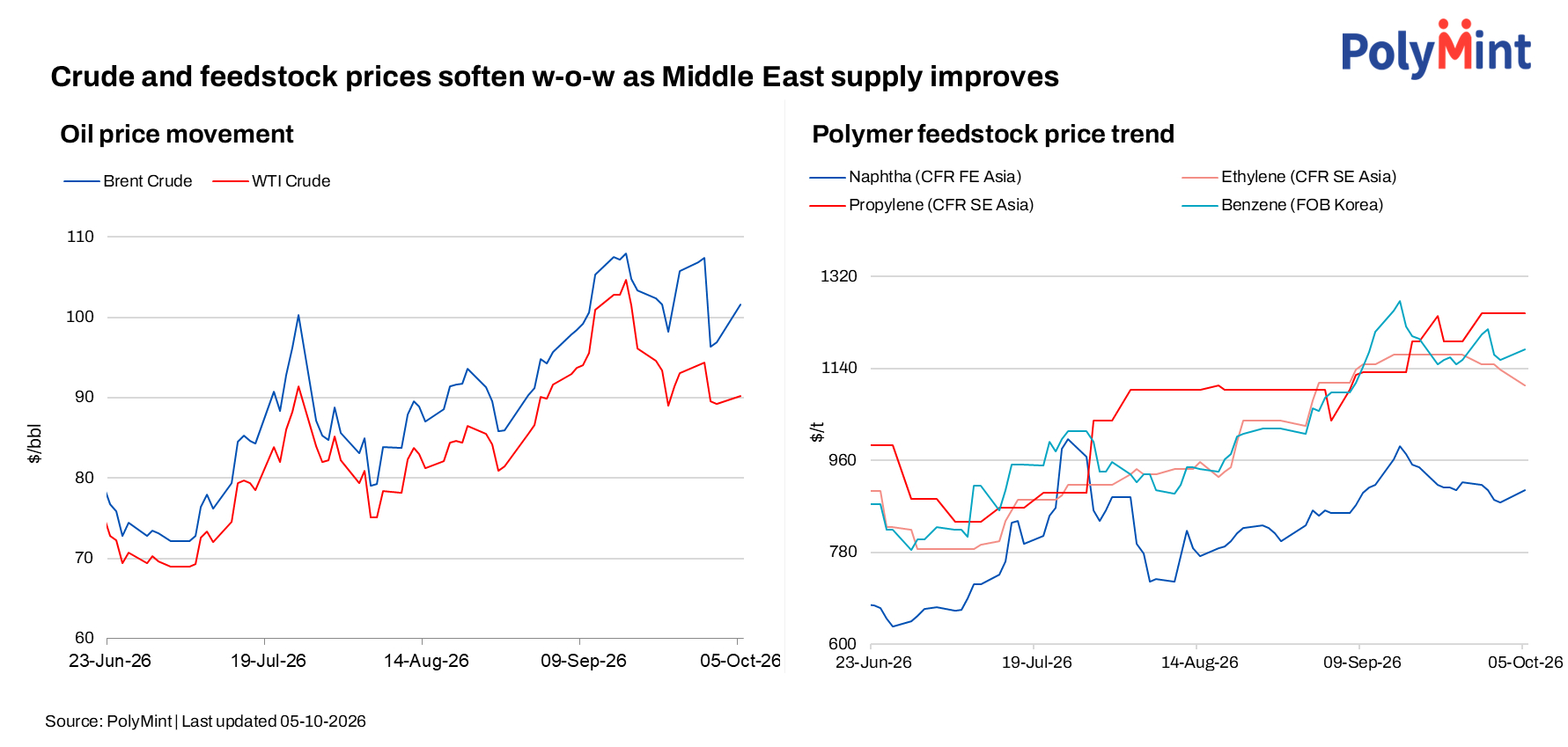
- Shipping inefficiencies, elevated tanker costs keep delivered costs of crude oil elevated
- Indian PP prices gain 1%, while PVC falls 3% amid mixed pass-through of lower crude costs
The global petrochemical complex softened in the assessment week , as improving Middle East crude flows eased some supply pressure, although shipping costs remained elevated. PolyMint assessments show Brent crude falling 4.9% w-o-w, while naphtha and ethylene also eased. Indian polymer prices showed mixed movement, with Polypropylene (PP) and High-Density Polyethylene (HDPE) strengthening, while Polyethylene Terephthalate (PET) and Polyvinyl Chloride (PVC) declined, reflecting uneven cost pass-through and cautious buying.
Crude oil and feedstocks
Brent eased as improving Middle East crude availability reduced the immediate supply-risk premium. India’s September crude imports reached a 2026 high of around 5.26 million barrels per day (bpd) as Gulf supplies recovered, while refiners increased sourcing flexibility amid tighter Russian availability. Indian refiners also continued shifting toward alternative grades and securing supply despite elevated logistics costs.

Asian feedstock markets softened alongside crude, although propylene remained comparatively resilient. Improved Gulf supply has eased outright availability concerns, but shipping inefficiencies and elevated tanker costs continue to influence delivered replacement costs. Indian refiners have increasingly arranged their own vessels and bought crude on an FOB basis, giving them greater control over freight and cargo movements.
In India, RIL’s Mixed Xylene (Ex-Hazira) increased by INR 1/kg to INR 130/kg, while Purified Terephthalic Acid (PTA) remained at INR 106.50/kg and Monoethylene Glycol (MEG) declined by INR 5/kg to INR 78.70/kg. The lower MEG price provided some relief to PET-chain replacement costs.
Indian polymer market
Indian CFR polymer prices diverged during the week, with PP and HDPE strengthening while PET and PVC moved lower. The divergence indicates that product-specific supply-demand balances are increasingly influencing polymer pricing alongside upstream costs.

Domestic buying remained active but selective. Indian refiners continued securing replacement barrels despite higher logistics costs, with supply security taking priority over price resistance. Some inventory cover was built as a precaution, rather than indicating aggressive stock accumulation.
Market implications
For Indian refiners, improved crude availability is being offset by high transportation costs. Arabian Gulf-West Coast India VLCC freight reached $90.02/t on 1 October, around 16% above September’s average, keeping delivered Middle Eastern crude costs elevated.
The sourcing shift is also changing India’s crude logistics. Indian Oil, Reliance, Bharat Petroleum and HMEL have increasingly bought Iraqi crude on an FOB basis and arranged their own tankers, while higher Gulf flows through ship-to-ship transfers have improved access to Saudi, Iraqi, Kuwaiti and Qatari barrels. This provides greater sourcing flexibility but leaves refiners exposed to freight and security costs.
For downstream markets, festive demand remains supportive, but buying is selective. Automotive and FMCG activity is improving, while higher inventories ahead of the festive period could limit aggressive restocking. Polymer buying therefore remains focused on immediate requirements rather than broad inventory accumulation.
Outlook
The near-term outlook is shifting from an outright supply shortage toward a logistics-led cost environment. Recovering Middle East flows, restored Saudi export routes and softer feedstocks should ease upstream pressure, but elevated tanker costs and security risks can continue to keep delivered replacement costs high. PP may retain relative support while propylene remains firm, whereas softer naphtha, ethylene and MEG could limit further increases in other chains. For India, crude sourcing flexibility is improving, but polymer price direction will depend on freight normalisation, refinery buying strategy and the strength of festive-season demand.
Leave a Reply