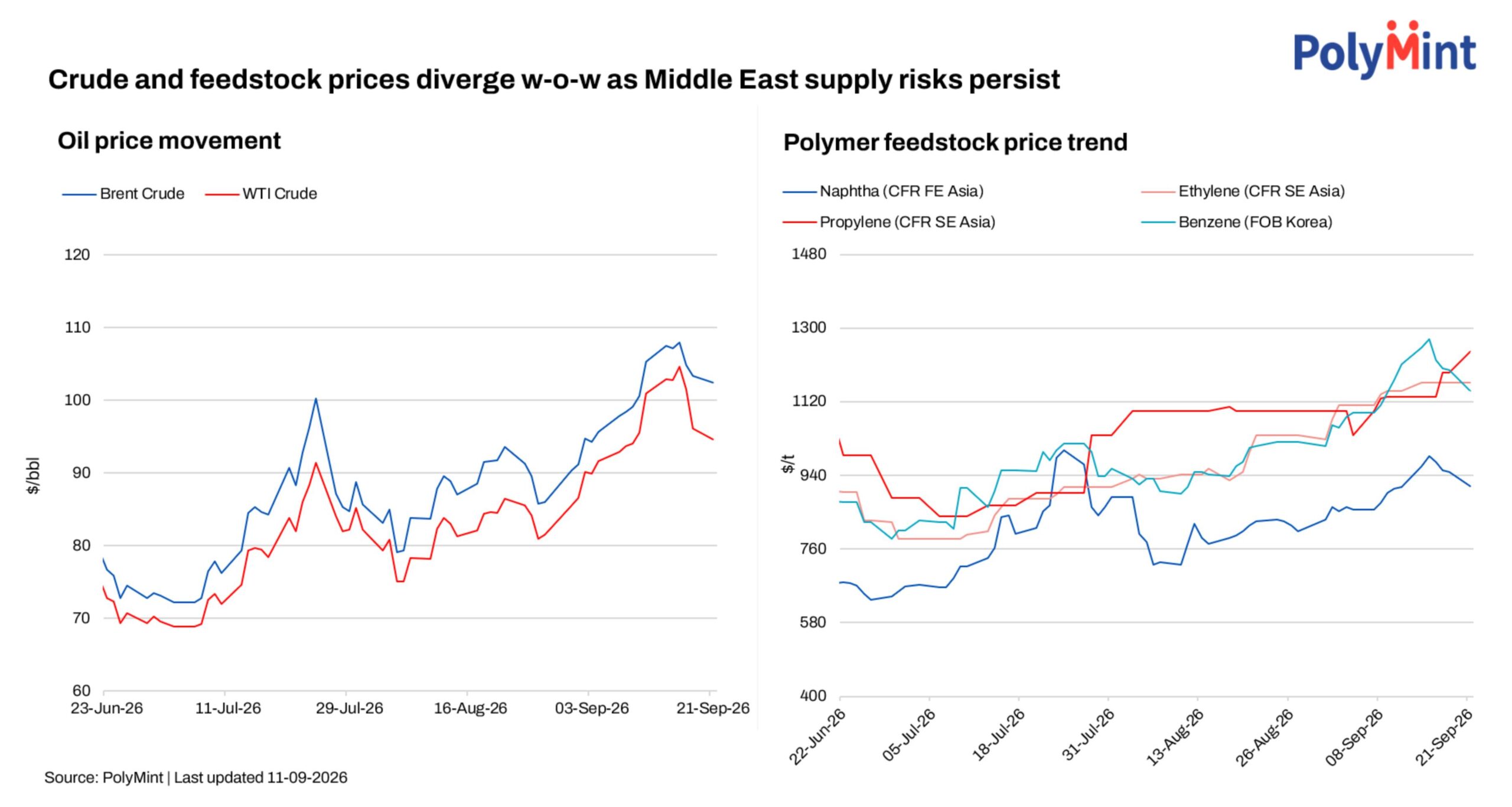
- Brent Crude falls up to 5% w-o-w as supply concerns ease
- Propylene gains 10%, outpacing ethylene and naphtha
The global petrochemical feedstock complex showed mixed movement in the week, 21 September as crude prices eased, while propylene remained firm amid supply and shipping uncertainties. PolyMint assessments show Brent crude falling 4.7% w-o-w to $102.42/bbl, while naphtha declined 5.2% and propylene increased 9.7%. Indian polymer prices moved higher across PET, PP and PVC, indicating continued replacement-cost pressure despite lower crude.
Crude oil and feedstocks
Brent fell from $107.48/bbl on 14 September to $102.42/bbl on 21 September, while WTI declined from $102.86/bbl to $94.63/bbl. The correction followed easing concerns over the extent of Middle East supply losses, although disruptions to crude and shipping flows continued to influence regional markets.

Asian naphtha declined 5.2% w-o-w, broadly tracking the correction in crude. Regional supply remained influenced by Middle East shipping disruptions, while physical availability and freight continued to shape replacement costs. Argus reported ongoing tanker activity and elevated freight requirements in the region.
Propylene was the stronger performer, gaining 9.7% w-o-w, while ethylene was unchanged. The sharper C3 increase points to firmer propylene replacement costs and continued pressure on PP margins. In India, RIL increased PTA to INR 105.40/kg from INR 103/kg, while MEG remained at INR 83.70/kg, keeping PET-chain costs supported.
Indian polymer market
Indian CFR polymer prices showed a firmer response, with PET rising 4.9% w-o-w, PP raffia increasing 2.7% and PVC gaining 3.4%, while HDPE was unchanged. The stronger movement in PET, PP and PVC indicates continued cost pass-through despite the decline in crude and naphtha.

Domestic indications remained supported by higher replacement costs, particularly in the PP and PET chains. The rise in propylene and MEG, alongside elevated freight and continued Middle East logistics risks, is keeping pressure on local pricing even as crude benchmarks correct.
Market implications
For Indian polymer producers, the divergence between lower crude and higher selected feedstocks is increasing margin pressure in PP and PET. The weaker rupee, with $/INR rising 0.2% w-o-w to 95.87, also adds to the landed-cost burden for import-dependent buyers.
Middle East-to-India freight remained elevated, with Fujairah–West Coast India around Worldscale 975 on 18 September, while VLCC AG-loading earnings exceeded $ 1 million/day.
For converters, polymer prices have increased less than propylene in the PP chain, while PET is facing additional PTA/MEG cost pressure. Upcoming festive-season demand across automotive, FMCG, packaging and consumer durables remains supportive, although construction-related demand is more mixed.
Outlook
Through the remainder of September, petrochemical markets are likely to remain sensitive to Middle East shipping conditions, crude-flow restoration and feedstock availability. Lower crude and naphtha could provide some cost relief, but firm propylene prices may keep PP margins under pressure. The extent of further polymer price movement will depend on feedstock availability and freight cost.
Leave a Reply