- Renewables to supply over 85% of growth in global electricity use
- Global thermal coal output may fall by 10-25% from 2024 to 2035
Mysteel Global: Global coal consumption is expected to peak and decline by the end of this decade, the International Energy Agency (IEA) says in its latest edition of World Energy Outlook 2025. The main driver is the rapid expansion of alternative energy sources, which continues to erode coal’s share in the power sector.
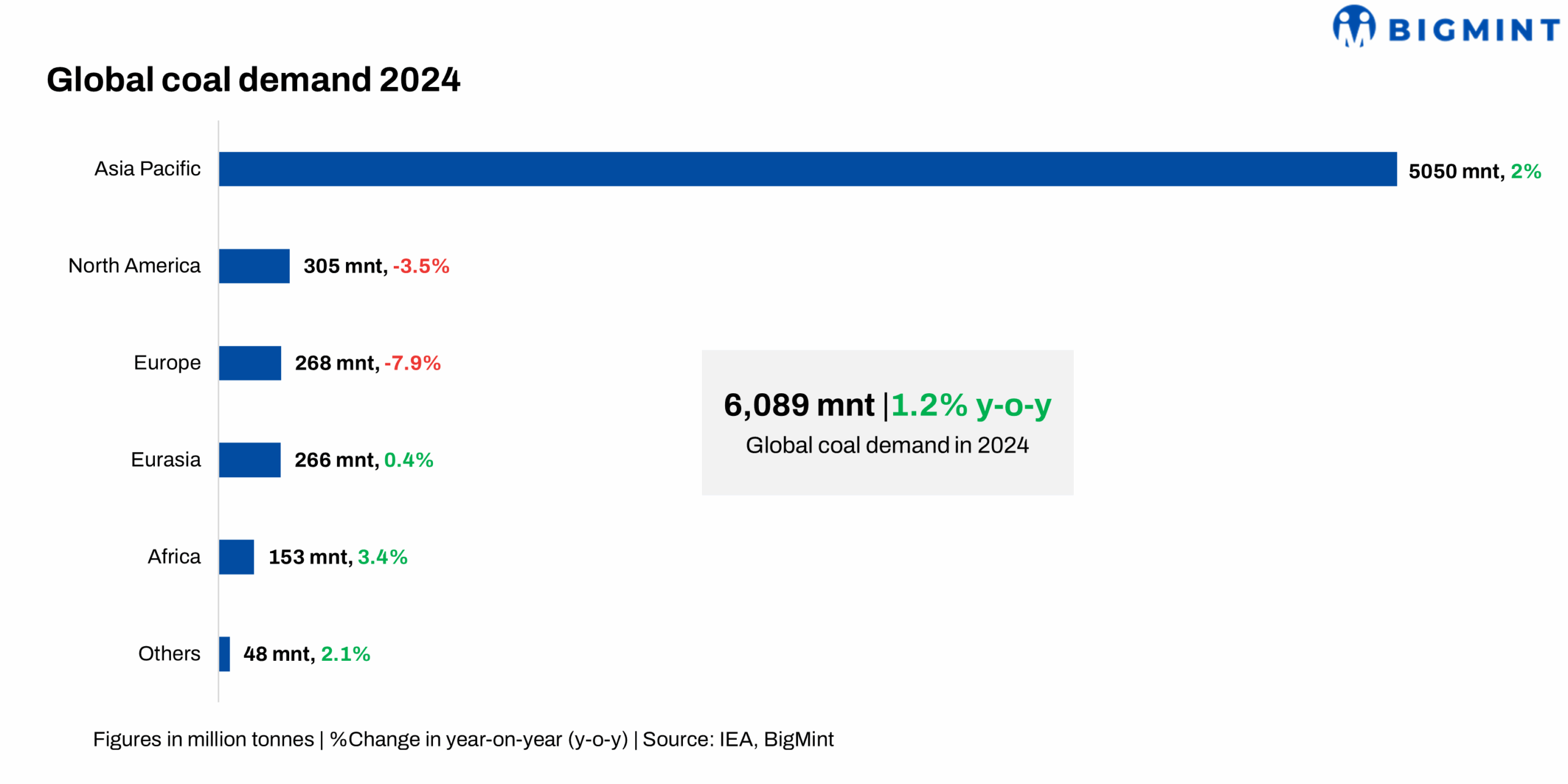
In all scenarios modelled by the IEA, global coal demand is projected to peak around 2030 and then fall steadily. By 2035, global coal consumption could decline by 8-20% from the 2024 level of 6.09 billion tonnes of coal equivalent (Btce), with most of the reduction coming from the power sector.
Although global electricity use could grow by around 40% between 2024 and 2035 — driven by rising demand for cooling, AI data centres, and electric vehicles — renewables are expected to supply over 85% of that increase. This outlook is supported by an average of more than 600 gigawatts/year of new renewable capacity additions in emerging and developing economies to 2035.
Meanwhile, renewed interest in nuclear energy among many countries, combined with more affordable natural gas prices due to improved supply conditions, will further displace coal from the power sector, the IEA report adds.
During this transition, China — the world’s largest coal consumer — will remain a critical market for renewables. The IEA notes that China is set to account for 45-60% of global renewable deployment over the next decade and will remain the world’s largest manufacturer of most renewable technologies.
As coal demand for power generation is weakening, the IEA expects major thermal-coal-producing countries — those that primarily supply coal for electricity generation — to see sharp output declines over the next decade. As a result, global thermal coal production may fall by 10-25% from 2024 to 2035, representing a reduction of nearly 1.2 Btce at the upper end.
In contrast, coal use by industries — mainly coking coal for iron/steelmaking — is expected to remain resilient. If countries continue with current policies, industrial coal demand could rise by around 30 Mtce from 2024 to 2035. The steel sector currently accounts for roughly one-third of global coal consumption.
In this scenario, developing economies in Asia may become a major growth driver for coking coal, with demand in India and Indonesia projected to rise by as much as 60% and 45%, respectively, from 2024 to 2035.
For China, however, the IEA expects coking coal consumption to fall by around 16% by 2035 — a reduction of roughly 150 Mtce from 2024 — as the country shifts from energy-intensive industries such as cement and steel towards more electricity-intensive sectors such as clean technology manufacturing.
With reduced domestic demand, China’s coking coal output is also projected to decline by around 20% or 100 Mtce over the same period. Overall, the IEA projects that by 2035, China’s total coal output could fall by 10-25% from the 3.35 Btce recorded in 2024, depending on the country’s policy choices.
Note: This article has been written in accordance with a content exchange agreement between Mysteel Global and BigMint.
Leave a Reply