- Rising energy demand to result in 1.5 degrees centigrade ‘overshoot’, as per UNEP
- Clean tech displaces 35 EJ of fossil fuels in CY’25, around 785 mnt of coal
- India sees rare decline in energy-related emissions for first time since 1970s
Morning Brief: A recent United Nations Environment Programme (UNEP) report stated that global warming can’t be restricted to 1.5 degrees centigrade above pre-industrial levels and an “overshoot” is most likely in the next few years. However, the pace of global surge in carbon emissions has dropped markedly over the last few years, and that is encouraging news.
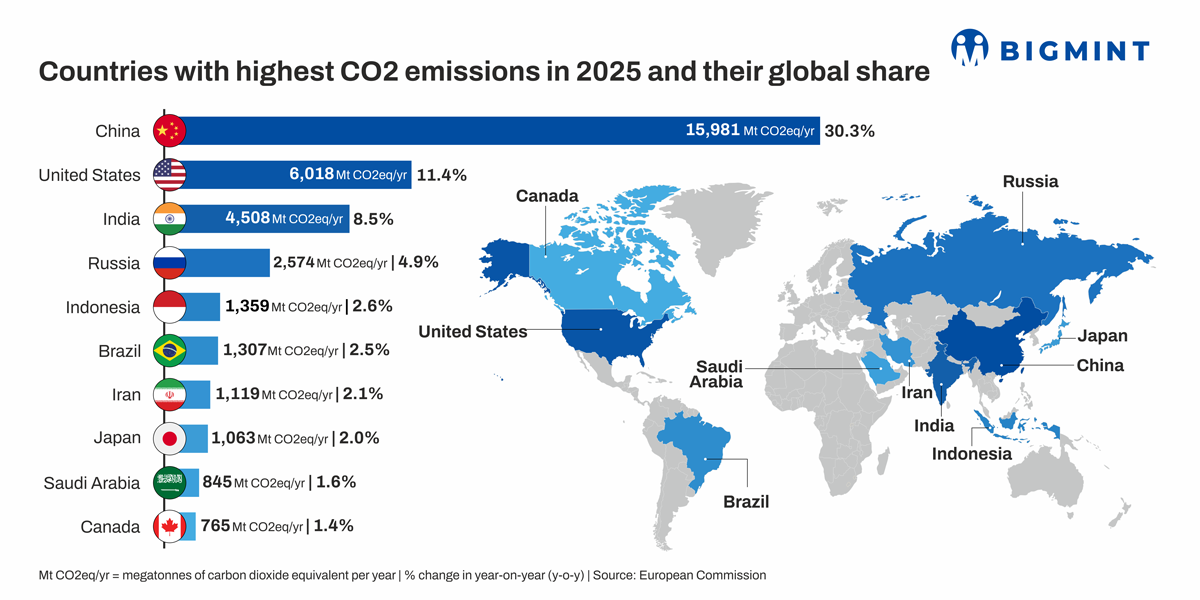
While the European Commission’s emissions database pegs total global emissions of GHG at around 52.7-53 gigatonnes/billion tonnes (bnt) in 2025 – the pace of growth in global emissions has slowed. As per International Energy Agency (IEA) data, global energy-related CO2-equivalent emissions (excluding land use, forestry and agriculture) exceeded 38 bnt, with a share of over 72% of cumulative global emissions.
Impact of low-carbon technologies
“The deployment of solar PV, wind power, nuclear power, electric cars and heat pumps since 2019 avoided annual global fossil fuel energy demand of more than 35 EJ (exajoules) in 2025. This is equivalent to around 7% of fossil fuel demand in 2025, or the combined total energy demand of Latin America,” the IEA noted in its Global Energy Review.
To understand the impact of low-emissions technologies, let us take IEA data: these low-emissions technologies displaced over 23 EJ of coal, more than 9 EJ of natural gas, and around 3 EJ of oil in 2025. To put this somewhat into perspective, 23 EJ of coal means around 785 mnt of coal – over 60% of India’s annual coal demand.
The average annual rate of growth in energy-related global emissions moderated to just 0.4% y-o-y. The rate of growth has moderated from over 2.7% annually during 2009-2014. Therefore, while total global emissions have increased, largely due to the rapid infrastructural and industrial development of the developing and emerging economies, emissions are gradually plateauing with the widespread deployment of technologies.
Top 3 responsible for over 50% of global emissions
China: Energy-related emissions from China fell by 0.5% y-o-y due to the boom in renewables, structural declines in energy-intensive industry, and overall slower demand growth. Coal-fired power generation fell by up to 1.6% while coal’s share in the power mix dropped to 51%, just 34% of the country’s installed capacity. Yet China has a disproportionate share of over 30% of global emissions.
US: Data centre expansion and industrial growth has led to rapid rise in the demand for electricity.
Emissions actually increased in 2025 on the country’s gas to coal switch amid high gas prices due to geopolitical conflicts. A more severe winter in the advanced economies such as the US and EU increased demand for heating and gas.
In fact, the advanced economies, for the first time since the 1990s, witnessed an increase in emissions at a faster growth rate in 2025 compared to the developing economies.
India: According to IEA data, saw a marginal 0.1% decrease in energy related carbon emissions in 2025 due to a strong and long monsoon, which lessened the demand for air-conditioned cooling and also, of course, the surge in renewables.
India’s annual renewable capacity additions increased by almost 60% in 2025, the fastest growth among major markets. This was driven by the commissioning of almost 50 GW of solar PV. Wind energy additions, while much smaller compared with solar PV, doubled in 2025 to reach over 6 GW.
Outlook
However, in 2026, geopolitical conflicts and shifting energy market dynamics, including an uncertain monsoon and surging electricity demand, may lead to a reversal of trends, especially in India. The marginal decline in 2025 was an exception since it was the only example of a y-o-y decline since the 1970s, barring the COVID years. Emissions are likely to rise in 2026 but the rapid deployment of renewables will moderate the pace of growth.
Globally this will be the case too, especially in China. Emissions growth may increase in volume terms, and projections of a 1.5 degree “overshoot” are indeed grim, yet the increasing deployment of low-carbon technologies will ensure that emissions growth gradually plateaus worldwide.
Leave a Reply