- MGO records sharpest gains as fuel prices rise across major hubs
- Fujairah VLSFO remains elevated amid tight availability and Hormuz risks
Global bunker fuel prices rose sharply across Singapore, Rotterdam and Fujairah in the week ended 4 September 2026, reversing the broad-based declines seen in the previous week. The sharp rebound was driven primarily by a stronger crude complex amid renewed US-Iran tensions and reduced shipping activity through the Strait of Hormuz.
Hormuz disruption keeps bunker supply risk elevated. Reduced vessel movements through the Strait are increasing concerns over Middle East fuel availability and adding voyage-risk premiums.

Regional bunker markets
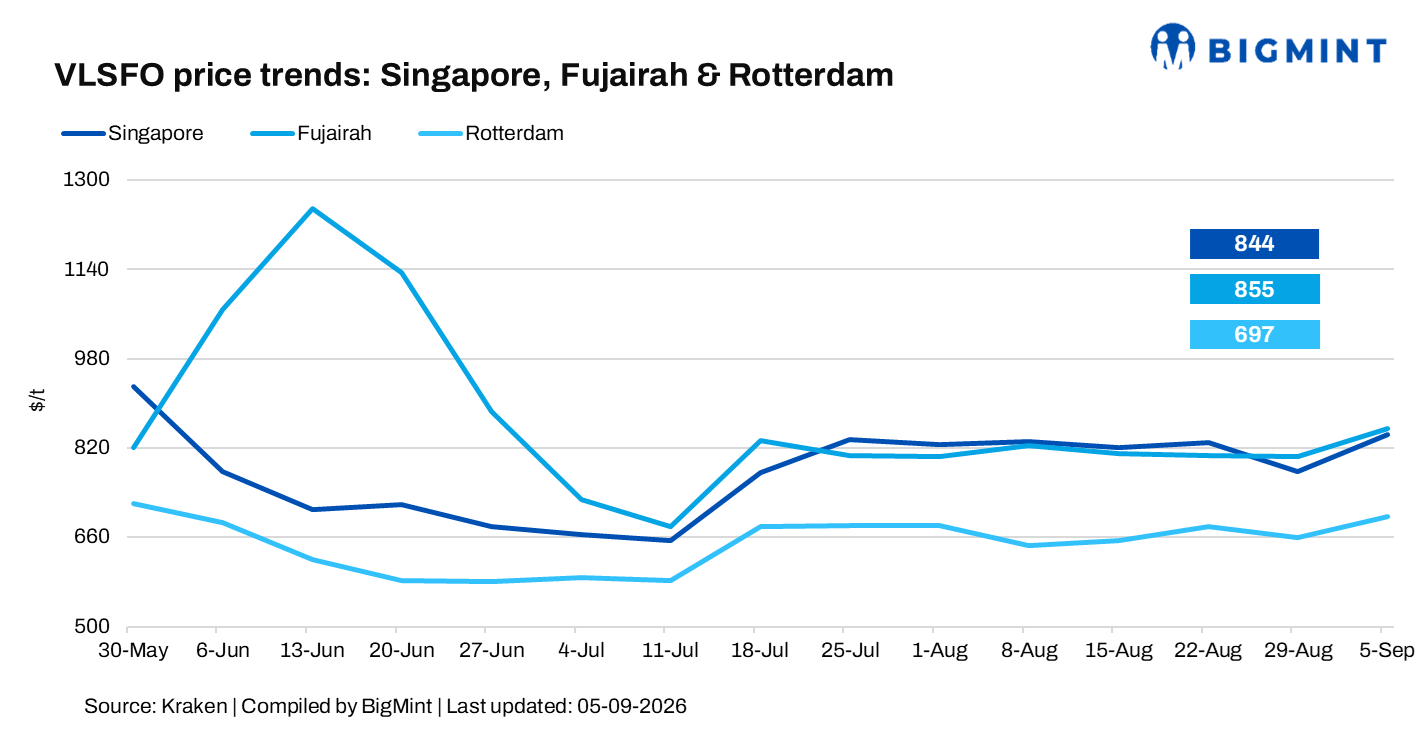
- Singapore: VLSFO rose $67/tonne (t) (8.6%) to $844/t, while MGO and HSFO gained. The broad-based increase reflects the stronger crude complex and renewed concerns over Middle East supply flows. East-of-Suez bunker prices subsequently eased on 4 September, but supply remained tight, particularly for VLSFO and LSMGO in Fujairah.
- Rotterdam: VLSFO increased $38/t (5.8%) to $697/t, while MGO jumped, the largest absolute gain among the tracked grades. HSFO rose indicating a broad strengthening across the European bunker market.
- Fujairah: VLSFO climbed $51/t (6.3%) to $855/t. Fujairah remained the most exposed market to the regional disruption, with VLSFO availability reported as tight and HSFO availability restricted.
Market factors
- Brent crude futures surge w-o-w: Brent crude futures for November 2026 rose $6.75/barrel (bbl) (7.6%) to $95.15/bbl, from $88.40/bbl. Renewed US-Iran tensions, attacks around the Strait of Hormuz and lower shipping activity increased concerns over Middle East supply disruption. Oil prices were on track for a more than 7% weekly gain.
- WTI strengthens: WTI rose to $91.48/bbl against $83.40/bbl on 28 August, reflecting the same geopolitical risk premium. Crude prices remain elevated despite higher Iraqi exports and provided some offset to supply concerns.
Outlook
Global bunker prices are likely to remain firm and volatile in the near term, with crude prices and Middle East shipping developments remaining the primary drivers. Continued disruption around the Strait of Hormuz could keep bunker replacement costs elevated, particularly in Fujairah and other East-of-Suez hubs, while tighter middle-distillate availability could sustain MGO premiums.
However, higher Iraqi exports and any sustained recovery in Hormuz vessel traffic could ease the geopolitical premium. For now, the combination of elevated crude prices, restricted shipping and tight regional fuel availability points to continued upward pressure on bunker costs.
Leave a Reply