- Iranian domestic billet prices hit record highs
- Domestic Turkish billet prices hold despite weaker rebar
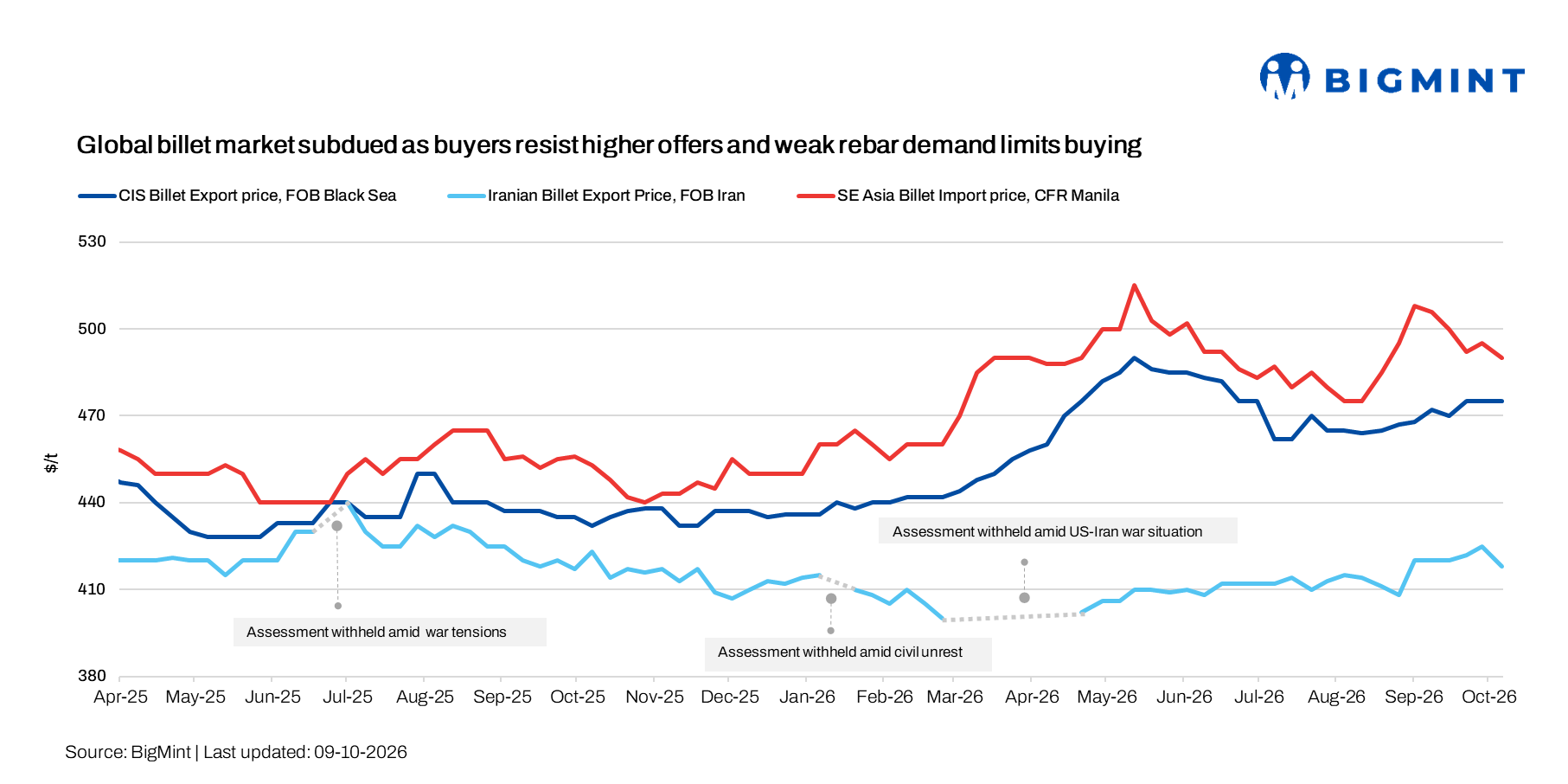
Global billet markets remained under pressure during the week ended 10 October, with Asian prices declining amid subdued post-holiday trading and weak finished steel demand. In the CIS, shipping disruptions and rising logistics costs constrained Russian exports, while Turkish buyers resisted higher offers. Middle Eastern markets were mixed, as weak rebar demand limited procurement in Saudi Arabia and the UAE, while Iranian domestic billet prices surged despite broadly stable export offers.
Turkiye’s imported ferrous scrap market also remained subdued, with cautious mill buying and weak steel demand limiting deep-sea transactions. US-origin HMS 80:20 scrap inched down to $400/t CFR on limited trades throughout the week, while financial uncertainty and pressure on rebar prices further dampened buying interest.
Domestic rebar offers stood at $600-610/t exw and export prices at $620-630/t FOB, keeping the scrap-rebar spread at around $215-225/t. Turkish 3SP billet export prices were reported at $540-545/t FOB.
Asian billet market
Asian billet export prices edged lower w-o-w as trading activity gradually resumed following China’s extended holiday. Chinese 3SP billet offers for November-December shipment fell to $460-462/t FOB from $465-468/t FOB previously.
A Chinese trading company representative reported a deal at $461-463/t FOB, reportedly destined for the Middle East. However, weak long steel sales continued to limit buying interest.
In China, billet prices declined by RMB 20/t ($3/t) to RMB 2,960/t ($442/t), while SHFE rebar futures fell to RMB 3,080/t ($457/t). Weak post-holiday demand and an increase of around 800,000 t in social inventories weighed on sentiment. Physical steel prices also dropped by RMB 10-20/t, prompting mills to reduce base prices more frequently amid cost pressures.
In Indonesia, major steel mills maintained base-grade billet offers at $475/t FOB for December shipment, although overseas demand remained limited. Middle Eastern buyers showed some interest, but low bids and logistical constraints continued to hinder transactions.
In the Philippines, Chinese 3SP billet offers declined to $480-485/t CFR from $485-488/t CFR the previous week, while locally produced billet remained higher at $495/t CFR. Chinese 5SP billet offers also fell by $3-5/t w-o-w to $488-490/t CFR. Buyers indicated that $482-485/t CFR could attract stock replenishment demand. However, weak domestic long steel demand, high interest rates, currency fluctuations, and unfavourable weather continued to weigh on buying activity.
CIS billet market
Russian billet exports remained constrained by Black Sea shipping disruptions, limited alternative routes, and weak buying interest from Turkiye. Rising port handling costs, Baltic port congestion, and rail transportation difficulties further complicated shipments.
Russian suppliers offered November billets at $530-535/t CFR Turkiye and $545-550/t CFR mills in the Izmir and Marmara regions, compared with occasional offers of $515-520/t CFR a week earlier. Turkish buyers resisted the higher levels, considering $520-525/t CFR more workable.
Agricultural exports and higher transshipment costs further restricted logistics. Russian rebar was offered at $560-570/t FOB Russia, while wire rod stood at around $570-575/t FOB, although freight costs remained uncertain.
In Turkiye, domestic billet offers in Iskenderun remained at $570-575/t exw, while buyers considered $555-560/t exw workable. Rebar prices declined to $600-605/t exw, squeezing rerollers’ margins and limiting their willingness to pay higher billet prices. Restricted domestic availability and limited import alternatives continued to support seller offers.
Kardemir continued fulfilling previously concluded sales, with a new sales round potentially expected the following week. No fresh import offers were reported, while Chinese semis had been offered at $525-530/t CFR Turkiye in late September. New Chinese offers were expected after the holiday, although cargoes from earlier deals remained in transit.
Middle East billet market
Middle Eastern billet markets showed mixed trends, with weak finished steel demand limiting procurement in Saudi Arabia and the UAE, while Iranian domestic prices rose sharply despite broadly stable export offers. Raw material constraints, shipping disruptions and elevated logistics costs continued to influence regional trade.
In Saudi Arabia, domestic billet supply remained sufficient to meet current requirements despite raw material constraints. Weak rebar demand kept procurement subdued, while billet prices were reported at SAR 2,380-2,400/t ($635-640/t) exw. Most steelmakers operate integrated melting and rolling facilities, with only a few specialising in billet production without downstream rolling. Market participants expected availability to remain adequate, while a possible November rebar price reduction by Hadeed remained unconfirmed.
In the UAE, billet prices remained relatively firm despite cautious buying and high delivery costs. Local material was quoted at $650-655/t DAP, while Omani billet stood at around $650/t CPT. Oman remained a key supplier due to its proximity and shorter delivery routes.
Iran’s domestic billet prices surged, while export offers remained broadly stable amid currency depreciation and weak overseas demand. On the Iran Mercantile Exchange (IME), average billet prices rose 8.13% w-o-w to a record rial 860,150/kg ($49/t), excluding VAT. Trading volume reached 87,285 t, down 12,765 t from the previous week, with all offered volumes sold.
Export billet offers remained at $400-405/t FCA at borders and $418-420/t FOB at ports. Rebar and wire rod offers stood at $425-440/t exw and $445-460/t exw, respectively. Two steel mills had tenders for 30,000 t and 25,000 t of billet for November delivery.
Domestic billet averaged around $302-305/t exw at the free-market exchange rate, while rebar exceeded $375-380/t exw. Currency depreciation limited export price gains despite rising domestic prices. Meanwhile, security risks around the Strait of Hormuz and potential winter gas restrictions threatened to disrupt logistics and constrain DRI and billet production.

Leave a Reply