- North America records sharpest 11.5% output decline
- Refinery expansions support steady global production
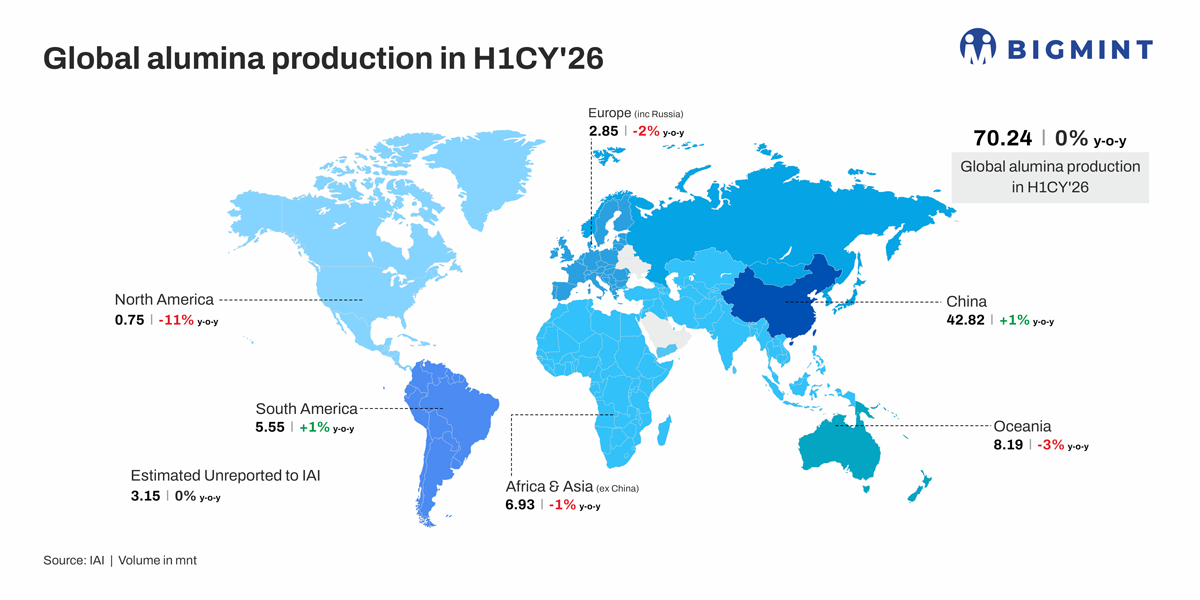
Global metallurgical-grade alumina production remained largely unchanged at 70.24 million tonnes (mnt) during H1CY’26, compared with 70.27 mnt in H1CY’25, according to the International Aluminium Institute (IAI).
Higher output in China and South America offset declines in other regions, although regional performance remained uneven. Refinery expansions, infrastructure upgrades, and strong bauxite availability supported production in some markets. However, maintenance shutdowns, weaker refinery margins, higher energy costs, feedstock constraints, weather disruptions, and geopolitical developments weighed on output elsewhere. Quarterly production also softened to 34.93 mnt in Q2CY’26 from 35.33 mnt in Q1CY’26 as refinery utilisation slowed across several major producing regions.
Regional drivers shaping global metallurgical alumina output
China, the world’s largest alumina producer, recorded an estimated 42.82 mnt of production, up 1% y-o-y from 42.42 mnt. New refining capacity, strong bauxite imports from Guinea, and relatively high refinery operating rates supported production during H1CY’26. However, scheduled maintenance, environmental inspections in Henan, Guangxi, and Guizhou, along with weaker refinery margins, moderated growth. Rapid capacity additions also created a domestic supply surplus. As a result, average spot alumina prices fell to around RMB 2,697/t. Lower prices encouraged several refineries to extend maintenance or reduce operating rates during Q2 despite stronger smelter demand earlier in the year.
Africa and Asia (excluding China) produced 6.93 mnt, down 0.9% y-o-y. The region recorded the sharpest quarterly slowdown, with production easing from 3.7 mnt in Q1 to 3.1 mnt in Q2. Guinea’s export restrictions tightened bauxite availability, while logistics disruptions linked to the Middle East conflict affected supply chains. Weaker international alumina prices and lower refinery margins also reduced operating rates at several refineries. Meanwhile, refinery expansions in India and Indonesia provided some support. However, most new projects remained in the ramp-up phase and contributed only modestly to overall production.
South America increased alumina production by 0.9% y-o-y to 5.55 mnt. Stable operations at Brazil’s Alunorte and Alumar refineries, infrastructure upgrades at Alunorte, adequate bauxite availability, and improved operational reliability supported output. However, quarterly production softened as weaker alumina prices outside China, higher logistics costs, and an oversupplied seaborne market reduced incentives to maximise output. This came despite Alumar operating above its nameplate capacity.
North America recorded the steepest regional decline, with production falling 11.5% y-o-y to 0.75 mnt. Lower output from Atlantic Alumina’s Gramercy refinery in Louisiana remained the primary reason. The region’s only smelter-grade alumina refinery continued operating at only around one-third of its installed capacity. Operational optimisation measures, structural capacity constraints, and trade policy uncertainty further limited production. Although expansion plans remain under way, additional capacity is not expected to contribute meaningfully until later phases.
Europe (including Russia) produced 2.85 mnt, down 1.8% y-o-y. Scheduled refinery maintenance, persistently high electricity and gas prices, and weaker refinery margins continued to constrain production during the first half of the year. Major refineries, including Aughinish in Ireland, maintained stable operations. However, elevated energy costs, lower hydropower generation during maintenance at Hydro’s facilities, and continued uncertainty surrounding EU-Russia trade policies prevented stronger regional growth. Even so, the region recorded a modest recovery in Q2.
Oceania produced 8.19 mnt, down 3.2% y-o-y, and remained the world’s second-largest alumina-producing region. The decline reflected the permanent closure of Alcoa’s Kwinana refinery, planned maintenance at Australian refineries, and weather-related disruptions. Heavy rainfall at Weipa and Tropical Cyclone Narelle affected both bauxite mining and logistics. Higher operating costs also weighed on production. Nevertheless, stable operations at Yarwun, Queensland Alumina, and Worsley helped limit the decline. Daily production rates remained broadly stable despite lower quarterly output.
Outlook
Global alumina production is expected to remain broadly stable over the coming months, although regional performance is likely to remain uneven. China should continue supporting global supply through high refinery utilisation and incremental capacity additions. India and Indonesia are also expected to contribute higher output as recently commissioned refineries ramp up production. Stable operations in South America and resilient bauxite availability should provide additional support.
However, downside risks remain. Refinery margins are likely to stay under pressure amid subdued alumina prices. High energy costs, scheduled maintenance, weather-related disruptions, and geopolitical developments could continue to constrain production in Europe, Oceania, and Africa & Asia (excluding China). Guinea’s evolving bauxite export policies and logistics disruptions could also affect feedstock availability. Overall, the global alumina market is expected to remain adequately supplied. However, regional imbalances and changing trade flows may keep market conditions volatile in the near term.
Leave a Reply