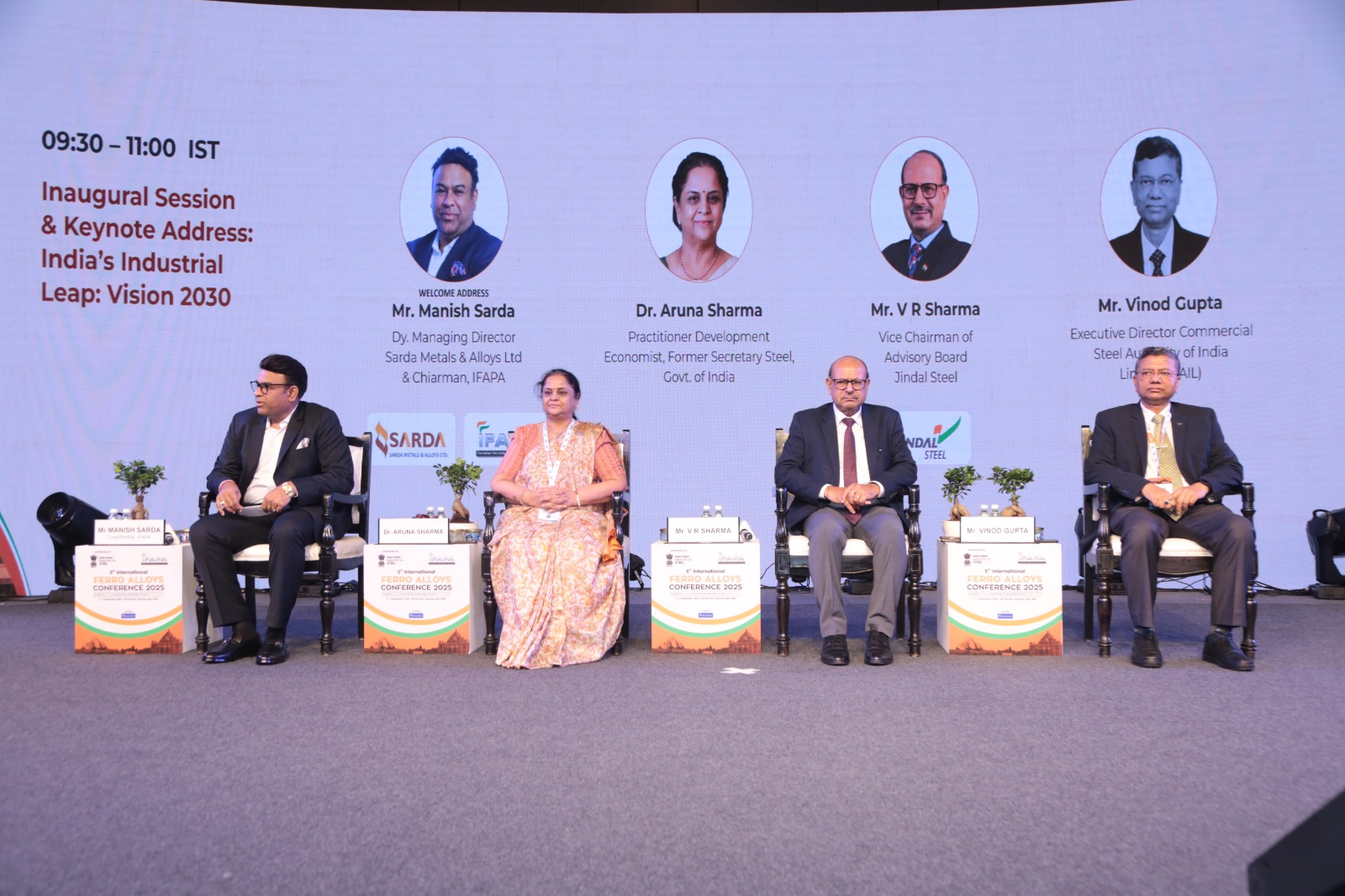
India’s steel industry is briskly scaling up, bolstered by significant infrastructure development, evolving demographic needs, and resilient macroeconomic fundamentals. Steel consumption is set to grow at a CAGR of 8-10%, while crude steel production is projected to double to 290 million tonnes (mnt) by 2035, increasing the nation’s share in global production to 14% from the current 7%.
While Indian steelmakers already have a firm grasp over basic grades, a vital gap remains in the availability of value-added steel – critical for meeting rapidly growing defence, railways, and automotive needs. To address supply constraints, India is making swift strides towards self-sufficiency through domestic production of value-added steel – a key feedstock for which is ferro alloys. Consequently, India’s demand for ferro alloys is projected to grow – at a strong 7-8% over the next five years.
How are India’s ferro alloys segments shaping up?
The Indian ferro alloys market is largely anchored by silico manganese and ferro manganese, which together account for nearly 60% of demand. Going forward, both domestic consumption and exports are poised for robust growth, supported by rising steel demand and India’s cost-competitive supply base.
Manganese alloys
India’s manganese alloys utilisation rate is the highest in the world, and as value-added steel production gains momentum, the country’s silico manganese output may increase by 0.7 mnt by FY’30. State-owned MOIL, the largest manganese ore miner in India, is targeting production of 2.5 mnt by FY’26 and 4 mnt by FY’30.

Ferro silicon
India’s ferro silicon consumption is estimated at 300,000–350,000 tonnes per annum (tpa) in FY’25. Demand is projected to rise to 450,000–480,000 tpa by FY’30, driven by rising consumption in carbon steel and alloy steel, particularly in long products and engineering and electrical steel.
However, ferro silicon imports are likely to remain prominent, especially from Bhutan, where multiple capacity expansion projects are underway. Indian producers also continue to export 30–35% of their production, leveraging competitive power costs and proximity to key markets.
Ferro chrome
While global chrome ore production stood at around 39.25 mnt in 2024, up 8.8% y-o-y, Indian output was at around 3.41 mnt, rising by a minor 2.2%. Meanwhile, Indian ferro chrome production was at around 1.32 mnt in 2024, down 7.1% y-o-y.

Indian producers have been grappling with challenges such as limited availability of lumpy chrome ore and a wider ore-ferro chrome price gap, which has reduced profit margins. Fluctuating chrome ore prices and the use of nickel and other substitutes in stainless steel alloys have also increased competition. Carbon taxes and emissions rules have raised concerns about elevated production costs, amid slow green technology adoption.
Noble alloys
India’s noble alloys demand is expected to grow at around 4-5% in the coming years. To illustrate, the country’s ferro vanadium market size reached 3,370 tonnes (t) in 2024 and is expected to touch 4,400 t by 2033.
Challenges include raw material security, especially for ferro molybdenum and ferro vanadium and price volatility, driven by China’s demand-supply imbalance. However, the Indian government’s protectionist measures such as quality control orders (QCOs) and safeguards have benefited the domestic industry.
Transforming for the ESG era
India’s CO2 emission per tonne of steel is one of the highest globally at around 2.55tCO2/tcs, with the average intensity in the ferro alloys segment at around 3.5tCO2/tcs. The EU accounts for 14% share in India’s ferro alloys exports, and the Carbon Border Adjustment Mechanism (CBAM) poses significant threat to the country’s export ambitions.
Notably, Tata Steel is piloting carbon-neutral charcoal-based ferro chrome production. The use of renewable biomass, with features such as high reactivity and low sulphur/phosphorus content, reduces CO2 emissions significantly.
Lower power costs to enable sustainable growth
The sustainable growth of the ferro alloys sector requires rationalisation of power tariffs, for which a cross-subsidy mechanism has been proposed. Additionally, industry stakeholders believe that a “one nation, one grid” framework is essential to minimising the tariff pressure on industry.
Meanwhile, notable achievements include the fact that India has achieved 50% of its renewable capacity target five years ahead of deadline, while the Production Linked Incentive (PLI) scheme for the battery energy storage system (BESS) is expected to facilitate round-the-clock renewable energy adoption.
Export prospects face threat
India’s export dependency on select markets such as the EU, Japan, and Korea presents risks. Trade protectionism and decarbonisation are also key challenges to look out for. The EU’s ongoing safeguard investigation and proposal of minimum import prices (MIPs) for ferro alloys have stirred a lot of confusion among exporting countries. Notably, there are a total of 28 trade and non-trade barriers in ferro alloys, of which 23 are anti-dumping duties (ADD).
Outlook
In the medium term, India’s steel and raw materials industry is expected to see robust momentum continue. The ferro alloys sector, despite external headwinds, will also continue flourishing. Notably, in the global export arena, power costs will emerge as a key differentiator, along with labour competitiveness, in determining India’s ability to sustain its edge against peers.
Leave a Reply