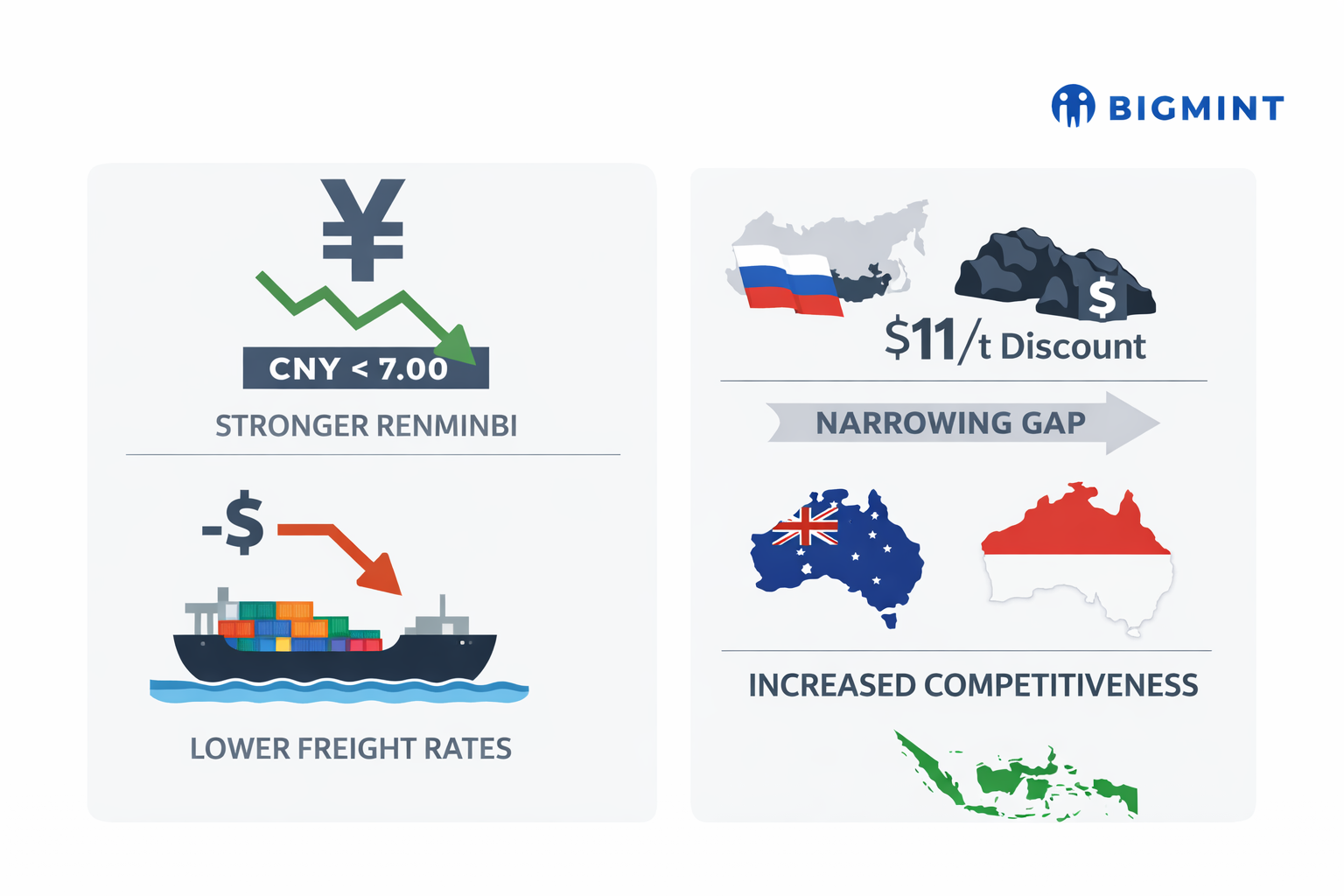
- Russian advantage narrows as Australian, Indonesian coal regain competitiveness
- South African, Colombian coal remain uncompetitive, limiting demand from China
The Asia-Pacific coal market has entered a phase where competitiveness is no longer dictated solely by coal prices at origin, but increasingly by currency movements and freight economics. Over the past fortnight, a strengthening renminbi (RMB) and sharply lower freights have quietly reopened arbitrage windows into North Asia, even as absolute coal price movements remain limited to a narrow range.
Since the start of 2026, the renminbi has remained below the RMB 7 level (per US dollar) for the first time since May 2023, trading around RMB 6.98. At the same time, spot freights fell by $2-3/tonne (t) across key Capesize and Panamax routes during the Christmas and New Year period, a seasonal pattern but one that has arrived at a particularly sensitive moment for coal trade flows.
Together, these two factors have improved delivered economics for almost all exporting origins into Southeast and North China. Russian coal remains the most competitive import option for China for the 23rd consecutive week, but its advantage has narrowed significantly. What was a discount of nearly $30/t in November has now compressed to around $11/t, reflecting not a deterioration in Russian pricing but an improvement in competing origins.
Australian and Indonesian 5,500 kcal/kg material is now delivered into East China at near parity, with discounts of roughly $5.7-5.9/t versus domestic benchmarks. This represents a material shift from late 2024, when these origins were largely sidelined by both freight and foreign exchange headwinds. South African and Colombian coal, however, remained uncompetitive, delivered at premiums of $9-22/t, effectively excluding them from the Chinese market for now.
The timing is also important. The Lunar New Year will only begin later this year, on 17 February, extending China’s effective working calendar through most of January. This longer trading window, combined with improving arbitrage economics, suggests January could be busier than usual for spot trade, particularly for mid- and low-calorific value coal.
Price signals reflect this cautiously constructive environment. Mid- and low-CV prices have held firm, supported by steady Chinese demand and the prospect of Indonesian supply discipline in the months ahead.
The broader implication is that the Asia-Pacific coal market is becoming more balanced. Russia still sets the floor, but no longer dominates pricing. Freight and foreign are once again central variables, restoring optionality to buyers and preventing any single origin from exerting outsized influence.
Leave a Reply