- Companies to submit decarbonisation plans to retain allowances post 2030
- European steel producers remain divided over revised ETS timeline
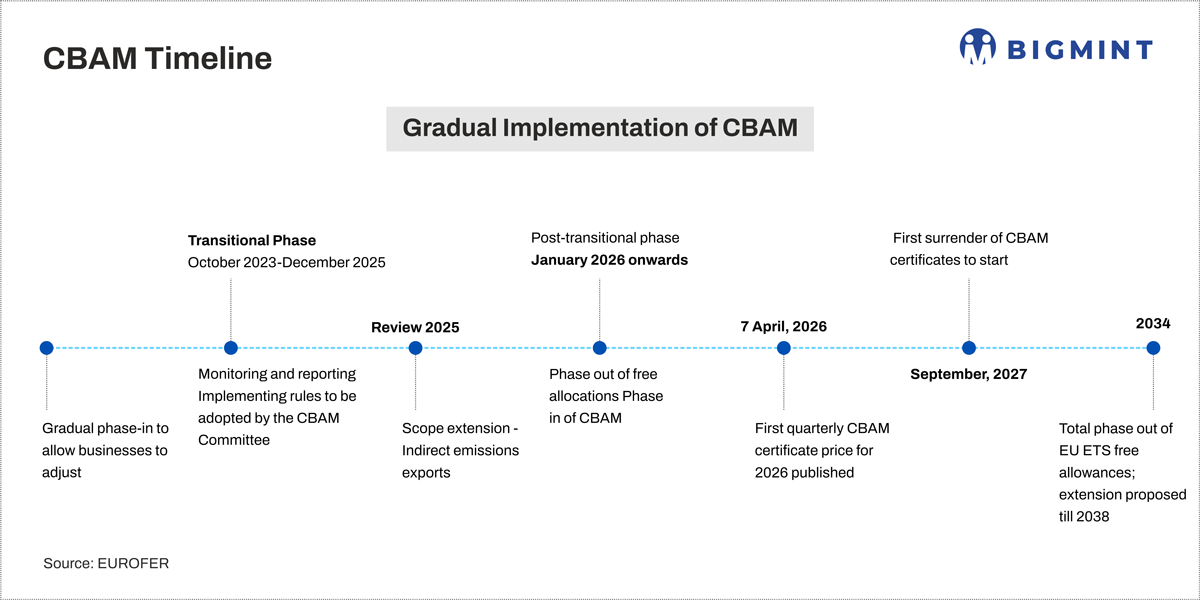
The European Commission has proposed amendments to the European Union Emissions Trading System (EU ETS), extending the phase-out of free carbon allowances for sectors covered under the Carbon Border Adjustment Mechanism (CBAM), including steel, until 2038. Under the previous framework, free allocations were scheduled to be fully phased out by 2034. The proposed revision, announced on 17 July, slows the reduction pace, providing additional transition time for affected industries while making continued access to free allowances conditional on investment in decarbonisation projects within the EU.
Under the proposal, companies seeking free allowances after 2030 will be required to submit “Invest in EU Decarbonisation Plans” from 2031 and reinvest an amount equivalent to the value of those allowances into low-carbon projects. The package also includes a proposed EUR 100 billion Industrial Decarbonisation Bank, including an initial EUR 30 billion funding window during 2028-2030, aimed at accelerating industrial decarbonisation.
Steelmakers push for longer transition
The proposal follows months of lobbying by Europe’s largest integrated steelmakers, including ArcelorMittal, thyssenkrupp Steel Europe, and voestalpine, which had urged the European Commission to delay the withdrawal of free ETS allowances. The companies argued that persistently high electricity and hydrogen costs, weak steel demand, rising imports, and limited availability of low-carbon energy had undermined the commercial viability of planned decarbonisation projects. They warned that removing free allowances too quickly would erode competitiveness before the conditions needed for large-scale green steelmaking are in place.
EUROFER says transition timeline remains unrealistic
However, the proposal has drawn mixed reactions from the European steel industry. On the same day, the European Steel Association (EUROFER) issued a statement titled, “Decarbonization by 2033 is Impossible Without Cheap Clean Power and Hydrogen.” The association argued that the revised ETS framework does not eliminate investment uncertainty, noting that the planned cuts in free allocations for the steel industry between 2029 and 2030 remain unchanged.
EUROFER said the European steel industry is investing to utilise hydrogen in around 35% of its ironmaking facilities between 2030 and 2032. However, it stressed that a full transition by 2033 remains unrealistic because competitively priced renewable electricity and green hydrogen infrastructure are not yet available at the scale required. The association also called for a larger share of ETS auction revenues to be directed towards industrial decarbonisation, arguing that EU member states currently reinvest less than 5% of auction proceeds into industrial decarbonisation projects.
Weak market delays green investments
The industry’s concerns have already translated into delays in major decarbonisation investments. ArcelorMittal has postponed or slowed several planned direct reduced iron (DRI) and electric arc furnace (EAF) projects across Europe, including developments in Germany, Belgium, France, and Spain. The company has cited high electricity costs, the lack of affordable green hydrogen, weak European steel demand, and uncertain customer willingness to pay a premium for low-carbon steel as key reasons for delaying final investment decisions. The prolonged downturn in the European steel market has further constrained producers’ ability to finance capital-intensive decarbonisation projects.
Industry split over ETS reforms
The proposed amendments have also exposed differing priorities within the European steel sector. Large integrated producers, including ArcelorMittal, thyssenkrupp, and voestalpine, have continued to call for a broader review of the ETS framework, arguing that extending free allowances is necessary to safeguard competitiveness during the transition. In contrast, companies that have already committed significant investments towards low-carbon steelmaking, including SSAB, Dillinger, Outokumpu, Salzgitter, and emerging producer Stegra, have supported maintaining the existing ETS framework to preserve policy certainty and avoid weakening incentives for decarbonisation.
The differing positions largely reflect each company’s stage of transition. Integrated blast furnace producers face higher capital requirements and greater dependence on affordable hydrogen and renewable electricity before replacing conventional ironmaking assets. Meanwhile, producers that have already advanced low-carbon projects argue that altering the ETS timeline could undermine investment confidence and delay Europe’s climate goals.
The proposal must still be approved by the European Parliament and EU member states before it becomes law. The debate is expected to focus on balancing the competitiveness of Europe’s energy-intensive industries with the bloc’s decarbonisation objectives. The outcome will shape the investment environment for hydrogen-based steelmaking projects over the coming decade and determine how quickly European producers can transition away from carbon-intensive ironmaking.
Note: This article is published as part of a content exchange agreement between Japan Metal Daily and BigMint.
Leave a Reply