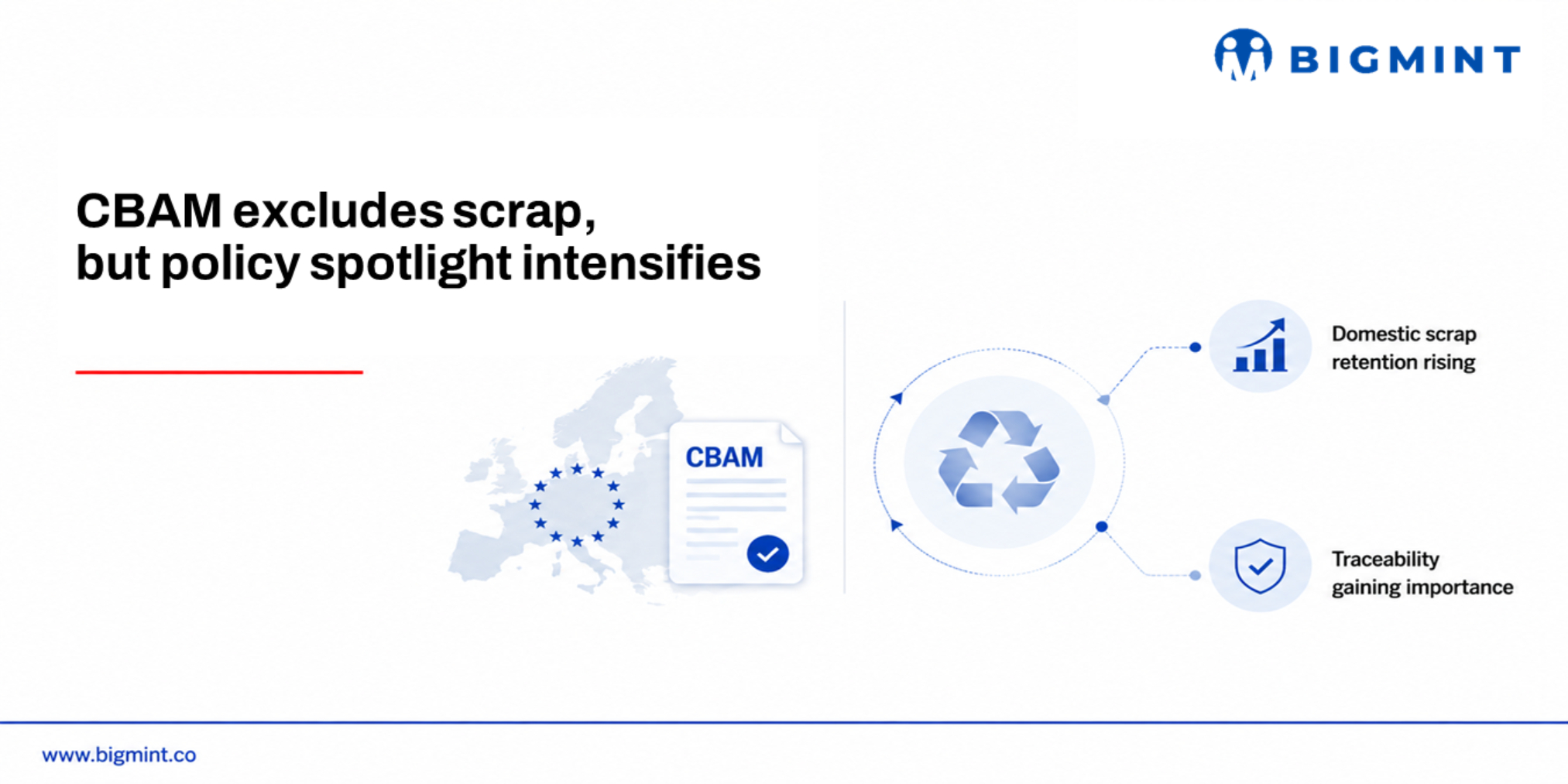
- Recycled content increasingly enters EU carbon-pricing discussions
- Europe and US prioritise domestic scrap retention amid decarbonisation efforts
The European Union’s Carbon Border Adjustment Mechanism (CBAM) currently excludes scrap from its scope, but growing discussions around recycled content and circularity are placing the recycling industry under increasing policy scrutiny, industry participants said during the Bureau of International Recycling’s (BIR) World Recycling Convention & Exhibition 2026 in Gothenburg, Sweden.
The discussion comes as CBAM entered its definitive phase on 1 January 2026, imposing carbon costs on selected imported products, including steel and aluminium. While post-consumer scrap is not currently included, industry representatives indicated that recycled content and circularity are becoming increasingly prominent within broader European carbon-pricing discussions.
Scrap trade flows becoming more selective
According to Anand Gupta, founder and chief executive officer of India’s Aamor Inox Ltd., mature scrap markets such as Europe and the United States are increasingly focusing on retaining cleaner scrap grades for domestic consumption. Circular economy targets, carbon reduction policies, traceability requirements, and raw material security concerns are gradually reshaping global trade flows.
“Scrap remains a liquid commodity, but the market is becoming more selective,” Gupta noted, highlighting the growing importance of quality requirements, domestic consumption priorities, logistics, and policy considerations in procurement decisions.
Industry participants observed that while Asia is often discussed as one market, China, Indonesia, and India have evolved under distinct growth models. China continues to dominate through scale and integration, while Indonesia’s rapid expansion has been supported by its nickel advantage and favourable nickel pig iron (NPI) economics.
India remains heavily dependent on imported scrap
India has emerged as one of the fastest-growing stainless steel ecosystems globally, with growth of around 54%, according to Gupta. Unlike China and Indonesia, however, India’s stainless steel industry remains significantly more dependent on scrap-based production routes.
According to BigMint data, India’s ferrous scrap imports declined by over 15% y-o-y to around 7 million tonnes (mnt) in FY’26 from 8.45 mnt in FY’25. In contrast, stainless steel scrap imports increased by nearly 14% y-o-y to 1.47 mnt from 1.29 mnt over the same period — a sustained demand from the country’s expanding stainless steel sector.
As discussed during the session, domestic ferrous and stainless steel scrap generation in India is not keeping pace with demand growth, creating an ongoing requirement for imported material. Challenges related to consistency, quality, and metallic yields continue to reinforce import dependence.
Gupta also noted that future competitiveness will increasingly depend not only on securing scrap supply but also on the ability to process scrap efficiently. While higher scrap usage remains an industry objective, operational realities differ across melt-shop routes, with some requiring tighter control over chemistry and residual elements than others. He added that the industry’s next phase of adaptation is likely to take place within melt shops, where processing efficiency and raw material optimisation will become increasingly important.
CBAM developments remain a key watch point
Julia Ettinger, secretary general of Recycling Europe, said the European Commission currently does not plan to bring post-consumer scrap under CBAM, as doing so could discourage recycling and run counter to the EU’s circular economy goals. This means scrap imports are not subject to the additional carbon-related costs that apply to products such as steel and aluminium. However, she noted that recycled content and circularity are increasingly becoming part of wider discussions on carbon pricing.
“Currently, scrap is not planned to be included in CBAM, but recycled content and circularity increasingly enter the discussion about carbon pricing,” Ettinger said.
She added that the EU is already evaluating proposals to expand CBAM’s scope further downstream, including certain semi-finished products.
The discussion also highlighted the close relationship between CBAM and the EU Emissions Trading System (ETS), under which companies purchase and trade carbon allowances. Free allowances currently available under ETS are scheduled to be phased out by 2034 as CBAM implementation progresses.
Global market backdrop
Red Sea disruptions continued to affect shipments between Asia and the Middle East, extending transit times and pushing up freight and insurance costs. While market conditions in Europe remained under pressure, participants reported early signs of recovery. The implementation of CBAM has also added to costs across sections of the steel value chain. Meanwhile, producers in Asia faced higher manufacturing costs as ongoing supply chain disruptions continued to impact raw material flows and logistics.
Outlook
While scrap remains outside the scope of CBAM, industry participants were advised to closely monitor developments surrounding recycled content and circularity as these topics increasingly feature in discussions around carbon pricing. Market participants also highlighted the growing focus on domestic melting and stainless steel scrap consumption, traceability requirements, and raw material security in Europe and the US, factors that are gradually influencing global scrap trade flows.
Leave a Reply