- Rising global overcapacity, low internal demand prompt move
- New traceability measures may impact China’s semis exports
Mysteel Global: The European Commission has proposed a new regulation to further restrict steel imports and protect the European steel industry, which includes three key measures: reducing duty-free steel quotas, doubling steel import tariffs, and strengthening the traceability of steel origins, according to the Commission’s announcement released on 7 October.
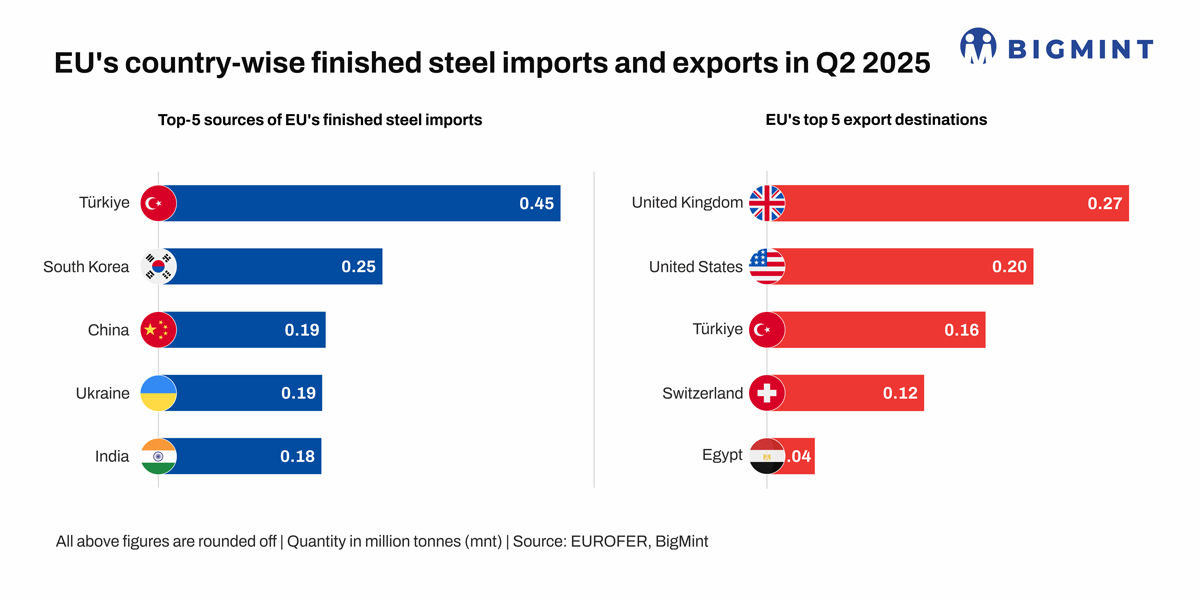
Specifically, the EU’s tariff-free steel import quota is planned to be cut to 18.3 million tonnes (mnt) a year, a significant reduction of 47% compared to the 2024 level; the current 25% tariff imposed on the out-of-quota imports will be doubled to 50%; and appropriate evidence is required for all imported steel products to identify their “melt and pour” country in which raw steel and iron are initially produced in liquid form.
The new proposal, subject to approval from the European Parliament and the Council, will take effect after June 2026 if passed, following the expiration of the current steel safeguard measures, including a 25% tariff on steel imports above a set quota, which have been in place since 2019, according to the announcement.
The EU steel industry is facing significant pressure from unsustainable levels of global overcapacity, the commission claimed, citing the increase in steel imports, the closing of third-country markets, and low internal demand. The new measures are aimed at helping the European steel industry regain global competitiveness and supporting the sector in its decarbonisation efforts, it maintained.
Global steel overcapacity has now risen to 620 mnt/year and is projected to reach 721 mnt/year by 2027, exceeding five times the EU’s annual consumption. Meanwhile, in 2024, the average capacity utilisation in the bloc sat at 67%, far below the healthy rate of around 80%, according to the commission’s statistics.
Despite the EU’s asserted compliance with WTO rules, the proposal has sparked worries about rising protectionism in the global steel market as well, Mysteel Global learnt.
“The move is expected to increase costs for downstream industries such as automobile and machinery, adversely affecting the development of these sectors,” accused the China Chamber of Commerce to the EU (CCCEU). “It contravenes the principles of free trade and could potentially trigger trade frictions and retaliatory measures from other countries,” it warns.
If implemented, the new policy is expected to create obstacles for China’s steel exports as well. During January-August this year, China’s steel exports to the EU jumped 22.3% y-o-y to 3.2 mnt, accounting for some 4% of its total steel export volume, according to the data of the country’s General Administration of Customs (GACC).
In addition to direct steel exports, China also ships a portion of its semi-finished steel products to third countries such as Turkey and Vietnam, where these semis could be further processed into finished steel products and re-exported to other markets, a trade flow that will be directly impacted by the EU’s new measure tracing the “melt and pour” countries of the imported steel.
For instance, China exported 9.2 mnt of steel billets during the first eight months of this year, nearly tripling the volume in the same period last year, and the volume shipped in August hit a record high of 1.8 mnt, GACC data showed.
Note: This article has been written in accordance with a content exchange agreement between Mysteel Global and BigMint.
Leave a Reply