- Rising global overcapacity, price pressure deepen EU industry distress
- Indian exporters face 30-40% market impact if measures take effect
The European Commission (EC) has proposed imposing safeguard measures that would curb the EU’s ferro alloys imports by 25% over a three-year period, in a bid to stabilise the region’s alloy industry amid rising competitive pressure from lower-priced imports, in its recent notification issued on 12 November. This proposal stems from an ongoing safeguard investigation launched on 19 December 2024 to determine whether temporary trade protection is necessary to prevent further injury to Union producers of silicon- and manganese-based alloying elements.
Key points at a glance
- Three-year safeguard proposal expiring on 17 November 2028
- The Commission considers it necessary to set the quota levels 25% below the average level of imports of 2022, 2023, and 2024.
- The proposed safeguard measures shall be in the form of specific TRQ per product type allowing a certain volume of imports to enter free of duty and a tariff increase for imports exceeding the quota volumes.
Why safeguard is being proposed ?
List of product types originating in developing countries to which the definitive measures apply are ferro manganese, ferro silicon, ferro-silico magnesium, and ferro-silico manganese.
In 2019-2024, the sector saw pronounced deterioration:
- EU consumption weakened. Domestic sales of the Union producers decreased between 2019 and the ‘Most recent period’ by 41%, resulting in a loss of 14% market share.
- Although imports rose only 13% in absolute terms, their penetration doubled relative to EU production, intensifying price pressure.
- EU production dropped 50%, and capacity utilisation declined from 56% to 35%.
- Profitability fell sharply – from a temporary profit in 2021 to a 20% loss in the most recent period.
- Employment contracted by 19%.
The Commission attributed these declines to several unforeseen global developments:
- In CY’23, global ferro-alloys production capacity was estimated at approximately 46 mnt, while global consumption amounted to only 27.6 mnt, creating an existing overcapacity of around 18 mnt
- Massive global overcapacity, which is projected to reach 27 million tonnes (mnt).
The proposed safeguard measure shall be in place for a period of three years, expiring on 17 November 2028. The Commission considers that the most appropriate way to liberalise the measure is to increase the level of the free of duty quota by 0,1% after each year. The first liberalisation will take place on 18 November 2026, with the second liberalisation taking place on 18 November 2027.
Impact on Indian producers
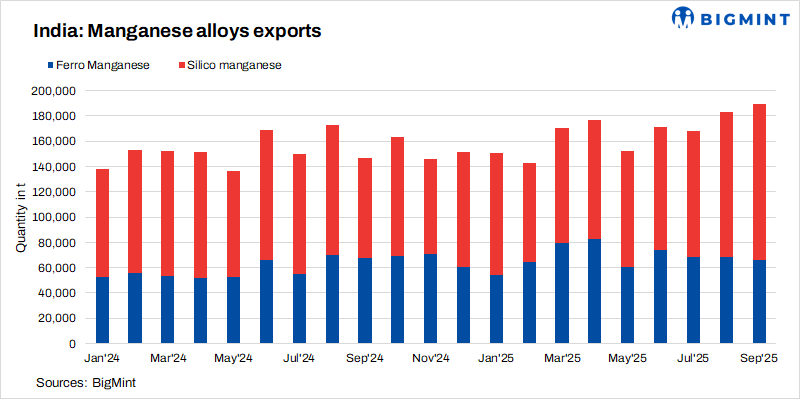
According to sources, a major ferro alloy producer from Durgapur, India, warns that the proposed EU safeguard could disrupt 30-40% of India’s ferro alloy export market. Indian smelters remain heavily dependent on EU demand, particularly for manganese alloys. Any quota restrictions or higher import-price thresholds could severely impact shipment flows, potentially forcing producers to absorb deeper discounts, explore new destinations, or even temporarily reduce production depending on the severity of the final measure.
Leave a Reply