- Policy may include tariffs, quotas, reporting rules
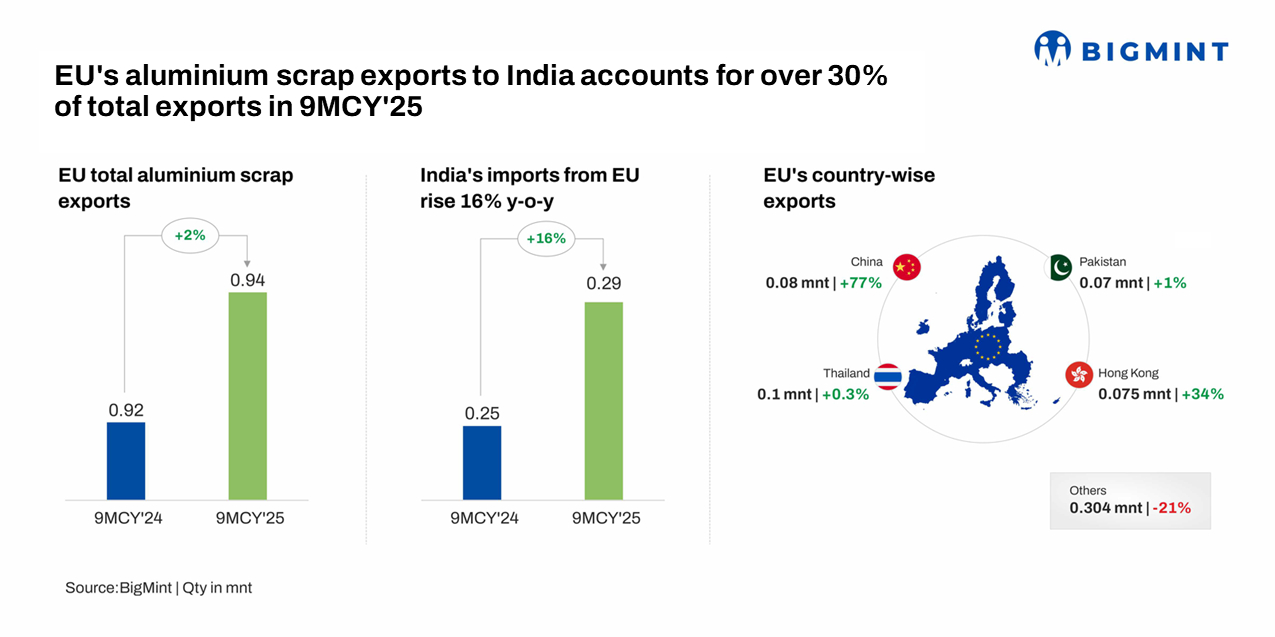
- India stands as largest buyer of EU scrap in 9MCY’25
The European Union (EU) excluding UK (United Kingdom) is preparing new measures to tighten control over aluminium scrap exports — an intervention that could reshape global scrap flows and directly impact major importers such as India. The initiative, announced at a high-level industry summit in Brussels, aims to address what EU policymakers describe as “scrap leakage,” a situation in which large quantities of valuable aluminium scrap leave the bloc despite strong long-term recycling needs.
How much aluminium scrap does EU generate?
The EU currently generates around 5 million tonnes (mnt) of aluminium scrap each year on average, representing 75-80% of all aluminium recycled within the bloc, which also comes to 5 mnt. These levels have held steady in recent years. However, sluggish industrial production, particularly in the automotive and construction sectors, has limited the growth in domestic demand for recycled metal.
With industrial recovery uncertain, European policymakers fear future supply pressures as the region accelerates its energy transition.
Growing scrap leakage to Asia — India at centre
Europe’s scrap exports have risen steadily, partly driven by global trade distortions. A key shift came after the US imposed much higher tariffs on primary aluminium than on scrap, limiting outflows of the latter. This pushed global buyers towards Europe. India — where domestic scrap availability trails rapidly growing consumption — has become the largest buyer of European material.
Lower-grade scrap typically dominates these outflows, while higher-grade material is consumed within the EU. Net shipments to the US remained limited. As of 9MCY’25, the US imported 12,591 t of aluminium scrap from the EU, reflecting a 101% increase y-o-y.
Looking at the data, India has imported around 0.29 mnt of aluminium scrap from the EU during 9MCY’25, showing a 16% increase against 0.25 mnt in the previous year.
On the other hand, Thailand has remained the second-largest importer of EU scrap with 0.1 mnt in 9MCY’25, largely stable y-o-y, followed by China with 76,390 t of scrap during the same period, reflecting a 77% rise y-o-y.
Why EU cannot absorb all its scrap
Despite pressure from European producers to restrict exports, a full ban is considered unlikely. The continent still lacks the capacity to process all the scrap it generates, limited by environmental rules, labour shortages, and technological bottlenecks. This structural gap ensures that exports will remain necessary — though the EU may increasingly regulate them.
Recycling’s role in decarbonisation — why India is concerned
Recycled aluminium requires 95% less energy than primary metal production. For Europe, securing enough high-quality scrap is essential to meet climate goals.
India, meanwhile, is relying heavily on imported scrap to support its fast-growing secondary aluminium industry, as demand rises across construction, automotive, renewables, and packaging.
Any disruption in European scrap supplies could ripple through India’s downstream sectors, tightening margins and pressuring producers to find new feedstock sources.
EU’s policy response: Monitoring first, restrictions later
Since July 2024, the European Commission has been monitoring aluminium scrap exports and is now drafting what it calls a “balanced measure.” Possible options include:
- Export tariffs
- Quotas
- Additional reporting requirements
A full export ban is not under consideration. However, even moderate restrictions could affect global markets — especially India.
Industry reactions
EU aluminium producers have welcomed the move, arguing that rising exports undermine Europe’s circular economy ambitions. Recycling companies, however, warn that restrictions could damage their business, noting that Europe currently generates more scrap than its smelters can absorb.
Recyclers argue that unless the EU expands smelting and refining capacity, curbing exports could create bottlenecks and push recyclers into financial stress.
The India question: What happens next?
For India, which relies heavily on European scrap to meet domestic demand, the EU’s forthcoming export rules could alter supply dynamics. Potential impacts include:
- Higher procurement costs if Europe introduces tariffs
- Reduced availability of certain scrap grades
- Diversification pressure, pushing India toward Middle Eastern, African, or Southeast Asian suppliers
- Acceleration of domestic scrap collection and processing initiatives
- Increased volatility in global scrap prices
The European Commission’s public consultation — expected soon — will reveal more about how stringent the final measures may be.
Looking ahead
As the EU shapes its new strategy for managing aluminium scrap outflows, India will remain a critical player in global trade patterns. Any adjustment in Europe’s export regime could influence India’s recycling sector, industrial growth, and long-term sustainability plans.
Leave a Reply