- EC abolishes quota carry-overs for certain products
- India’s HRC quota reduced by approximately 25%
The European Commission (EC) has introduced substantial amendments to its steel safeguard measures, effective 1 April 2025, with the objective of shielding the European Union’s steel industry from escalating import volumes.
These revisions are expected to reduce import inflows by approximately 15%. Import shipments within the established quotas will continue to be exempt from tariffs, whereas those exceeding the allocated limits will be subject to a 25% tariff. Additionally, the Commission has decided to abolish the transfer of unused quotas for countries and categories experiencing high import pressure and low consumption, aiming to ensure a more balanced and equitable trade environment.
Key changes to steel import quotas
New limits on HDG, CRC imports: Suppliers of hot-dip galvanised (HDG) and cold-rolled coils (CRCs) will face new limits within the “other countries” quota, ranging from 13-25% based on the product.
Reduced duty-free HRC quota: The quarterly duty-free HRC quota will decrease by 12.1% to 1.9 million tonnes (mnt), primarily due to the elimination of Russian volumes.
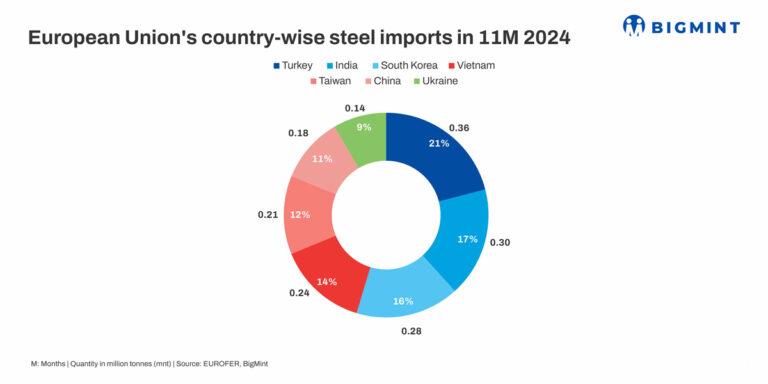
Impact on Indian HRC quota: India’s HRC quota will be reduced by approximately 25%. Quotas for plates, wire rods, and hollow sections will also be impacted.

Impact on EU’s domestic steel market
The revised steel import policies will significantly reshape the European steel market. Reduced HRC quotas and new caps on CRC, HDG, and plate imports will redistribute market share, impacting major suppliers. While some countries may benefit from the resulting gaps, overall EU import volumes are expected to decrease, benefiting domestic producers and intensifying competition among them.
Outlook
The EU’s revised steel import policies signal a more protectionist stance, aiming to safeguard the domestic steel industry. The elimination of quota carry-overs for certain products has further tightened the EU’s import controls. Global steel exporters must navigate these changes strategically to remain competitive in the European market.
Leave a Reply