- Coal remains grid’s balancing backbone
- Weak hydro output boosts coal dependence
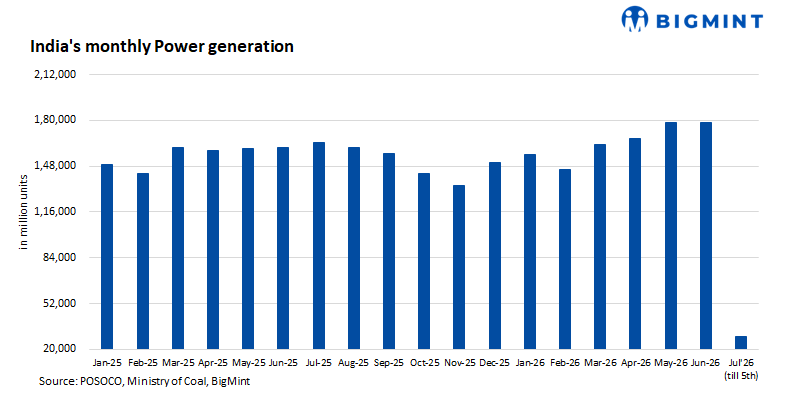
India’s electricity market entered July with a markedly different structure from a year ago. Despite the southwest monsoon covering most parts of the country by early July, coal-fired generation has continued to operate at exceptionally high levels as delayed and uneven rainfall curtailed hydroelectric output while electricity demand remained significantly above last year’s levels.
The first five days of July illustrate this structural shift. Total electricity generation increased by nearly 10% y-o-y, while maximum power demand on working days remained 12-16% above the corresponding period last year. At the same time, hydro generation declined by over 21%, forcing coal-fired stations to compensate for the shortfall even as renewable generation continued to record impressive growth.
Unlike 2025, when widespread and well-distributed rainfall quickly reduced cooling demand and boosted hydroelectric generation, the 2026 monsoon has been characterised by delayed onset, prolonged dry spells and highly uneven rainfall distribution. Although rainfall intensified during the first week of July, many important catchment areas continue to lag behind last year’s performance, delaying the seasonal transition away from thermal generation.
Coal continues to shoulder the grid
Fuel-wise generation data underline coal’s continuing importance.
During the first five days of July, coal-fired generation rose to 18,760 million units (MU), up 12.1% y-o-y, while hydro generation fell sharply to 2,838 MU, down 21.4%. Renewable energy output, meanwhile, increased by 29% to 5,764 MU, reflecting continued capacity additions across solar and wind.

The figures demonstrate that India’s expanding renewable fleet is increasingly meeting incremental daytime demand. However, weaker hydro generation has meant coal continues to provide the dispatchable capacity needed to maintain system reliability.
Erratic monsoon delays seasonal shift
Normally, the arrival of the southwest monsoon brings a gradual reduction in coal-fired generation as hydroelectric output improves and temperatures moderate.
This year has been different.
June witnessed one of the weakest starts to the monsoon in recent years, with rainfall remaining well below normal across several major regions before recovering sharply during early July. Rather than continuous rainfall, much of the country experienced intermittent heavy showers separated by prolonged dry periods.
This temporal variability has produced two important consequences.
First, daytime temperatures remained relatively elevated across several regions, sustaining electricity demand even after the formal arrival of the monsoon.
Second, hydroelectric generation has recovered much more slowly than in 2025, leaving coal-fired generation to bridge the resulting supply gap.
Peak demand remains exceptionally strong
Demand has shown little sign of slowing.
Maximum demand during the first three working days of July ranged between 241 GW and 243 GW, compared with 209-215 GW during the corresponding period last year.
Although demand moderated over the weekend, reflecting lower commercial and industrial activity, the overall trajectory remains significantly above 2025 levels.
Interestingly, maximum demand also continued to occur predominantly during the late evening, highlighting the growing influence of residential cooling demand after sunset.
India’s electricity market becomes increasingly bipolar
Perhaps the most striking development has been the behaviour of exchange prices.
The Indian Energy Exchange displayed two distinctly different markets.
During daylight hours, abundant renewable generation pushed market-clearing prices sharply lower. On 5 July, prices fell to almost zero during several afternoon trading blocks as solar generation flooded the market.
However, the picture changed completely after sunset.
As solar generation declined and demand remained elevated, prices recovered sharply, touching the market cap of INR 10,000/MWh during evening peak hours on some trading sessions.
This growing divergence illustrates how India’s electricity market is evolving. Solar increasingly determines daytime pricing, while dispatchable thermal generation continues to set prices during the evening peak.
Rather than competing directly, renewables and coal are increasingly performing complementary roles within the electricity system.
Coal stocks ease but system resilience improves
Despite stronger coal-fired generation, fuel availability remains comfortable.
According to the Central Electricity Authority, total coal stocks at thermal power plants declined marginally from 44.11 mnt on 30 June to 43.13 mnt on 5 July, reflecting sustained coal consumption as generators operated at relatively high utilisation rates.
Importantly, operational indicators improved over the same period.
The number of power stations classified as having critical coal stocks declined from 32 to 29, while overall stock coverage improved to 67% of normative requirements from 58% at the end of June. These trends suggest that coal production and logistics continue to replenish inventories despite elevated consumption, reducing supply risks even as demand remains robust.
Outlook
India’s power market is entering a new operational phase.
Rather than replacing coal, rapid renewable additions are reshaping when coal is needed. Solar generation is increasingly suppressing daytime prices and reducing thermal generation during daylight hours, while delayed hydro recovery and strong evening demand continue to reinforce coal’s role as the grid’s principal balancing fuel.
If the monsoon becomes more widespread and reservoir inflows improve through the remainder of July and August, hydro generation should gradually recover and reduce pressure on coal-fired stations. Until then, the combination of robust electricity demand, uneven rainfall and expanding renewable generation is likely to keep coal at the centre of
India’s power system–even as the country’s electricity market becomes increasingly defined by the interaction between low-cost daytime renewables and dispatchable thermal generation.

Leave a Reply