- Strong steel demand, high EAF scrap usage boost Vietnam’s imports
- Weak construction activity weighs on South Korea’s scrap intake
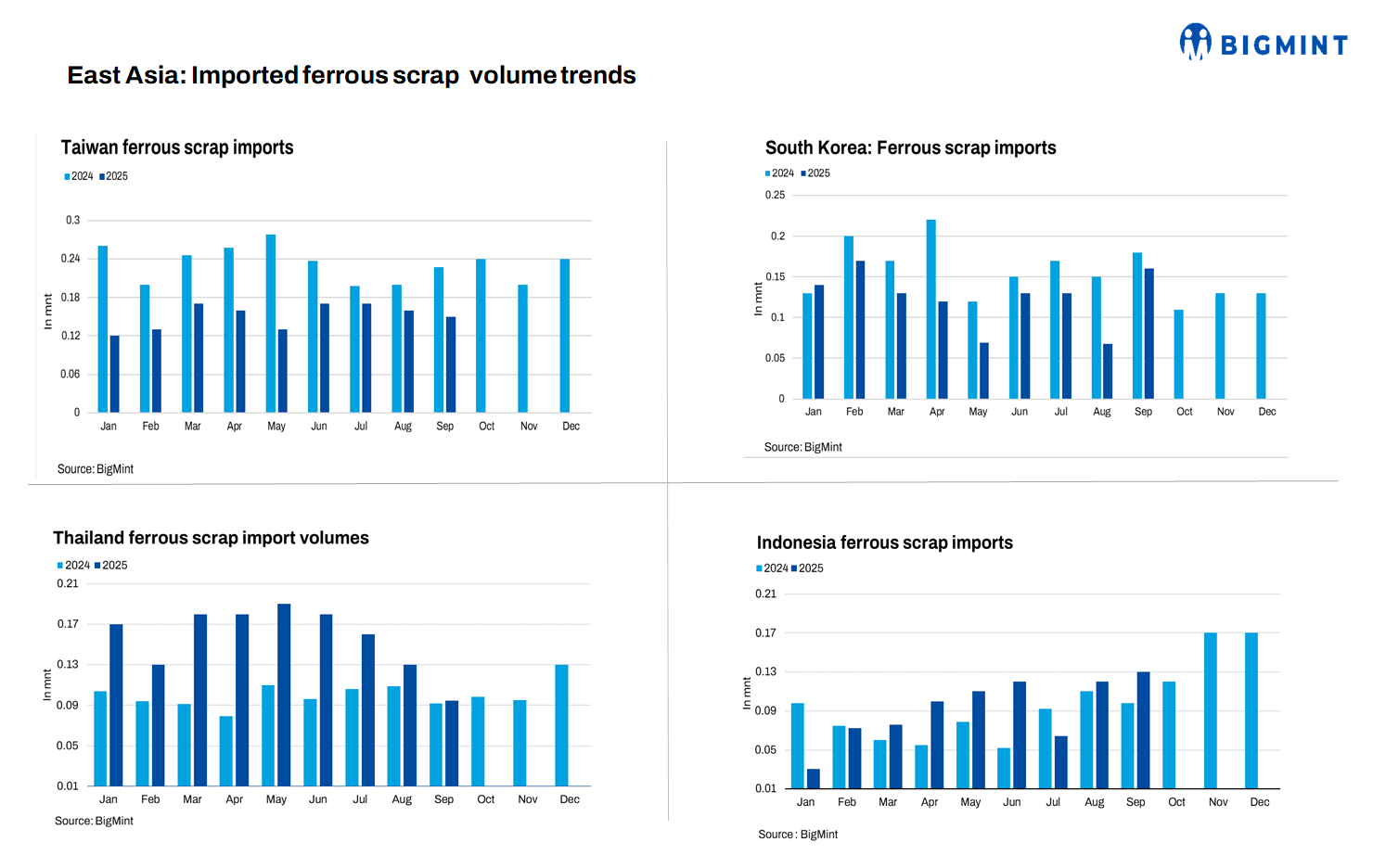
East Asian ferrous scrap imports showed mixed trends across regions in 9MCY’25, with Vietnam seeing a sharp surge, while Taiwan recorded a steep decline due to weak steel demand, high inventories, and cheaper alternatives. South Korea’s imports also fell y-o-y despite a brief restocking-led uptick in September. Meanwhile, Thailand experienced strong growth on higher scrap usage and improved supply, while Indonesia recorded moderate gains, supported by policies encouraging greater scrap utilisation.
Vietnam: Vietnam’s imported ferrous scrap imports rose by 24% y-o-y to 3.98 million tonnes (mnt) in 9MCY’25, from 3.2 mnt in 9MCY’24. In September, imports stood at 0.49 mnt, a 9% m-o-m rise from 0.45 mnt in August.
Exports to Vietnam were led by Japan, whose shipments climbed up by 35% to 2.44 mnt in 9MCY’25 from 1.81 mnt last year. The US also expanded its share, boosting exports by 49% to 0.58 mnt from 0.39 mnt in 9MCY’24.

Vietnam’s ferrous scrap imports rose in September, supported by strong domestic steel demand and high scrap usage in EAF-based production. The growth reflects increasing consumption, driven by expanding construction and manufacturing activity, which kept reliance on imported scrap elevated. Vietnam’s crude steel output rose 8% to 17.64 mnt in 9MCY’25 from 16.41 mnt.
Taiwan: Taiwan’s ferrous scrap imports fell 36% y-o-y to 1.36 mnt in 9MCY’25, from 2.12 mnt, with September volumes slipping 6% m-o-m to 0.15 mnt from 0.16 mnt in August.
US exports dropped 27% y-o-y to 0.67 mnt in 9MCY’25, while Japan’s shipments fell 29.5% to 0.31 mnt.
The decline reflects weak domestic steel demand, lower mill output, falling steel prices, and competition from cheaper Chinese steel. Crude steel production fell 12% y-o-y to 12.83 mnt, with high costs and pressure on small-to-mid mills limiting import appetite.
South Korea: South Korea’s ferrous scrap imports fell 40% y-o-y to 1.12 mnt in 9MCY’25 from 1.86 mnt in 9MCY’24. However, September saw a strong 129% m-o-m rebound to 0.16 mnt from 0.07 mnt in August.
Japan’s shipments to South Korea dropped 40% y-o-y to 0.88 mnt in 9MCY’25, and Russia’s exports plunged 73.9% to 0.06 mnt. In contrast, the US recorded a 20% y-o-y increase, exporting 0.12 mnt.
Demand weakened due to sluggish construction activity, lower steel output, and mills delaying purchases amid expectations of rising prices. Low inventories may pressure operations if supply remains unstable. South Korea produced 45.8 mnt of crude steel in 9MCY’25, down 4% from 48 mnt in 9MCY’24.
Thailand: Thailand’s ferrous scrap imports surged 60% y-o-y to 1.41 mnt in 9MCY’25, from 0.88 mnt, although September volumes fell 31% m-o-m to 0.09 mnt from 0.13 mnt in August.
The US led supply with a 171% y-o-y jump to 0.65 mnt in 9MCY’25, while Japan’s exports doubled to 0.16 mnt. Australia maintained steady shipments near 0.1 mnt. The strong import growth was driven by better availability from key exporters and mills increasing scrap intake for steelmaking. However, crude steel output in Thailand edged down by 2% y-o-y to 3.72 mnt in 9MCY’25, compared with 3.79 mnt in 9MCY’24.
Indonesia: Indonesia’s ferrous scrap imports rose 14% y-o-y to 0.82 mnt in 9MCY’25, supported by stronger domestic steel requirements. On a m-o-m basis, imports increased 8% to 0.13 mnt in September from 0.12 mnt in August.
Tanjung Priok remained the top entry point, with inflows rising 20% to 0.54 mnt in 9MCY’25, while Tanjung Perak dropped 31% to 0.11 mnt. Hong Kong led supply with 0.24 mnt (+14% y-o-y), followed by Australia at 0.23 mnt (+28% y-o-y).
The rise in imports reflects Indonesia’s efforts to curb billet dependency and boost domestic steelmaking, aided by relaxed scrap import rules, promotion of cleaner high-grade scrap, and technology-driven efficiency improvements.
Leave a Reply