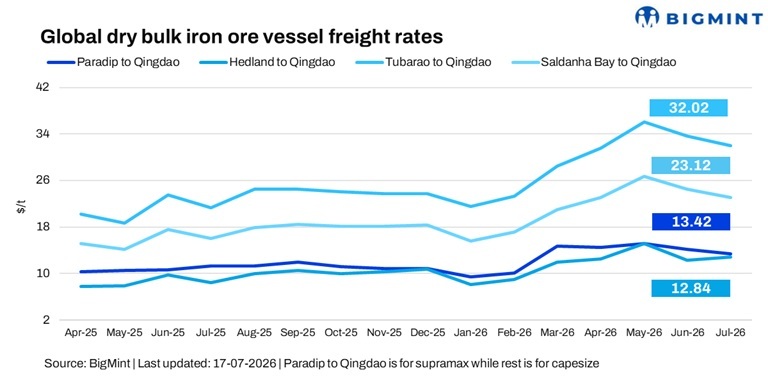
- Atlantic chartering activity lends support to long-haul freight
- Higher bunker costs keep owners’ freight expectations elevated
Dry bulk iron ore freight remained firm in the week ended 17 July, supported by healthy Atlantic chartering activity, resilient regional Supramax demand and rising bunker prices. Although Capesize momentum eased later in the week amid thinner Pacific cargo availability, balanced vessel supply and steady long-haul cargo programmes prevented a broader correction in freight rates.
The week was marked by contrasting regional trends. Atlantic routes continued to outperform on healthy long-haul cargo demand and limited prompt tonnage, while the Pacific basin witnessed slower trading activity despite regular miner fixtures.
A shipbroker said, “Healthy Atlantic cargo demand and balanced vessel supply continued to support owners’ rate expectations, even as Pacific activity turned more cautious.”
Route-wise update

Meanwhile, the Supramax segment remained comparatively resilient, with stronger cargo activity across South East Asia and the Indian Ocean supporting regional employment and round-voyage earnings.
“The recent surge in bunker prices has significantly raised voyage costs, making owners reluctant to soften freight offers. Unless fuel prices retreat, operating costs are expected to keep supporting freight across key dry bulk routes”, another shipbroker added.
Factors influencing freight rates
- Baltic Dry Index (BDI) drops w-o-w: The BDI declined by 2.4% (70 points) w-o-w to 2,840 on 16 July, retreating from a one-month high as weaker Capesize earnings weighed on the broader dry bulk market. The Capesize Index fell by 5% (230 points) w-o-w to 4,339, amid easing momentum across key iron ore trade routes and softer freight sentiment. Meanwhile, the Supramax Index rose by 1.8% (30 points) w-o-w to 1,730, supported by stronger cargo activity across South East Asia and firmer round-voyage earnings in the North Pacific and Australian markets.
- Brent crude futures rise w-o-w: Brent crude oil (September 2026 contract) climbed to $85.98/barrel (bbl) as of 17 July, up $9.33/bbl w-o-w from $76.65/bbl a week earlier. The increase was driven by rising geopolitical tensions, supply-side concerns, and stronger buying sentiment amid uncertainty over global crude availability.
- Bunker prices rise sharply w-o-w: Singapore’s Very Low Sulphur Fuel Oil (VLSFO) bunker prices increased by $112/tonne (t) w-o-w to $764/t as of 17 July, compared with $652/t a week earlier. The sharp increase tracked stronger Brent crude prices and heightened geopolitical tensions, pushing up voyage operating costs for shipowners.
- DCE iron ore futures rise w-o-w: Iron ore futures on the Dalian Commodity Exchange (DCE) increased by RMB 10.5/t w-o-w to RMB 762/t ($112.50/t) as of 17 July, compared with RMB 751.5/t ($110.6/t) a week earlier. The gain was supported by expectations of stronger Chinese steel demand, resilient iron ore consumption, and continued steel mill restocking, which lifted buying interest and supported seaborne market sentiment.

Outlook
Dry bulk iron ore freight is expected to remain range-bound with a firm undertone in the near term, supported by Atlantic cargo programmes, resilient Supramax demand and elevated bunker prices. Freight direction in the coming weeks will largely depend on Chinese steel demand, iron ore procurement trends, freight derivatives (FFAs), weather-related disruptions and vessel availability across key loading regions.

Leave a Reply