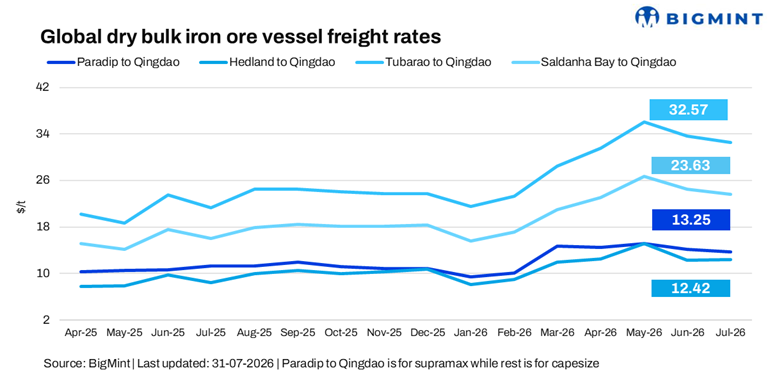
- Pacific Capesize gains offset weaker Atlantic activity
- India-China Supramax freight remained under pressure
Dry bulk iron ore freight rates remained mixed across key Atlantic and Pacific routes in the week ended 31 July 2026, as firm Australian export flows and steady Chinese buying lent support to Pacific Capesize activity, while softer cargo demand and ample vessel availability weighed on India- and Brazil-origin trades.
Capesize iron ore freight sentiment remained mixed across the major Atlantic and Pacific basins during the week. In the Pacific, firm Western Australian iron ore exports and steady Chinese buying interest supported activity, while the Atlantic saw softer cargo demand and increased vessel availability, particularly on Brazil-origin trades. Overall, vessel supply remained relatively comfortable, keeping market gains limited despite steady demand from major iron ore routes.
Meanwhile the Supramax market remained under pressure, with activity on the India-China route subdued by limited cargo enquiries and softer minor bulk demand. Ample vessel availability further weakened chartering interest, as owners faced a relatively comfortable tonnage position amid a lack of fresh support from the cargo side.
A shipbroker said, “Freight rates on the India-China route declined as lower trading activity and fewer cargo enquiries reduced chartering interest, while ample vessel availability continued to weigh on freight sentiment.”
Route-wise update

Factors influencing freight rates
- Baltic Dry Index (BDI) drops w-o-w: The Baltic Dry Index (BDI) declined by 1.91% (52 points) w-o-w to 2,673 on 30 July. The Baltic Capesize Index (BCI) eased 0.74% (31 points) to 4,167, while the Baltic Supramax Index (BSI) fell 5.41% (92 points) to 1,610. The weekly decline reflected softer dry bulk market sentiment amid weaker minor bulk demand, seasonal slowdown, and higher vessel availability. However, resilient Capesize earnings, supported by steady iron ore and coal exports, helped limit the overall decline in the BDI.
- Brent crude futures decline w-o-w: Brent crude oil (September 2026 contract) eased to $90.25/barrel (bbl) as of 31 July, down $7.44/bbl w-o-w from $97.69/bbl a week earlier. The decline reflected easing geopolitical risk premiums as traders focused on actual crude and tanker flows, though persistent Middle East tensions continued to support prices and maintain market volatility.
- Bunker prices decline w-o-w: Bunker prices fell to $808/tonne (t) as of 31 July, down $74/t w-o-w from $882/t a week earlier. The decline tracked weaker crude oil prices, though persistent geopolitical risks, tighter fuel availability, and shipping route disruptions kept bunker prices historically elevated and voyage costs high.
- DCE iron ore futures drop w-o-w: Iron ore futures on the Dalian Commodity Exchange (DCE) declined by RMB 30/t ($4.4/t) w-o-w to RMB 716/t ($106/t) as of 31 July, from RMB 746/t ($110.43/t) a week earlier. The decline was driven by seasonally weaker steel demand in China, thinning steel mill margins, which dampened buying interest.

Outlook
Iron ore freight rates are likely to remain mixed in the near term, with steady Chinese demand and Australian export flows providing support to Pacific Capesize rates, while ample tonnage and subdued cargo activity could keep pressure on India-origin and Atlantic routes.

Leave a Reply