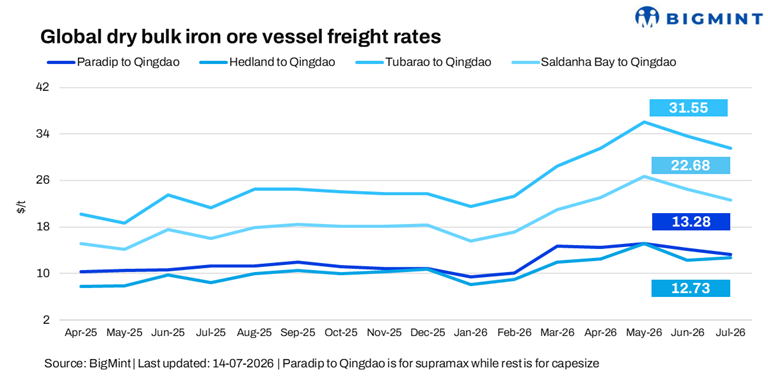
- Dry bulk iron ore freight strengthened w-o-w, led by Capesize gains
- Typhoon Bavi disruptions and limited cargo activity capped market momentum
Dry bulk iron ore freight sentiment strengthened w-o-w on 14 July 2026, led by continued gains in the Capesize segment. Firm shipowner sentiment, higher bunker prices, and steady iron ore cargo enquiries supported freight rates.
Meanwhile, the Supramax market remained subdued, with limited fresh fixtures and cargo enquiries. However, higher bunker prices continued to lend support to freight rates despite persistent bid-offer disparities.
Singapore’s Very Low Sulphur Fuel Oil (VLSFO) bunker prices surged to $741/tonne (t) on 14 July, up sharply by $87/t from $654/t on 11 July. The increase was primarily driven by a rally in crude oil prices amid renewed geopolitical tensions and supply disruption concerns. Firmer refining margins, stronger marine fuel demand, and tighter prompt availability in Singapore further supported bunker prices.
A shipbroker said, “Capesize freight remained firm, supported by higher bunker prices, steady iron ore enquiries, and shipowner resistance. Meanwhile, Panamax, Supramax, and Handysize markets traded largely flat amid limited fresh fixtures and modest cargo demand, resulting in only marginal freight gains.”
Overall market activity remained restrained due to limited fresh cargoes across both the Pacific and Atlantic basins. In addition, Typhoon Bavi-related disruptions at Chinese ports affected vessel schedules and slowed fixture activity. Nevertheless, tighter vessel positioning and owners’ firm pricing stance continued to underpin freight rates.
Route-wise update

Outlook
Dry bulk iron ore freight rates are expected to remain firm in the near term, supported by steady iron ore cargo enquiries, firm shipowner sentiment, elevated bunker prices, and relatively tight vessel availability, particularly in the Capesize segment. Continued resilience in iron ore exports from Australia and Brazil is also expected to provide underlying support to freight rates.
However, upside may remain limited as Typhoon Bavi-related disruptions at Chinese ports continue to affect vessel schedules and cargo operations. In addition, limited fresh fixtures and subdued cargo enquiries across the smaller vessel segments could keep overall trading activity muted, although owners’ firm pricing stance is likely to prevent any significant decline in freight rates.

Leave a Reply