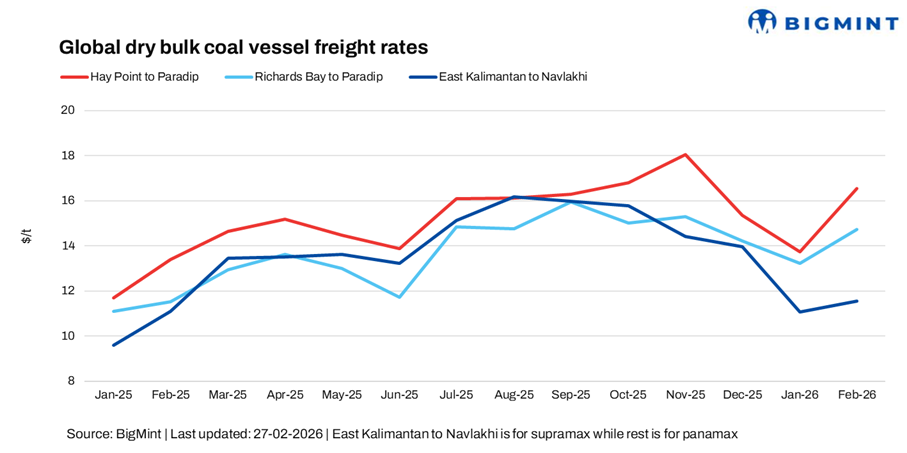
- Australia–Paradip near 2-year high; Indonesia-Navlakhi at 2-month high
- Atlantic freights stay firm on limited vessel availability
Dry bulk coal freights surged w-o-w on 27 February 2026, supported by a firm Pacific outlook driven by tight vessel supply and healthy cargo demand. Australia–Paradip rates hovered near a two–year high, while Indonesia–Paradip touched a two–month high. Freight forward agreement (FFA) rates also strengthened during Asian hours, with bunker prices largely steady from the previous session.
“Indonesian demand was expected to be stronger, but rates for Indonesian rounds have still risen comfortably w-o-w,” a ship broker said.
Route-wise updates

What drove freight rates higher?
- Brent crude oil futures rise w-o-w: Brent crude oil futures climbed up by about $1.93/bbl w-o-w to $72.88/bbl (May 2026 contract) on 27 February, supported by stronger demand sentiment and concerns over tighter global supply.
- Higher bunker prices support freights: Firm bunker prices lent support to the dry bulk market this week, as elevated fuel costs raised voyage expenses and strengthened owners’ rate expectations. The higher cost base, particularly on long-haul routes, helped keep freight levels steady despite only moderate cargo enquiries.
- Baltic dry bulk indices extend weekly gains: The Baltic Dry Index rose 98 points w-o-w to 2,117 as of 26 February 2026, supported by firmer sentiment across the Panamax and Supramax segments. The Panamax index gained 100 points to 1,916 on improved coal and grain activity, while the Supramax index climbed up by 139 points to 1,299, driven by steady minor bulk demand and tighter vessel availability in the Pacific.
Enquiries understood fixed (20-26 Feb’26)

Outlook
Near-term dry bulk coal freights to India are expected to remain firm, supported by tight vessel availability in the Pacific and steady cargo flows from Australia, Indonesia, and South Africa. Elevated bunker prices and improving FFA sentiment may further underpin owners’ rate expectations, particularly on long-haul routes. However, any slowdown in buying interest from Indian utilities or a pickup in prompt tonnage supply could cap further upside.
Leave a Reply