- Disruption on Western Australian port
- South African coal inquiries from India fall
Coal freight rates exhibited mixed trends this week. Notably, fresh bookings from Australian cargoes were absent.
Recently, some enquiries fixed this week, SAIL has booked a Panamax vessel (cargo capacity-75,000 t) for metallurgical coal from Hay Point, Australia to Vizag and Haldia, India at freight $17.45/tonnes (t). The shipment is scheduled for the period of 10-19 March. Another enquiry from SAIL for Panamax vessel (cargo capacity-75,000 t) for metallurgical coal from Gladstone, Australia to Vizag and Haldia, India at freight $17.20/tonnes (t). The shipment is scheduled for the period of 5-14 March.
Route-wise details:
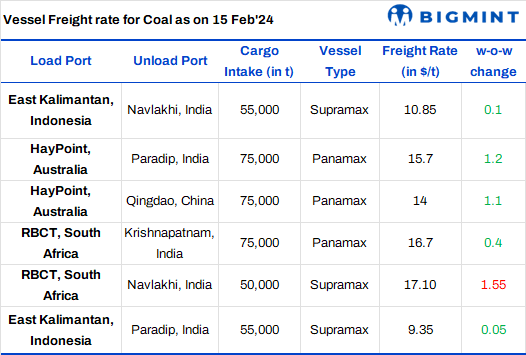
South Africa to India freight weakens: Freight rates for coal shipments from Richards Bay terminal to Krishnapatnam, India, are currently at around $16.7/t, largely stable w-o-w. However, RBCT to Navlakhi port, the freight has declined by $1.55/t w-o-w. Notably, buying activity for South African coal remained limited due to fall in sponge iron prices, driven by expectations of further price drops amid subdued demand. The market reflected decreased industrial activity leading to lower consumption and constrained trading. Market participants noted a cautious atmosphere, indicating buyer hesitancy as they await potentially more favourable pricing conditions.
Australia to India freight rises on weather condition: Freight rates from Australian port inched up by around $1/t w-o-w for the Indian as well as for Chinese ports. Exporters encountered production and vessel delays from various coal-producing mines. Moreover, Kembla Port in Australia underwent maintenance shutdown from February 12 to 15, 2024. These circumstances disrupted shipping schedules, affecting coal supply chains and likely causing freight rate escalations.
Indonesia to India freight remains majorly stable: Freight rates for coal shipments from East Kalimantan to Paradip, India stood at $9.35/t. Freight rates remained majorly stable amid subdued demand from major countries and surplus domestic thermal coal supplies. Cargoes brought by Indian traders at higher prices were still lying at the ports. Moreover, exports from Indonesia dropped amid weather related constraints.