- Iron ore supply growth to be marginally higher than demand
- NMDC to hit 60 mnt production; over 60% merchant share in total output
- Iron ore imports may hit 15 mnt in FY’27 on rising high-grade demand
Data Deep Dive: Iron ore availability, both in terms of volume and quality, has become a key issue in the Indian steel industry with the rapid expansion of crude steelmaking capacity. Government data shows that while crude steel capacity increased by 55% during the period between FY’20 and FY’26, iron ore production during the same period witnessed far slower growth of around 28%.
According to BigMint data, the country’s approved iron ore environmental clearance (EC) capacity increased by 10.1% y-o-y to 521 million tonnes (mnt) in FY’26 from 473 mnt in FY’25. However, iron ore production rose at a slower pace of around 8% to an estimated 316 mnt in FY’26 from 290 mnt in FY’25.
This is mainly because till May 2026, more than 150 iron ore mines have been auctioned out of which only 42 have commenced operations. The slow pace of operationalisation of auctioned mines and the delays and regulatory hurdles in obtaining clearances account for the fact that India’s iron ore capacity utilisation fell to around 60% in FY’26, meaning 40% of capacity was left unutilised. The gap between EC capacity and actual production was over 200 mnt in FY’26.
Supply growth may outpace demand in FY’27
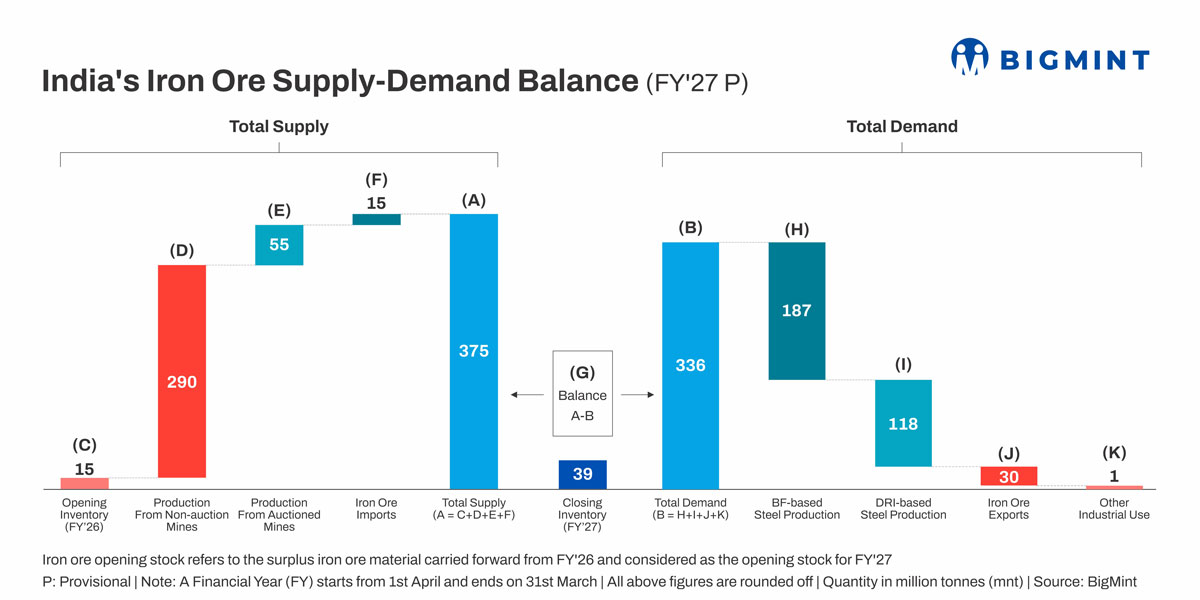
However, unlike last fiscal, in FY’27 BigMint projects domestic iron ore availability to improve somewhat. As per data, total consumption is expected to be around 303 mnt, while iron ore production may reach around 345-350 mnt. Notably, even as demand growth y-o-y is expected to be 8%, growth in supplies should be around 9-10%.
Iron ore consumption will increase in FY’27 on the back of a projected 7% increase in hot metal production which may reach around 104 mnt. Sponge iron production may touch 65 mnt in the current fiscal, an increase of over 8% y-o-y.
As per BigMint data, the domestic iron ore market is expected to be in a slight surplus in FY’27, with apparent availability (production + imports – exports) increasing by 10% on the year to approximately 330 mnt.
Projected production scenario
In FY’27, BigMint projects total domestic iron ore production to reach around 345 mnt, with the merchant producers accounting for over 60% of total production. The over 9% y-o-y growth forecast is based on projections of total merchant production rising by 12% y-o-y in FY’27 to approximately 211 mnt.
Lloyds Metals is expected to record a growth of 19% y-o-y while state-owned NMDC will emerge as India’s largest miner with total output expected to reach 60 mnt – an increase of 13% y-o-y. The company intends to start commercial mining from the 7-mnt Deposit 4 at Bailadila in Chhattisgarh and the 10-mnt Deposit 13 in FY’27. OMC may see output rising by around 10% to 44 mnt, with significant capacity additions, plus a change in the MDO model, triggering higher production.
The captive miners, on the other hand, largely all the integrated steel players, may see their cumulative iron ore output rise by roughly 7% y-o-y to around 134 mnt. The expected 7% growth in FY’27 contrasts with the 1% growth seen in FY’26, with major miners such as JSW and AM/NS recording declines in production. Surrender of large mines, unfavourable mining economics for the auctioned mines and delays in clearances and operational ramp-ups accounted for the very slow growth in production in FY’26.
The Ministry of Mines has issued the Mineral (Auction) Second Amendment Rules, 2025, introducing stricter timelines, enhanced performance security mechanisms, and automatic online transparency measures to expedite the operationalisation of auctioned mineral blocks. The Ministry is tightening the window to operationalise mines won through auctions. Currently, under Section 4A (4) of the MMDR Act preferred bidders have two years to operationalise a mine bid for and begin dispatches of ore.
The amendment in auction rules is obviously aimed at pushing the captive players (some of the leading steel producers who had won the majority of mines in auctions since 2016) to operationalise auctioned mines and ensure mandated dispatches. Miners like Tata Steel and Jindal Steel are expected to operationalise auctioned leases while others will look to raise output from existing leases to meet growing demand from steelmaking.
Miners like JSW, AM/NS and Jindal are expected to see output remaining largely stable y-o-y. After the surrender of an auctioned mine, JSW is looking to raise captive output as well as balance the rising costs of iron ore mining by increasing purchases from the merchant market and partially through imports.
Iron ore imports may hit 15 mnt
Our projection shows that imports of iron ore may touch 15 mnt in FY’27 continuing the uptrend seen in FY’26. Iron ore imports rose to 12.35 mnt in FY’26, a seven-year high, driven by rising domestic steel demand, and especially surging demand for high-grade and low-impurity ore. High domestic logistics costs and delays often make imports attractive for port-based plants.
In January-May 2026, iron ore imports increased by 50% y-o-y while pellet imports were affected due to the geopolitical crisis in the Middle East. Notably, around 85% of the imports were by JSW Steel. With blast furnace ramp-ups in Vijaynagar and Dolvi and higher crude steel production, JSW may continue its current pace of imports during the remainder of FY’27.
Significantly, imports are playing a role in the iron ore demand-supply balance in terms of high-grade ore requirement for blending, as well as a viable alternative for some mills to meet production requirements amid high costs of domestic mining and domestic logistics bottlenecks.

Leave a Reply