- China aluminium output hits record as capacity ceiling looms
- DRC copper exports rise to record levels in H1 2026
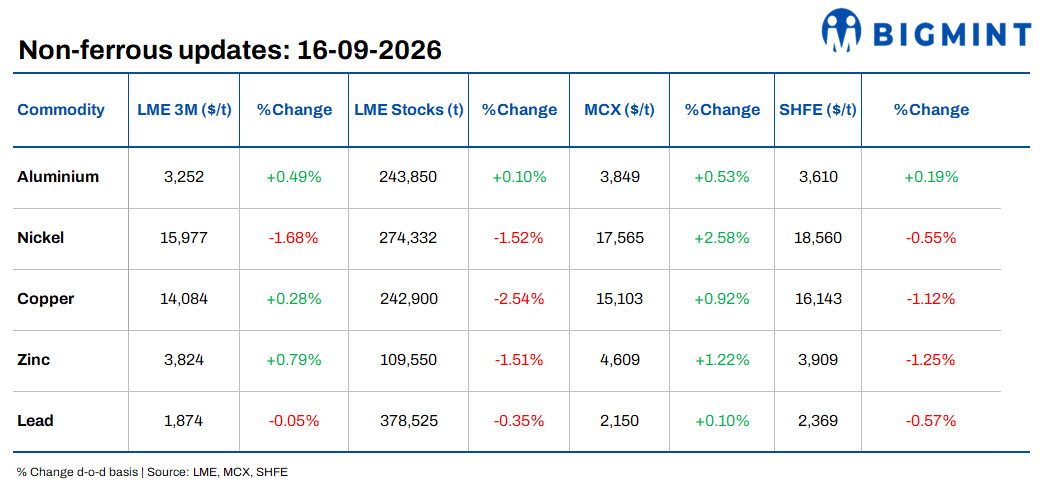
LME base metals traded mixed on 15 September. Nickel recorded the sharpest decline, falling 1.68% d-o-d to $15,977/t. Zinc rose 0.79% to $3,824/t, and aluminium rose by 0.49% to $3,252/t. Meanwhile, copper gained 0.28% to $14,084/t, while lead eased 0.05% to $1,874/t. MCX prices moved higher across all five metals, while SHFE performance remained mixed.
MCX base metals moved higher across the board, supported partly by a weaker rupee, which increased the INR value of dollar-denominated metals. The rupee fell to around INR 95.99/$ on 15 September amid elevated crude prices and expectations of tighter US monetary policy.
LME inventories recorded mixed trends d-o-d, with copper posting the sharpest decline. Copper stocks fell 2.54% to 242,900 t, followed by nickel, down 1.52% to 274,332 t, and zinc, which declined 1.51% to 109,550 t. Lead inventories eased 0.35% to 378,525 t, while aluminium stocks edged higher by 0.10% to 243,850 t.
Domestic market overview
India’s non-ferrous scrap market was largely stable on 15 September, with aluminium prices unchanged while copper scrap moved lower. Aluminium tense scrap (loose) remained unchanged at INR 253,000/t ex-Delhi and INR 250,000/t ex-Chennai. Meanwhile, aluminium P1020 ingot was unchanged at INR 355,000/t. MCX aluminium gained 0.53% d-o-d to $3,849/t, while LME aluminium rose 0.49% to $3,252/t.
Meanwhile, copper armature scrap (Cu 99%), ex-Delhi, declined by INR 8,000/t, or 0.61%, to INR 1,310,000/t from INR 1,318,000/t. MCX copper advanced 0.92% d-o-d to $15,103/t, while LME copper gained 0.28% to $14,084/t. The domestic scrap decline contrasted with firmer international and futures prices reflecting weaker local demand after earlier trades.

Other updates
US crude inventories rise despite Saudi supply concerns
Crude inventories rose by 7.14 million barrels in the week ended 11 September, while Cushing stocks fell by 246,000 barrels. Meanwhile, US oil production climbed to 13.947 million b/d, with Brent and WTI futures at $108.11/bbl and $105.83/bbl, respectively. Higher domestic production drove the overall inventory build, while falling Cushing stocks and Saudi supply disruption concerns continued to support the physical market. The inventory increase could ease energy-cost pressure on aluminium smelters, although Middle East supply risks remain relevant.
China aluminium output reaches record as capacity ceiling looms
China’s primary aluminium output reached a record 3.98 mnt in August, up 4.7% y-o-y, while January-August production rose 3.9% to 31.12 mnt. At the current pace, annualised output could reach about 46.7 mnt, above the government’s 45 mnt capacity ceiling. Strong aluminium margins and elevated prices encouraged smelters to maximise utilisation. Consequently, higher Chinese supply could weigh on aluminium prices in the near term, although potential capacity controls could provide longer-term support.
DRC copper exports reach record in first half of 2026
Copper exports from the Democratic Republic of Congo reached 1.72 mnt in H1 2026, up from 1.65 mnt a year earlier. Meanwhile, the share of exports shipped to the US and Europe doubled from 2025 levels as Kinshasa pursued trade diversification and expanded critical-mineral relationships outside China. The higher export volumes indicate additional copper availability and could ease supply tightness. However, changing trade flows may also influence regional copper premiums and physical market dynamics.
RUSAL nears approval for Indonesian bauxite-to-alumina project
RUSAL is nearing final permits for a bauxite-to-alumina facility in Kalimantan, Indonesia, although the investment value and production capacity remain undisclosed. Meanwhile, Indonesia’s bauxite downstreaming investment rose 193% q-o-q to IDR 40.1 trillion ($2.28 billion) in Q2 2026. The project would diversify RUSAL’s alumina supply base while supporting Indonesia’s push to process minerals domestically. However, its immediate market impact is expected to remain limited until capacity and commissioning timelines are confirmed.
Leave a Reply