- Centinela strike vote raises near-term copper supply risk
- Bell Bay power talks reduce potential aluminium supply disruption
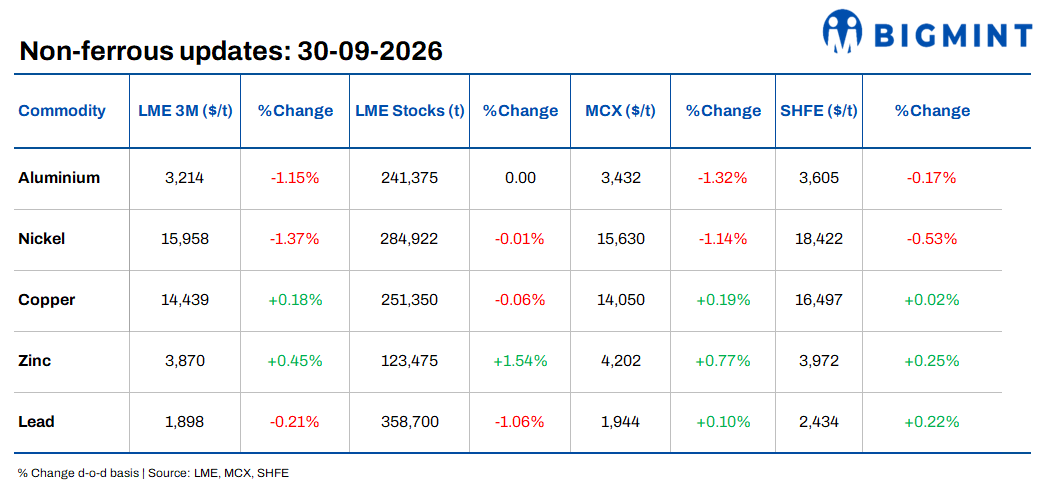
LME base metals traded mixed on 29 September. Nickel recorded the sharpest decline, falling 1.37% d-o-d to $15,958/t, followed by aluminium, down 1.15% to $3,214/t, and lead, which slipped 0.21% to $1,898/t. Meanwhile, zinc gained 0.45% to $3,870/t, while copper edged higher by 0.18% to $14,439/t.
LME inventories recorded mixed trends. Zinc stocks posted the largest movement, rising 1.54% to 123,475 t, while lead inventories declined 1.06% to 358,700 t. Copper stocks fell 0.06% to 251,350 t, nickel stocks eased 0.01% to 284,922 t, while aluminium stocks were unchanged at 241,375 t.
Domestic market overview
India’s non-ferrous scrap market witnessed mixed trends on 29 September.
According to BigMint’s assessments, aluminium tense scrap (loose), ex-Delhi, remained unchanged at INR 247,000/t. Meanwhile, ex-Chennai prices rose by INR 500/t, or 0.20%, to INR 249,000/t from INR 248,500/t. Aluminium P1020 prices were unchanged at INR 353,000/t. On MCX, aluminium prices declined 1.32% to $3,432/t.
Meanwhile, copper armature scrap (Cu 99%) ex-Delhi rose by INR 2,000/t, or 0.15%, to INR 1,339,000/t from INR 1,337,000/t. MCX copper prices also gained 0.19% to $14,050/t amid supply concerns due to USA and China stockpiling.

Other updates
Higher oil prices add cost pressure across base metals
Oil prices rose on 30 September after US President Donald Trump denied reports that Washington was prepared to ease sanctions on Iran. Brent futures reached $103.20/bbl, while WTI stood at $89.38/bbl. Meanwhile, Saudi Arabia had resumed crude loadings at Yanbu after restoring flows through its East-West pipeline, which has a capacity of about 7 million b/d. Middle East oil exports had also recovered to around 15.5 million b/d in September, more than 80% of pre-war levels.
Centinela strike vote raises copper supply-risk premium
Workers at Antofagasta Minerals’ Centinela copper mine in Chile rejected the latest contract offer, with 98.73% voting in favour of a strike and full participation. The two unions represent around 708 workers. However, a five-day mandatory government mediation process has begun, with a possible five-day extension before a legal strike can start. Centinela produced 240,400 t of copper in 2025, making the dispute relevant to concentrate and refined-copper supply availability.
Deutsche Bank highlights potential copper supply-liquidity squeeze
Deutsche Bank expects copper prices to surge 50%, reaching $22,050/t by the second quarter of 2027, citing constrained mine supply, refined-production disruptions and stockpiling by the United States and China. The bank estimates the two countries could collectively account for around 71% of global copper supply by year-end. However, the price target remains a bank forecast. The projected tightening of physical availability could also encourage greater aluminium use in electrical applications.
Bell Bay power agreement could secure Australian aluminium output
Rio Tinto and the Australian and Tasmanian governments are nearing a 10-year electricity agreement for the Bell Bay aluminium smelter. The existing 355 MW arrangement expires at the end of 2026, while negotiations had faced a reported a $60 million annual pricing gap. Bell Bay produces around 190,000 t of aluminium annually. Therefore, a long-term power agreement would reduce the risk of production curtailment and help secure the smelter’s output.
Leave a Reply