- Metals stocks decline highlighting supply tightness
- Russia-Ukraine war provides support to oil prices
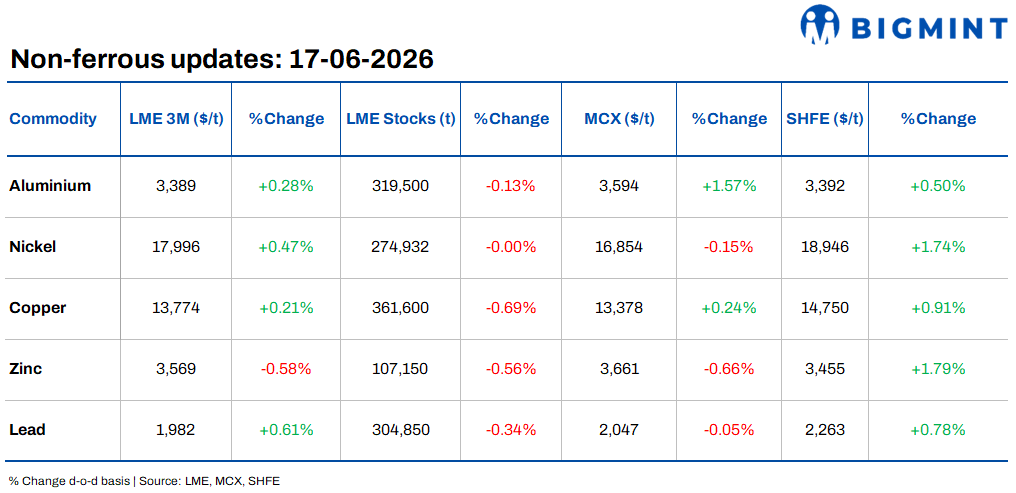
Base metals on the London Metal Exchange (LME) traded mixed on 17 June 2026, with gains in most major non-ferrous metals offset by weakness in zinc. Lead recorded the strongest gain, rising 0.61% d-o-d to $1,982/t, followed by nickel, which increased 0.47% to $17,996/t. Aluminium and copper also edged higher by 0.28% and 0.21% to $3,389/t and $13,774/t, respectively. In contrast, zinc witnessed a decline, falling 0.58% to $3,569/t amid continued profit-booking after recent gains.
On the inventory side, exchange stocks continued to decline across most metals, highlighting persistent supply tightness. Copper inventories registered the sharpest drop, falling 0.69% d-o-d to 361,600 t, followed by zinc stocks, which decreased 0.56% to 107,150 t. Lead and aluminium inventories fell 0.34% and 0.13% to 304,850 t and 319,500 t, respectively, while nickel inventories were largely unchanged at 274,932 t. The continued drawdown in inventories suggests that underlying physical demand remains supportive despite broader market volatility.
Domestic market overview
India’s non-ferrous scrap market remained largely stable on 17 June amid limited movement in domestic aluminium prices and cautious buying activity. Aluminium tense scrap (loose), ex-Delhi, remained unchanged at INR 300,000/t, while ex-Chennai prices were also steady at INR 305,000/t, reflecting balanced market conditions across key regional markets.
Meanwhile, copper armature scrap (Cu 99%), ex-Delhi, declined by INR 6,000/t, or approximately 0.48% d-o-d, to INR 1,254,000/t. The decline tracked softer domestic sentiment despite continued strength in global copper prices and tightening exchange inventories.

Oil prices fall as traders unwind war premium
Global crude oil prices extended their decline on 17 June as markets increasingly priced in the return of Middle Eastern oil supplies following the US-Iran peace agreement. Brent crude fell 5.38% d-o-d to $78.47/bbl, while WTI crude dropped 6.41% to $75.49/bbl, marking their lowest levels since early March. Natural gas prices, however, rose 3.28% to $3.25/MMBtu amid ongoing uncertainty surrounding global LNG supply flows.
Market sentiment remained bearish as traders continued to unwind the geopolitical risk premium following the US-Iran peace agreement and plans to reopen the Strait of Hormuz. Expectations that Persian Gulf crude exports could return to pre-war levels by the end of July, along with Goldman Sachs lowering its Q4 Brent crude forecast to $80/bbl from $90/bbl, added further pressure on prices.
Additional downside pressure came from expectations of higher US crude production, with the US Department of Energy raising its 2026 output forecast to 13.72 million bpd. However, analysts cautioned that supply normalisation may take time, as nearly 600 vessels remain stranded in the Persian Gulf and global inventories have been significantly depleted following months of disruptions.
Continued attacks on Russian energy infrastructure and ongoing sanctions on Russian oil exports also continue to provide underlying support to the market.
Other updates
Goldman cuts oil forecasts on faster Gulf supply recovery
Goldman Sachs has lowered its oil price forecasts after the US-Iran interim agreement increased expectations for a quicker recovery in Persian Gulf oil exports and the reopening of the Strait of Hormuz. Goldman believes Gulf oil exports could return to pre-war levels by late July, supported by the lifting of restrictions on Iranian oil shipments and improving regional supply flows.
However, the bank noted that risks remain, including potential delays in restoring shipping routes and the possibility of renewed geopolitical tensions, while low inventories and continued strategic stockpiling are expected to provide underlying support to oil prices.
China aluminium output, trade growth support sentiment
China’s primary aluminium production increased 1.7% y-o-y to 3.89 million tonnes in May, extending its growth streak to nine consecutive months. Meanwhile, Japan’s exports rose 17% y-o-y, the strongest growth since November 2022, supported by robust overseas demand for automobiles and semiconductors, particularly from China and the United States.
In a separate development, the United States and Iran moved closer to formalizing a peace agreement that would allow Iran to resume oil exports and regain access to frozen assets, while committing to maintain the free flow of trade through the Strait of Hormuz. The agreement is expected to ease geopolitical tensions and improve confidence across global commodity and energy markets.

Leave a Reply