- Aluminium heading towards surplus stocks in 2027
- Japanese aluminium premiums drop sharply for Q4
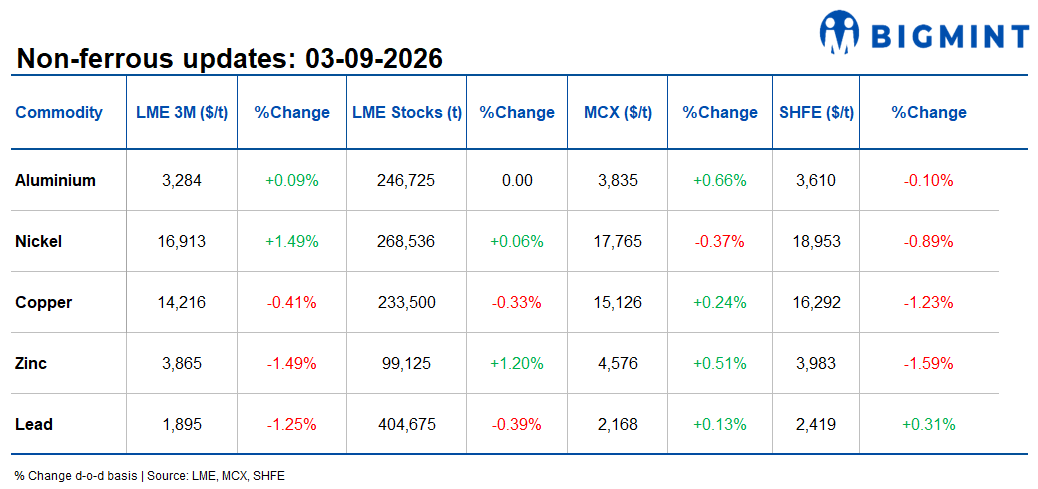
LME base metals traded mixed on 2 September. Nickel recorded the strongest gain, rising 1.49% d-o-d to $16,913/t. Zinc fell 1.49% to $3,865/t. Lead declined 1.25% to $1,895/t, while copper slipped 0.41% to $14,216/t. However, aluminium edged higher by 0.09% to $3,284/t.
LME inventories recorded mixed trends on 2 September. Zinc stocks recorded the steepest gain, rising 1.20% d-o-d to 99,125 t; aluminium was unchanged at 246,725 t, while nickel stocks edged higher by 0.06% to 268,536 t; copper inventories fell 0.33% to 233,500 t and lead stocks declined 0.39% to 404,675 t.
The divergence in price movements suggests that investors are becoming more selective, with supply tightness supporting some metals while concerns over global growth, China’s weak domestic demand and a stronger US dollar are limiting upside across the metals complex.
Domestic market overview
India’s non-ferrous scrap market witnessed mixed trends on 02 September, with aluminium prices stable and copper weakening. Aluminium tense scrap remained unchanged at INR 253,000/t ex-Delhi and INR 247,000/t ex-Chennai.
Meanwhile, copper armature scrap (Cu 99%) declined by INR 5,000/t, or 0.4%, to INR 1,300,000/t ex-Delhi from INR 1,305,000/t. The decline broadly tracked the softer LME copper market, where prices fell 0.41% d-o-d.

Other updates
Oil prices ease as US-Iran uncertainty persists
Brent crude slipped to $94.32/bbl and WTI to $90.63/bbl as markets weighed renewed US-Iran strikes against signs that the latest escalation could ease. Oil remains supported by potential supply disruptions through the Strait of Hormuz; however, the absence of confirmed new attacks and continued flows through the waterway eased pressure. Iraq also raised exports to 2.34 million bpd in August from 1.35 million bpd in July. Higher energy costs could support metals production costs, while weaker industrial demand presents a countervailing risk.
Aluminium market seen moving into surplus from 2027
CRU expects the global aluminium market to shift from a deficit of slightly under 500,000 t in 2026 to a substantial surplus in 2027–28. The current deficit reflects Middle Eastern smelter disruptions and shipping problems around the Strait of Hormuz. However, recovering Middle Eastern production and new capacity in China and Indonesia are expected to lift supply faster than demand. Consequently, the outlook could cap aluminium prices from 2027, although tight availability may continue supporting prices in the near term.
LME zinc hits 4-year high amid severe supply squeeze
LME zinc climbed to around $3,990/t, its highest level in four years, as falling mine supply and depleted Western inventories tightened the physical market. Global zinc mine output declined 2.6% y-o-y in H1 2026, while lower ore grades and mine disruptions reduced concentrate availability. Meanwhile, treatment charges have fallen to record lows, highlighting intense competition among smelters for feedstock. Continued concentrate shortages and low inventories could keep zinc prices elevated, particularly in Western markets.
Japanese Q4 aluminium premiums offered 18-22% lower
Major aluminium producers offered Japanese buyers Q4 premiums of $310–325/t, down from $395/t in Q3, while buyers are targeting levels below $300/t. Producers see improving prospects for Middle Eastern output, softer European premiums and rising Indonesian shipments. However, Japanese inventories remain low at 201,000 t, while semiconductor-related demand continues to provide support. Therefore, lower premiums indicate easing physical tightness, although low inventories and geopolitical shipping risks could limit downside pressure in the near term.
NLC India gets Telangana licences for two critical mineral blocks
NLC India received LoIs on 31 August for composite licences covering the Govindpur and Parvathapur critical mineral blocks in Telangana’s Sangareddy district. The blocks hold combined resources of 53.14 mt of vanadium, 91.51 mt of titanium and 154 mt of aluminous laterite. GSI exploration found vanadium concentrations of up to 2,023–2,876 ppm. The licences support India’s efforts to reduce import dependence. Over the medium to long term, the resources could support energy storage, aerospace, defence and aluminium industries. However, base-metal price impact should remain limited until commercial production begins.
Leave a Reply