- China’s copper refining expansion faces tighter feedstock availability
- NALCO partners with EGA on 0.5 MnTPA aluminium expansion
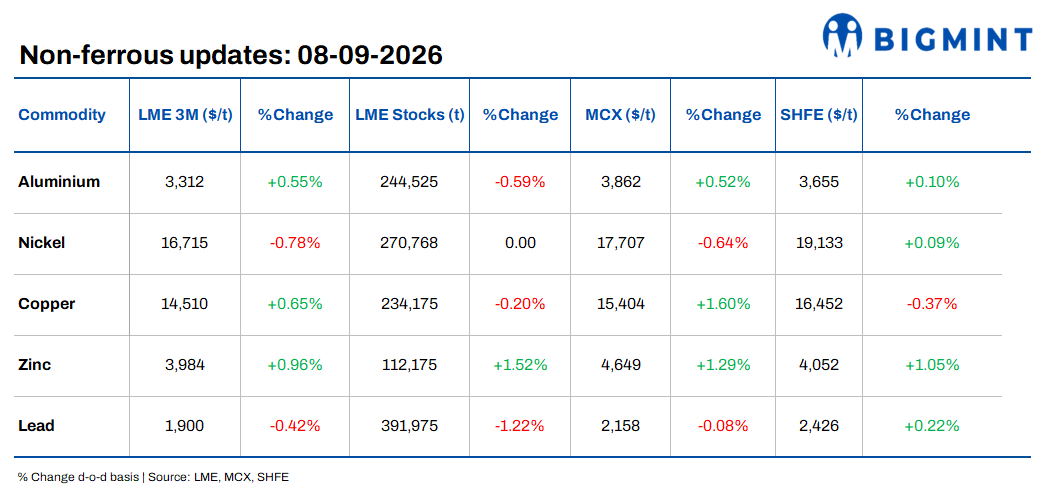
LME base metals traded mixed on 7 September. Zinc recorded the strongest gain, rising 0.96% d-o-d to $3,984/t, followed by nickel, which fell 0.78% to $16,715/t, and copper, which advanced 0.65% to $14,510/t. Meanwhile, aluminium edged higher by 0.55% to $3,312/t, while lead slipped 0.42% to $1,900/t.
LME inventories recorded mixed trends. Zinc stocks posted the sharpest rise, gaining 1.52% d-o-d to 112,175 t, while lead inventories declined 1.22% to 391,975 t, aluminium stocks fell 0.59% to 244,525 t and copper inventories eased 0.20% to 234,175 t; nickel stocks were unchanged at 270,768 t.
Domestic market overview
India’s non-ferrous scrap market remained largely stable d-o-d, as subdued downstream demand offset higher replacement costs and supply-side constraints. Aluminium tense scrap (loose) remained unchanged at INR 253,000/t ex-Delhi and INR 247,000/t ex-Chennai. Meanwhile, copper armature scrap (Cu 99%) held at INR 1,306,000/t.
Domestic buying remained cautious amid weaker manufacturing momentum. At the same time, elevated global and domestic metal prices continued to limit aggressive downstream buying. MCX aluminium rose 0.52% to INR 351,100/t, while MCX copper gained 1.60% to INR 1,400,400/t. The higher metal prices increased replacement costs, but also constrained buying interest, keeping scrap prices unchanged.
In the primary aluminium market, P1020 aluminium ingot, ex-Delhi NCR, rose INR 3,000/t, or 0.9%, to INR 354,000/t from INR 351,000/t. However, import-dependent scrap availability and a weaker rupee provided a floor to domestic offers. Seasonal caution during the monsoon period also kept construction-related demand measured.

Other updates
Middle East conflict pushes oil toward $100/bbl
Brent crude rose 1.6% to $98.54/bbl on 8 September, while WTI reached $92.5/bbl intraday as the US-Iran conflict raised concerns over prolonged Gulf supply disruptions. ANZ expects regional throughput to return to pre-war levels only by late Q1 or early Q2 2027. Meanwhile, Goldman Sachs raised its December 2026 Brent forecast to $85/bbl.
Jiangxi Copper plans 300,000 t/y refined copper expansion
Jiangxi Copper’s Hongyuan smelter is moving toward a further 300,000 t/y capacity expansion, lifting total capacity to 550,000 t/y. The project will depend on copper anodes as concentrate and scrap availability remains tight. Consequently, the additional capacity may not translate into an equivalent rise in refined copper output. The expansion could instead intensify competition for feedstock and place further pressure on treatment and refining charges and smelter margins.
NALCO partners with EGA for 0.5 MnTPA aluminium expansion
NALCO has signed an agreement with Emirates Global Aluminium to deploy EGA’s DX+ Ultra smelting technology at its planned 0.5 MnTPA brownfield expansion in Anugula, Odisha. The technology is aimed at improving productivity and energy efficiency. Once commissioned, NALCO expects its overall aluminium production capacity to approach 1 MnTPA. The project should strengthen India’s domestic supply base over the longer term, while higher-efficiency technology could help offset elevated energy costs.
China’s auto exports surge while domestic sales weaken
China’s passenger-vehicle exports jumped 77.5% year on year to a record 894,000 units in August, while domestic sales fell 23.7% to 1.55 million units, marking the 11th consecutive monthly decline. EV and plug-in hybrid vehicles accounted for 64.7% of domestic sales, although those sales still declined 10.1% year on year. Meanwhile, EV exports accelerated 154.7%. The divergence points to stronger external demand offsetting weaker domestic vehicle consumption, with implications for metals used in automotive manufacturing.
Leave a Reply