- Copper leads LME declines as stocks fall sharply
- Oil prices rise as US-Iran talks remain stalled
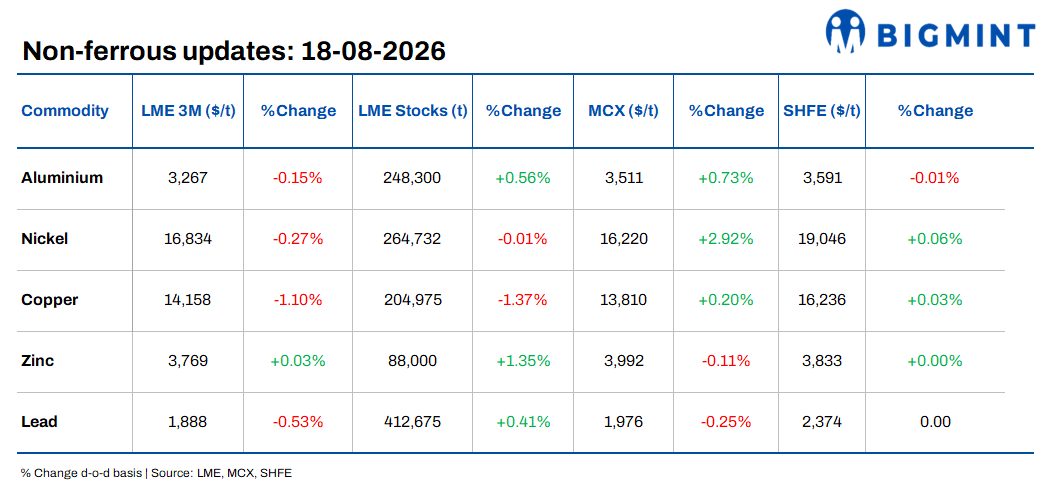
LME base metals traded mixed on 17 August. Copper recorded the sharpest decline, falling 1.10% d-o-d to $14,158/t, followed by lead, down 0.53% to $1,888/t, and nickel, which slipped 0.27% to $16,834/t. Meanwhile, aluminium eased 0.15% to $3,267/t, while zinc edged higher by 0.03% to $3,769/t.
LME inventories recorded mixed trends on 17 August. Zinc stocks posted the strongest gain, rising 1.35% d-o-d to 88,000 t, followed by aluminium, up 0.56% to 248,300 t, and lead, which gained 0.41% to 412,675 t. Copper stocks fell 1.37% to 204,975 t, while nickel inventories edged lower by 0.01% to 264,732 t.
Domestic market overview
India’s non-ferrous scrap market witnessed higher prices across grades on 17 August. Aluminium tense scrap (loose), ex-Delhi, rose by INR 2,000/t (0.8%) d-o-d to INR 247,000/t. Meanwhile, ex-Chennai prices gained INR 5,000/t (2.1%) to INR 245,000/t. The Chennai market recorded the sharpest regional increase during the period.
Meanwhile, copper scrap prices increased by INR 15,000/t (1.2%) to INR 1,300,000/t. The domestic copper move came despite a 1.10% decline in LME copper prices, indicating firmer domestic scrap pricing during the session.

Other updates
Oil prices rise as US-Iran talks remain stalled
Oil prices rose on 17 August as stalled US-Iran talks and sharply reduced shipping through the Strait of Hormuz raised supply concerns. Brent crude settled at $90.87/bbl, while WTI ended at $84.50/bbl. Only five commodity vessels transited the strait on Saturday and none on Sunday, compared with 31 the previous weekend. Higher energy costs remain relevant for aluminium, given the metal’s electricity-intensive smelting process and ongoing disruption to Gulf supply. However, weaker industrial demand from higher fuel costs and inflation could offset some of the supply-side support, leaving the impact on base metals mixed.
LME aluminium stocks remain largely Russian-origin
Around 95% of on-warrant aluminium stocks outside China are reportedly of Russian origin, limiting the volume readily accessible to Western consumers despite headline LME inventories of 248,300 t. At the same time, aluminium production outside China is heading for a second consecutive quarterly decline, while LME backwardation has returned. Consequently, physical availability in Western markets remains a key focus, with the composition of exchange stocks carrying greater significance than headline inventory levels alone.
China cushions aluminium supply disruption
China is increasingly supplying Western markets following disruptions to Gulf aluminium production. Strong domestic output and weaker local demand have encouraged exports of aluminium alloys and semi-finished products, while the country’s export-tax structure makes these products more competitive than primary aluminium. As a result, Chinese shipments are helping ease physical shortages in Western markets. However, greater reliance on Chinese capacity could raise trade concerns and increase pressure on Western fabrication activity.
China copper output faces feedstock constraints
China’s August refined copper production is expected to decline y-o-y for a second consecutive month as shortages of copper concentrate and other feedstocks constrain smelter operating rates. Lower refined output could tighten the global copper balance if concentrate availability remains restricted. Meanwhile, the supply constraint comes against a 1.10% decline in LME copper prices on 17 August. The development therefore adds a supply-side factor to the copper market even as exchange prices remain under pressure.
Global markets: Iran tensions, bonds and inflation
Global markets remain focused on Iran-related geopolitical tensions, higher oil prices, elevated bond yields and inflation risks. Meanwhile, changing expectations for monetary policy are adding to uncertainty across financial markets. Higher oil prices could raise production costs for energy-intensive metals, including aluminium. However, elevated yields and persistent inflation could tighten financial conditions and weaken industrial demand. Consequently, the macroeconomic backdrop remains mixed for base metals, with supply-side cost pressures offset by potential demand headwinds.
Leave a Reply