- US-Iran deal sparks hope of improved oil flows
- China’s aluminium exports rise 9% y-o-y in Jan-Apr
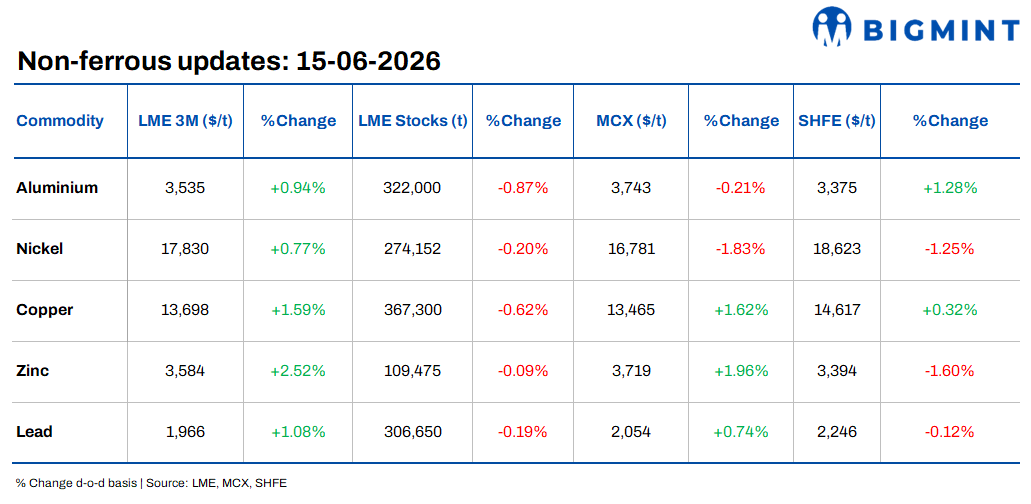
Base metals on the London Metal Exchange (LME) traded higher on 12 June 2026, supported by improving market sentiment and continued supply tightness. Zinc recorded the strongest gain among major non-ferrous metals, rising 2.52% d-o-d to $3,584/t, followed by copper, which increased 1.59% to $13,698/t. Copper was supported by persistent concerns over global supply deficits and disruptions across key producing regions. Lead gained 1.08% to $1,966/t, while aluminium and nickel advanced 0.94% and 0.77% to $3,535/t and $17,830/t, respectively.
On the inventory side, all major metals registered declines, underscoring ongoing supply constraints. Aluminium stocks fell 0.87% d-o-d to 322,000 t, while copper inventories declined 0.62% to 367,300 t. Nickel stocks dropped 0.20% to 274,152 t, followed by lead and zinc inventories, which decreased 0.19% and 0.09% to 306,650 t and 109,475 t, respectively. The continued drawdown in exchange inventories reflects resilient physical demand and reinforces expectations of a tight global metals market.
Domestic market overview
India’s non-ferrous scrap market remained largely stable d-o-d amid steady domestic demand and limited movement in benchmark aluminium prices. Aluminium tense scrap (loose), ex-Delhi, remained unchanged at INR 301,000/t, while ex-Chennai prices were also steady at INR 305,000/t, indicating balanced market fundamentals across key regional markets.
Meanwhile, copper armature scrap (Cu 99%), ex-Delhi, increased by INR 13,000/t, or around 1.0% d-o-d, to INR 1,260,000/t. The rise was supported by firmer copper prices and continued concerns over tightening global copper supplies.

Oil prices tumble on Hormuz reopening hopes
Global crude oil prices declined sharply on 15 June 2026 as prospects of a diplomatic agreement between the US and Iran raised expectations of the reopening of the Strait of Hormuz. Brent Crude fell 6.22% d-o-d to $83.24/bbl, while WTI crude dropped 6.59% to $80.55/bbl. Natural gas prices also eased 0.52% to $3.06/MMBtu as traders unwound geopolitical risk premiums built into energy markets during the conflict.
Market sentiment weakened after reports of a US-Iran framework agreement raised expectations for the reopening of the Strait of Hormuz, which handles around 20% of global oil and LNG trade. Despite optimism over the resumption of oil flows, supply normalisation is expected to take time. Industry estimates suggest that clearing shipping routes and reducing tanker backlogs could take anywhere from a few weeks to six months.
Market participants also noted that oil flows may need to recover to only 60-70% of pre-war levels for global markets to return to an oversupply scenario, helping explain the sharp unwinding of geopolitical risk premiums in crude prices.
Indian bonds rally as oil prices tumble
Indian government bonds strengthened on 15 June as easing crude oil prices following the preliminary US-Iran peace agreement boosted market sentiment. The benchmark 10-year government bond yield fell 3.2 basis points to 6.86%, its lowest level in nearly 12 weeks, while the Indian rupee traded near a five-week high at 94.58 per US dollar.
The sharp decline in crude prices is viewed as positive for India, helping ease concerns over inflation, the trade deficit, and currency stability. Market participants also expect improved foreign portfolio inflows into government securities.
Strong exports support Chinese aluminium sector
China’s aluminium industry continued to benefit from strong export demand and improving profitability. Exports of unwrought aluminium and aluminium products reached 2.05 mnt during January-April 2026, up 8.9% y-o-y, while April exports hit a multi-month high of 598,000 t, rising 15.4% y-o-y.
Lower alumina and power costs helped lift average domestic aluminium profits to $1,245/t in May, while demand from electric vehicles, energy storage, photovoltaics, and overseas infrastructure projects remained supportive of high operating rates and strong industry margins.

Leave a Reply