- China copper output declines as concentrate shortages deepen
- Iran blockade threat keeps oil prices supported
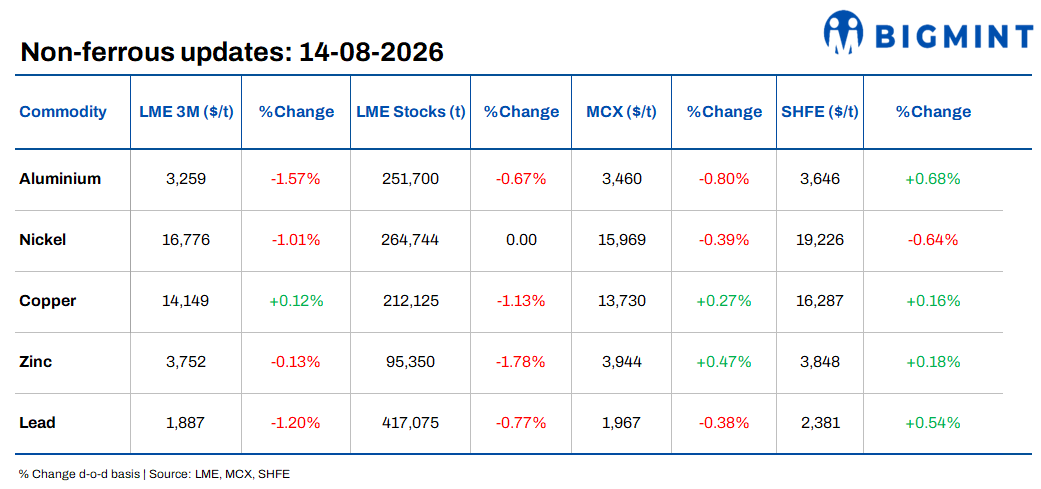
LME base metals traded mixed on 13 August. Zinc recorded the sharpest decline, falling 1.78% d-o-d to $3,752/t. Aluminium followed, down 1.57% to $3,259/t. Lead slipped 1.20% to $1,887/t, while nickel eased 1.01% to $16,776/t. Meanwhile, copper edged higher by 0.12% to $14,149/t.
LME inventories recorded mixed trends, with most metals declining. Zinc stocks posted the steepest fall, down 1.78% d-o-d to 95,350 t. Copper stocks fell 1.13% to 212,125 t. Lead inventories declined 0.77% to 417,075 t, while aluminium stocks slipped 0.67% to 251,700 t. Nickel inventories were unchanged at 264,744 t.
Domestic market overview
India’s non-ferrous scrap market witnessed mixed trends on 13 August.Aluminium tense scrap remained unchanged at INR 245,000/t ex-Delhi. Ex-Chennai prices also held steady at INR 240,000/t.
Meanwhile, copper armature scrap (Cu 99%), ex-Delhi, declined by INR 4,000/t, or 0.31% d-o-d, to INR 1,284,000/t. The previous price was INR 1,288,000/t. However, LME copper edged higher by 0.12% during the session.

Other updates
LME aluminium inventories approach a 36-year low
LME aluminium stocks have fallen to around 250,000 t. That is roughly half their level at the start of 2026. It is also the lowest level since 1990. Supply-chain disruption linked to the Iran conflict has contributed to the decline. Meanwhile, Gulf aluminium production has reportedly fallen by around 2 million t/year. Much of the remaining LME stock is Russian aluminium. This limits availability for some Western buyers. Asian physical premiums have reached $350-$353/t, signalling tighter nearby supply.
China copper output set to decline amid concentrate shortage
China’s refined copper output is expected to fall 2.83% year on year in August. Output is forecast at about 1.05 million t. July output also stood near 1.05 mnt, down 3.18% year on year. The decline reflects a worsening copper concentrate shortage. Moreover, treatment and refining charges have stayed negative for 19 months. Imported concentrate charges reached a record -$175.7/t on 7 August. Consequently, Chinese smelters are reducing utilisation as raw-material supplies tighten.
Iran blockade threat keeps oil prices supported
The US has threatened to maintain a naval blockade of Iran indefinitely. Ceasefire negotiations have stalled. As a result, risks around the Strait of Hormuz remain elevated. Brent crude was around $87.76/bbl on 14 August, 12 AM UTC. WTI stood at $81.37/bbl. However, weaker demand forecasts from the IEA and OPEC have limited oil’s upside. Higher US crude inventories have also weighed on prices. For non-ferrous metals, prolonged Gulf disruption could raise energy, shipping and insurance costs.
Indonesia nickel processors trim output as sulphur supply tightens
Several Indonesian nickel processors have reportedly reduced battery-feed production. The move follows a sulphur shortage linked to Iran war disruptions. Sulphur is an important input for the high-pressure acid leach process. That process produces nickel intermediates for the battery industry. Meanwhile, prolonged Strait of Hormuz disruption has pushed sulphur prices higher. This has added cost pressure for Indonesian processors. The development could also tighten near-term nickel intermediate supply and provide support to nickel prices.
Leave a Reply