- EGA diversifies aluminium exports as Hormuz disruption continues
- Bell Bay funding preserves Australian aluminium supply
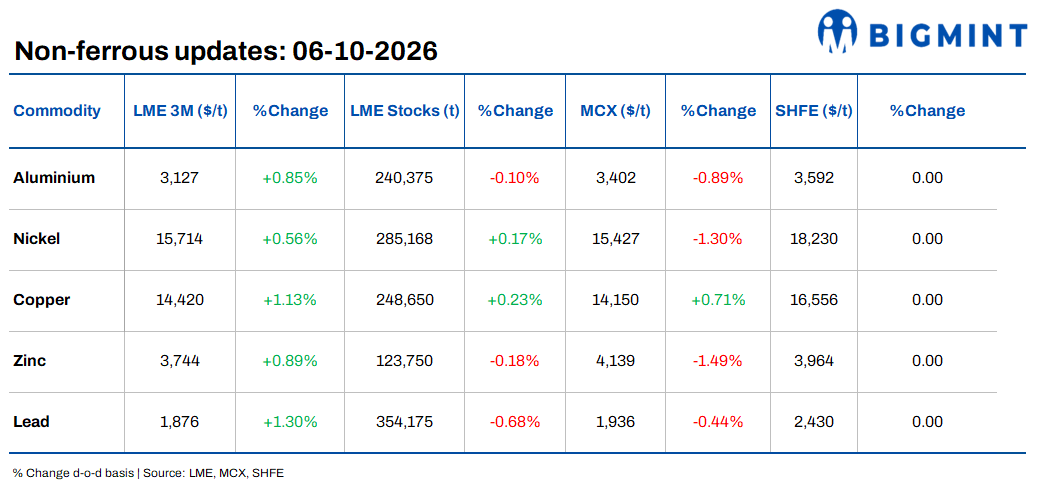
LME base metals traded higher on 5 October. Lead recorded the sharpest gain, rising 1.30% d-o-d to $1,876/t, followed by copper, up 1.13% to $14,420/t, and zinc, which advanced 0.89% to $3,744/t. Meanwhile, aluminium gained 0.85% to $3,127/t, while nickel edged higher by 0.56% to $15,714/t.
The broad-based advance came as markets reduced expectations of a US Federal Reserve rate hike in October following weaker US employment data. Consequently, improved risk appetite and gains in global equities supported growth-sensitive industrial metals. Oil prices also eased on 5 October as Middle East exports increased and the G7 pledged additional supplies, reducing some pressure on the broader macro backdrop.
LME inventories recorded mixed trends. Lead stocks posted the largest move, declining 0.68% to 354,175 t, while copper stocks rose 0.23% to 248,650 t and nickel inventories gained 0.17% to 285,168 t; zinc stocks fell 0.18% to 123,750 t and aluminium declined 0.10% to 240,375 t.
Domestic market overview
India’s non-ferrous scrap market witnessed mixed movement on 5 October. Aluminium scrap prices declined across the reported grades, while copper armature scrap also moved lower. Domestic d-o-d prices showed weaker pricing despite the international advance.
Aluminium tense scrap (loose), ex-Delhi, declined by INR 1,000/t (0.4%) d-o-d to INR 244,000/t from INR 245,000/t. Similarly, ex-Chennai prices fell by INR 1,000/t (0.4%) to INR 246,000/t from INR 247,000/t. Aluminium P1020 also eased by INR 1,000/t (0.3%) to INR 344,000/t from INR 345,000/t. While MCX aluminium declined 0.89% to $3,402/t.
Meanwhile, copper armature scrap (Cu 99%) declined by INR 7,000/t (0.5%) d-o-d to INR 1,343,000/t from INR 1,350,000/t. MCX copper, however, rose 0.71% to $14,150/t. The divergence indicates that the domestic scrap market remained softer than international futures, despite firmer overseas copper prices.

Other updates
Middle East tensions keep energy costs elevated
Brent crude rose 0.3% to $100.69/bbl on 6 October, while WTI gained 0.3% to $89.73/bbl. Meanwhile, Middle East crude exports excluding Iran recovered to more than 81% of pre-war levels in September, supported by higher Saudi exports through Gulf and Red Sea routes and renewed Iraqi shipments through the Strait of Hormuz. However, tanker attacks and elevated security risks continue to disrupt shipping, keeping freight and insurance costs high.
EGA shifts aluminium exports away from Strait of Hormuz
Emirates Global Aluminium has agreed with Gulftainer to route up to 250,000 t of aluminium through Khorfakkan on the UAE’s East Coast in the first year, rising to 300,000 t in the second year. The move follows disruption around the Strait of Hormuz and EGA’s earlier suspension of outbound shipments. Alternative routes have already helped reduce accumulated UAE inventories. Consequently, the development should improve export reliability and reduce the risk of regional aluminium shortages.
Mexico-US tariff talks could reshape aluminium trade flows
Mexico and the US are discussing an interim trade arrangement that could reduce tariff pressure on Mexican exports. However, the reported 4–5% effective rate relates to automotive tariffs and does not confirm a reduction in the 50% Section 232 treatment for Mexican aluminium. A successful agreement could improve Mexican producers’ competitiveness in the US market and alter North American aluminium trade flows.
Bell Bay support prevents potential aluminium supply loss
Australia’s federal and Tasmanian governments have agreed to provide $200 million over five years to support Rio Tinto’s Bell Bay aluminium smelter. The facility produces around 190,000 t/year and accounts for a significant share of Tasmania’s aluminium output. The support addresses high electricity costs and aims to maintain domestic production.
Leave a Reply