- EGA restarts half of Al Taweelah smelter as recovery advances
- Middle East tensions lift oil prices amid fresh supply concerns
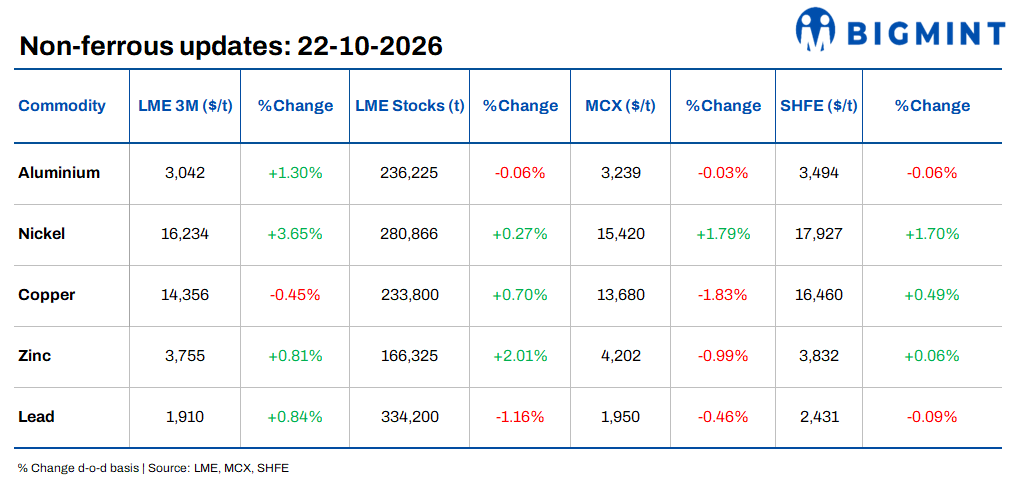
LME base metals traded mixed on 21 October, Nickel recorded the strongest gain, rising 3.65% d-o-d to $16,234/t, followed by aluminium, up 1.30% to $3,042/t. Lead gained 0.84% to $1,910/t, while zinc advanced 0.81% to $3,755/t. Copper was the only decliner, slipping 0.45% to $14,356/t.
LME inventories also recorded mixed movements. Zinc stocks posted the largest percentage change, rising 2.01% to 166,325 t, while lead inventories declined 1.16% to 334,200 t. Copper stocks increased 0.70% to 233,800 t, followed by nickel, up 0.27% to 280,866 t. Aluminium inventories edged down 0.06% to 236,225 t.
Domestic market overview
India’s non-ferrous market showed mixed trends d-o-d, with aluminium scrap prices unchanged, while aluminium ingot and copper armature scrap prices declined.
Aluminium tense scrap (loose) remained unchanged at INR 239,000/t ex-Delhi and INR 243,000/t ex-Chennai. P1020 aluminium ingot fell by INR 2,000/t, or 0.61%, to INR 327,500/t from INR 329,500/t. MCX aluminium edged down 0.03% to INR 3,239/kg.
Meanwhile, copper armature scrap (Cu 99%) declined by INR 10,000/t, or 0.75%, to INR 1,325,000/t from INR 1,335,000/t. MCX copper fell 1.83% to INR 13,680/kg.

Other updates
Middle East tensions lift oil prices amid shipping risks
Brent crude rose 2.2% to $111.3/barrel on 22 October as attacks in Saudi Arabia and a US order for some diplomats and their families to leave heightened regional security concerns. Meanwhile, threats to maritime traffic raised concerns over crude shipments. Additionally, US crude inventories fell by 3.06 million barrels, although distillate stocks increased. Consequently, oil markets remained focused on potential supply disruptions and evolving inventory trends.
EGA restarts half of Al Taweelah smelter
Emirates Global Aluminium (EGA) restarted 631 of the 1,262 reduction cells at its Al Taweelah smelter in Abu Dhabi on 21 October, restoring 50% of its cells. The facility shut down on 28 March following an attack on Khalifa Economic Zone Abu Dhabi. Meanwhile, EGA expects full production to resume in Q1 2027. The smelter produced approximately 1.6 mnt of cast metal in 2025. Therefore, the gradual restart should improve regional primary aluminium availability, although restored cells require time to stabilise.
EU carbon rules reshape aluminium import economics
The European Union’s Carbon Border Adjustment Mechanism (CBAM) is increasing the focus on emissions reporting and carbon-related costs for aluminium imports. The European Commission set the Q3 2026 CBAM certificate price at EUR 82.32/t of CO₂ equivalent, up from EUR 75.28/t in Q2. Under the mechanism, importers must account for embedded emissions, while verified producer-level data can help determine their liabilities. Consequently, rising certificate prices could increase landed costs and influence sourcing decisions, potentially widening regional aluminium premium differentials.
First Quantum’s Kansanshi mine targets higher ore processing
First Quantum Minerals expects its expanded Kansanshi copper mine in Zambia to process approximately 27 mnt of ore in 2026, exceeding the new processing line’s annual design capacity of 25 mnt by 8%. The $1.2 billion S3 expansion was commissioned in August 2025 and is expected to double annual copper output to approximately 277,000 t. The company cited equipment availability, utilisation and milling efficiency for the stronger throughput. Higher processing volumes support the production outlook.
Vidya Metal expands aluminium winding wire capacity
India’s Vidya Metal Manufacturing Company has expanded its installed capacity for super-enamelled aluminium winding wires and strips to 25,000 t/y from 18,000 t in early 2025. The increase followed commissioning of a new facility at Bandapur, Rajasthan. The company also produces approximately 12,000 t/y of copper products across seven plants. The expansion serves transformer, motor, inverter and switchgear manufacturers. It highlights aluminium’s growing role in selected electrical applications, where manufacturers assess material costs alongside conductivity and engineering requirements.
Leave a Reply