- Chinese smelters reject Antofagasta’s spot pricing proposal
- India opposes EU aluminium scrap export restrictions
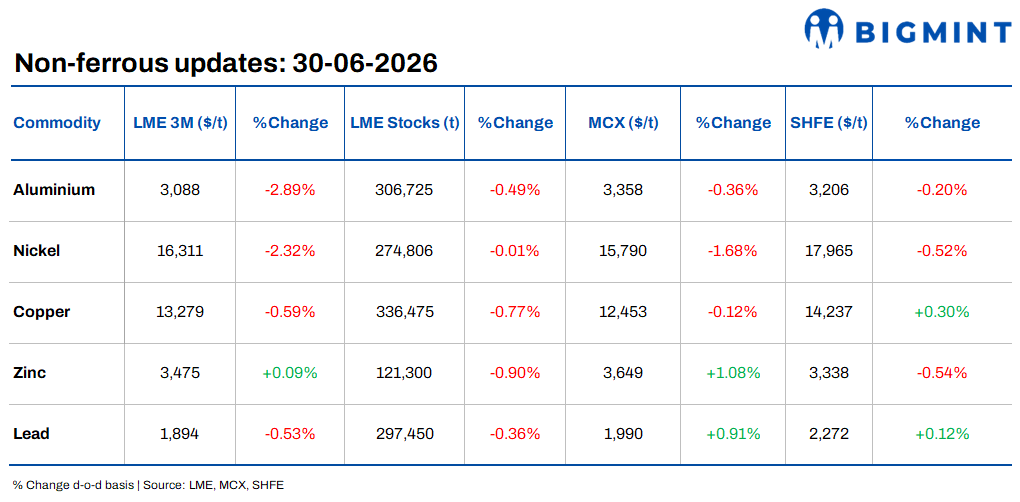
Base metals on the London Metal Exchange (LME) traded mostly lower on 29 June 2026, with aluminium leading declines with fall of 2.89% d-o-d to $3,088/t, followed by nickel, which declined 2.32% to $16,311/t. Copper also eased 0.59% to $13,279/t, while lead slipped 0.53% to $1,894/t. Zinc was the only gainer, edging up 0.09% to $3,475/t. The decline was driven by uncertainty surrounding the management of the Strait of Hormuz and a stronger US dollar, although continued inventory drawdowns provided underlying support to the market.
On the inventory side, stocks continued to decline across all major base metals. Zinc inventories recorded the largest fall, declining 0.90% d-o-d to 121,300 t, followed by copper inventories, which dropped 0.77% to 336,475 t. Aluminium stocks decreased 0.49% to 306,725 t, while lead and nickel inventories slipped 0.36% and 0.01% to 297,450 t and 274,806 t, respectively. The continued decline in copper and aluminium inventories suggests that physical demand remains supportive despite recent price volatility.
Domestic market overview
India’s non-ferrous scrap market remained mixed on 29 June. Aluminium tense scrap (loose), ex-Delhi, remained unchanged at INR 280,000/t, while ex-Chennai prices declined by INR 3,000/t, or 1.03% d-o-d, to INR 287,000/t amid weaker global aluminium prices.
Meanwhile, copper armature scrap (Cu 99%), ex-Delhi, increased by INR 4,000/t, or 0.33% d-o-d, to INR 1,200,000/t, supported by stable domestic demand despite weakness in LME copper prices.

Oil prices remain volatile as Hormuz risks persist
Global crude oil prices were mixed on 30 June 2026, with WTI crude rising 0.29% d-o-d to $70.24/bbl, while Brent crude slipped 0.12% to $72.41/bbl. Natural gas declined 3.76% to $3.17/MMBtu, while the US dollar index eased 0.05% to 101.32.
Market sentiment remained cautious despite oil prices retreating to near pre-war levels following the US-Iran ceasefire. Analysts warned that markets may be overly optimistic about a rapid recovery in global oil flows, as shipping through the Strait of Hormuz remains well below normal. Many shipping companies continue to avoid the route due to uncertainty over the peace agreement, concerns over sea mines and elevated war-risk insurance premiums.
Although vessel traffic has improved, industry experts noted that conditions remain far from pre-conflict levels, suggesting supply-side risks persist and could continue to support crude prices. Brent crude was trading near $72.45/bbl, well below its wartime peak of over $188/bbl recorded in late April, reflecting the removal of much of the geopolitical risk premium while leaving the market vulnerable to renewed disruptions.
Other updates
Chinese smelters reject Antofagasta’s spot pricing proposal
Chinese copper smelters have rejected Antofagasta’s proposal to replace annual benchmark treatment and refining charges (TC/RCs) with a spot index pricing mechanism, citing concerns over increased price volatility and reduced cost visibility. The decision comes as the copper concentrate market remains exceptionally tight, with annual benchmark TC/RCs already falling to $0/t and 0 cents/lb in 2026, while spot treatment charges remain deeply negative.
Chinese smelters continue to face pressure from raw material shortages despite refined copper output rising 8% y-o-y in 2025, as mine supply has failed to keep pace with expanding smelting capacity. Market participants expect benchmark pricing to remain in place for now, although widening divergence between annual contracts and spot market conditions continues to fuel calls for pricing reforms.
India seeks exemption from EU scrap export curbs
India has urged the European Union to exempt it from proposed metal scrap export restrictions, warning that the measures could disrupt raw material supplies for domestic steel and non-ferrous industries. Under the revised EU waste shipment regulation, exports of non-hazardous scrap to non-OECD countries will be restricted from May 2027, unless approved by November 2026.
India imported around 366,000 t of aluminium scrap from the EU in 2025, making it the bloc’s largest buyer in Q1 2026. Meanwhile, EU aluminium scrap exports reached a record 1.27 million t in 2025, about 50% higher than 2019 levels. Industry bodies have warned that the proposed curbs, coupled with the UAE’s recent export ban, could tighten global scrap availability and raise procurement costs for Indian recyclers.
Hindustan Zinc targets critical minerals expansion
Hindustan Zinc plans to add at least three new metals over the next five years as part of its critical mineral’s strategy. The company has secured blocks for tungsten, potash and rare earth elements and is evaluating copper and gold opportunities. It is also investing ₹40,000-45,000 crore to double its annual metal production capacity to 2 million tonnes, positioning itself as a key supplier of critical minerals for sectors including electric vehicles, renewable energy and advanced manufacturing.

Leave a Reply