- Q2 aluminium shipments up 17%; alumina trade down 4%.
- Global oil inventories remain at five-year lows
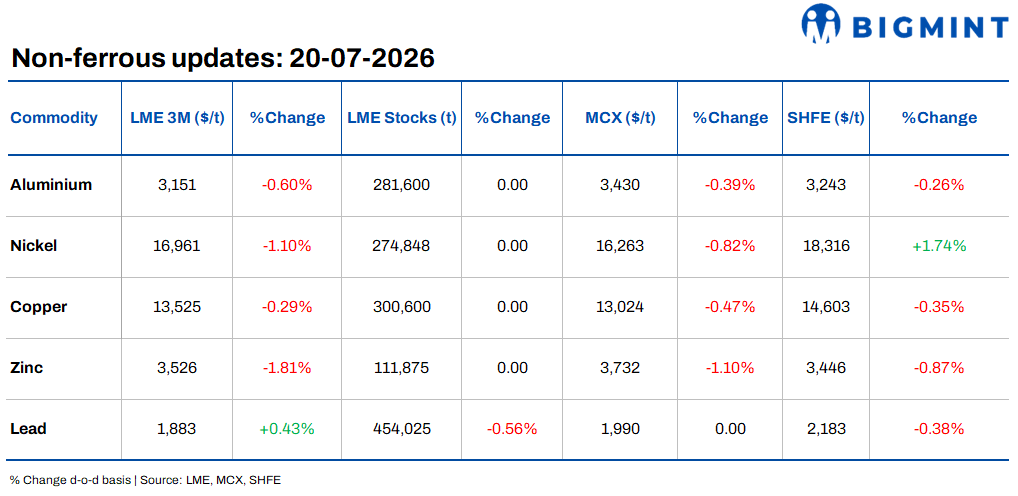
Base metals on the London Metal Exchange (LME) traded mostly lower on 17 July 2026, pressured by cautious sentiment despite elevated geopolitical risks. Zinc posted the steepest decline, falling 1.81% d-o-d to $3,526/t, followed by nickel, down 1.10% to $16,961/t, aluminium, which slipped 0.60% to $3,151/t, and copper, down 0.29% to $13,525/t. Lead was the only gainer, rising 0.43% to $1,883/t, supported by tighter inventories.
LME inventories were largely unchanged across major base metals. Copper stocks remained steady at 300,600 t, while aluminium inventories were unchanged at 281,600 t and nickel inventories held at 274,848 t. Zinc stocks also remained stable at 111,875 t, whereas lead inventories declined 0.56% d-o-d to 454,025 t, indicating a slight tightening in available supplies following last week’s sharp stock build.
Domestic market overview
India’s non-ferrous scrap market remained largely stable on 17 July. Aluminium tense scrap (loose), ex-Delhi, remained unchanged at INR 265,000/t, while ex-Chennai prices were also steady at INR 255,000/t.
Meanwhile, copper armature scrap (Cu 99%), ex-Delhi, declined by INR 6,000/t, or 0.48% d-o-d, to INR 1,234,000/t, tracking weaker international copper prices despite stable domestic buying activity.

Oil surges above $90/bbl on escalating US-Iran conflict
Global crude oil prices rallied sharply on 20 July 2026, with Brent crude climbing 7.35% d-o-d to $90.22/bbl, while WTI crude gained 6.74% to $84.26/bbl. Natural gas edged up 0.56% to $2.88/MMBtu.
Oil prices extended last week’s rally as the conflict between the US and Iran intensified, raising fears of prolonged disruptions to crude flows. Brent climbed above $90/bbl for the first time in over a month after reports of continued US airstrikes on Iran, renewed attacks on shipping, and a decline in tanker traffic through the strait.
While softer US inflation data reduced immediate pressure for further Federal Reserve tightening, policymakers maintained a hawkish stance amid persistent inflation risks driven by higher energy prices. Elevated crude prices continued to pressure oil-importing economies and currencies across Asia, while analysts warned that global oil inventories remain at their tightest levels in five years, leaving the market vulnerable to further supply disruptions if geopolitical tensions escalate.
Other updates
Hormuz disruption weighs on alumina trade
Global aluminium supply chains remained disrupted in Q2 2026 as tensions around the Strait of Hormuz weighed on alumina trade while boosting aluminium shipments. Global seaborne bauxite flows increased 2% q-o-q to 68.4 mnt, driven by higher exports from Guinea, whereas alumina trade declined nearly 4% to 10.4 mnt due to restricted access for Gulf importers.
In contrast, seaborne aluminium shipments surged 17% to 1.4 mnt, supported by higher exports from Australia and Canada, although UAE exports fell 4% amid ongoing shipping disruptions. Market participants expect continued geopolitical tensions to keep alumina trade constrained, while Indonesia’s expanding smelting capacity is likely to support regional alumina demand over the medium term.
Goldman Sachs sees tighter ex-US copper market near term
Goldman Sachs expects the copper market outside the US to remain tight in the near term, supported by weaker global mine supply growth and continued diversion of metal into the US ahead of potential import tariffs. The bank estimates an ex-US refined copper deficit of around 640,000 t in 2026 and 170,000 t in 2027, driven by slower recoveries at major mines such as Grasberg and Kamoa-Kakula.

Leave a Reply