- Chile’s copper output drops 12.9%, raising supply concerns
- China manufacturing PMI offers support, high US interest rates weigh
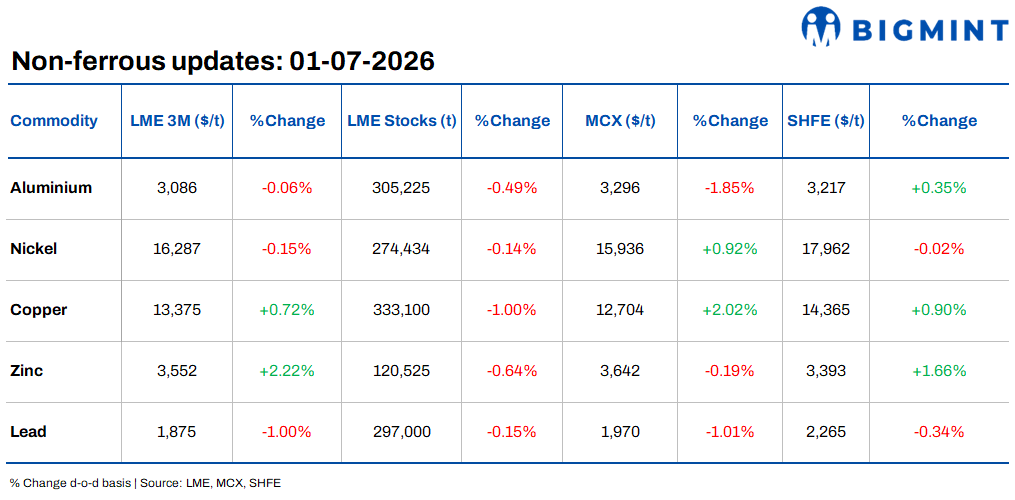
Base metals on the London Metal Exchange (LME) traded mostly higher on 30 June 2026, with zinc leading gains, rising 2.22% d-o-d to $3,552/t, followed by copper, which advanced 0.72% to $13,375/t. Aluminium and nickel edged lower by 0.06% and 0.15% to $3,086/t and $16,287/t, respectively, while lead posted the steepest decline among the complex, falling 1.00% to $1,875/t. Market sentiment remained mixed as stronger China’s manufacturing PMI supported industrial metals, while expectations of prolonged higher US interest rates limited gains.
On the inventory side, stocks continued to decline across all major base metals. Copper inventories recorded the largest decline, falling 1.00% d-o-d to 333,100 t, followed by zinc, down 0.64% to 120,525 t. Aluminium inventories slipped 0.49% to 305,225 t, while lead and nickel inventories eased 0.15% and 0.14% to 297,000 t and 274,434 t, respectively. The continued drawdown in LME inventories, particularly for copper and aluminium, indicates underlying physical demand remains resilient despite ongoing macroeconomic headwinds.
Domestic market overview
India’s non-ferrous scrap market remained stable on 30 June. Aluminium tense scrap (loose), ex-Delhi, remained unchanged at INR 280,000/t, while ex-Chennai prices were also steady at INR 287,000/t amid subdued domestic trading activity.
Meanwhile, copper armature scrap (Cu 99%), ex-Delhi, remained unchanged at INR 1,200,000/t, reflecting balanced domestic demand despite the recovery in LME copper prices.

Oil prices retreat as geopolitical risk premium fades
Global crude oil prices were mixed on 1st July 2026, with WTI crude declining 0.78% d-o-d to $69.69/bbl, while Brent crude rose 1.01% to $73.14/bbl. Natural gas increased 2.52% to $3.25/MMBtu, while the US dollar index eased 0.04% to 101.28.
Oil prices remained under pressure as easing US-Iran tensions continued to erode the geopolitical risk premium. Brent crude is on track to decline 20% in June and 30.4% for the quarter, its steepest quarterly fall since the 65.5% plunge in Q1 2020, while both Brent and WTI have retreated to pre-conflict levels amid expectations of improving traffic through the Strait of Hormuz.
Meanwhile, the American Petroleum Institute (API) estimated that US crude inventories fell by 6 million barrels in the week ended 26 June, extending total draws to 59.4 million barrels over the past 11 weeks. The Strategic Petroleum Reserve (SPR) also declined by 5.5 million barrels to 326 million barrels, its lowest level in over four decades, while US crude production increased to 13.8 million bpd, keeping overall market sentiment cautious despite supportive inventory data.
Other updates
Chile’s copper output declines sharply in May
Chile, the world’s largest copper producer, reported a 13% y-o-y decline in copper production to 0.42 mnt in May, following a 14% drop recorded in April. The country’s Mining Production Index also fell 10.6% y-o-y, driven by lower copper extraction and processing activities, highlighting continued supply-side challenges.
Meanwhile, Chile’s manufacturing output declined 7.2% y-o-y, marking its sharpest contraction since November 2022 and significantly exceeding economists’ expectations of a 2.5% decline. The sustained drop in Chilean copper output is likely to reinforce concerns over tightening global copper supply and could provide underlying support to copper prices in the coming months.
Auto sector accelerates shift towards aluminium wiring
Rising copper prices are accelerating the substitution of copper with aluminium in the automotive industry as manufacturers seek to reduce production costs and vehicle weight. The copper-to-aluminium price ratio has exceeded 4.2, well above the 3.5 threshold at which substitution becomes economically viable, making aluminium an increasingly attractive alternative.
Although aluminium offers only 61% of copper’s electrical conductivity, it costs nearly one-quarter as much and provides significant weight savings. Leading automakers and several Chinese EV manufacturers have expanded the use of aluminium wiring. According to JPMorgan, aluminium substitution could reduce global copper demand by around 2% in 2026, with the impact expected to increase to 6% by 2030.

Leave a Reply