- Vedanta Aluminium eyes 6 mnt/year production capacity
- Dollar strength outweighs supportive copper fundamentals
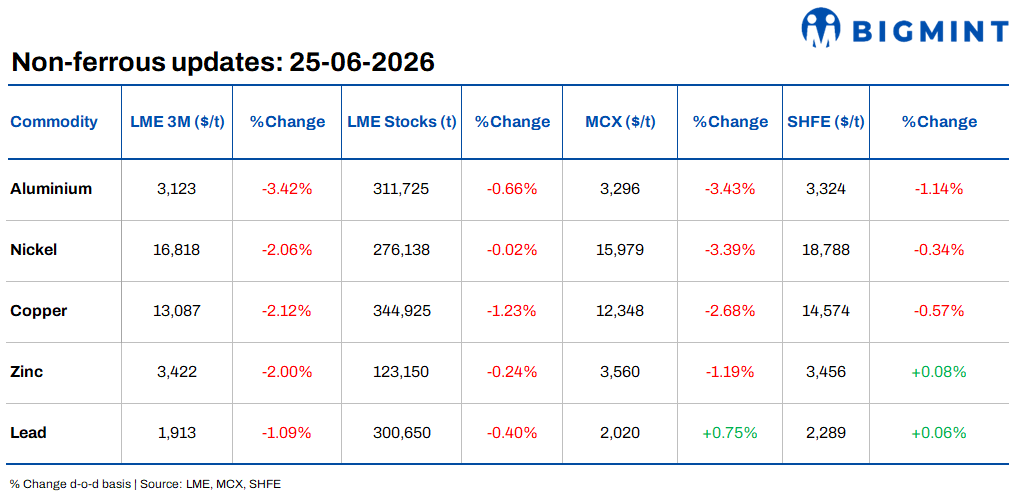
Base metals on the London Metal Exchange (LME) continued to trade lower on 24 June 2026, with aluminium leading losses among major non-ferrous metals. Aluminium declined 3.42% d-o-d to $3,123/t, followed by copper, which fell 2.12% to $13,087/t. Nickel and zinc slipped 2.06% and 2.00% to $16,818/t and $3,422/t, respectively, while lead eased 1.09% to $1,913/t. The broad-based decline reflected continued macroeconomic pressure from a stronger US dollar and cautious investor sentiment despite improving geopolitical conditions in the Middle East.
On the inventory side, stocks also declined across all major base metals. Copper inventories recorded the sharpest drawdown, falling 1.23% d-o-d to 344,925 t, followed by aluminium inventories, which dropped 0.66% to 311,725 t. Lead stocks declined 0.40% to 300,650 t, while zinc and nickel inventories edged lower by 0.24% and 0.02% to 123,150 t and 276,138 t, respectively. Continued declines in copper inventories indicate that underlying physical demand remains resilient despite the recent correction in exchange prices.
Domestic market overview
India’s non-ferrous scrap market remained subdued on 24 June amid weakness in global benchmark prices. Aluminium tense scrap (loose), ex-Chennai, declined by INR 1,500/t, or 0.51% d-o-d, to INR 292,000/t, while ex-Delhi prices remained unchanged at INR 300,000/t.
Meanwhile, copper armature scrap (Cu 99%), ex-Delhi, fell by INR 12,000/t, or 0.98% d-o-d, to INR 1,208,000/t, tracking continued weakness in LME copper prices and cautious buying from downstream consumers.

Oil prices slide as Hormuz traffic normalises
Global crude oil prices extended their decline on 25 June, with Brent crude falling 4.93% d-o-d to $72.70/bbl and WTI crude dropping 4.29% to $69.54/bbl, the lowest level since the Middle East conflict began. Meanwhile, natural gas prices rose 3.80% to $3.25/MMBtu
Market sentiment remained focused on the restoration of oil flows through the Strait of Hormuz following the US-Iran agreement. More than 20 oil tankers carrying around 35 million barrels of crude have resumed transit through the Strait of Hormuz, strengthening expectations of improving global supply.
The sharp decline in oil prices has also eased inflation concerns, prompting markets to expect a more dovish European Central Bank. The euro weakened to a one-year low of $1.135 from $1.165 before the US-Iran ceasefire agreement, while the stronger US dollar continued to pressure commodity markets.
Meanwhile, the US dollar index remained firm at around 101.5, supported by the Federal Reserve’s higher-for-longer interest rate stance. Oil prices were further pressured by reports that the United States granted Iran a 60-day sanctions waiver following initial peace talks, allowing the country to resume oil exports.
Other updates
Vedanta demerger lifts market valuation
Vedanta Group’s demerger has unlocked shareholder value, with the combined market capitalisation of its five listed entities rising over 16%, from INR 3.02 trillion before the split to INR 3.53 trillion post-listing. The company plans to double its aluminium production capacity from 3 million tonnes per annum (mtpa) to 6 mtpa over the next three years while maintaining a relatively low leverage of 1.3x net debt-to-EBITDA.
Meanwhile, Vedanta Oil & Gas listed with a debt-free balance sheet, while Vedanta Power posted the fastest earnings growth in FY26 despite carrying the group’s highest leverage of 4.7x net debt-to-EBITDA.
Copper weakens; stronger dollar outweighs supportive fundamentals
Copper prices remained under pressure on 25 June, with LME copper declining 2.12% to $13,087/t, while the most-active SHFE copper contract also fell 0.57%% to 104,100 yuan/t. The decline was primarily driven by a stronger US dollar, as expectations of a higher-for-longer Federal Reserve policy reduced investor appetite for dollar-denominated commodities.
Easing geopolitical tensions in the Middle East also lowered the risk premium across commodity markets, further weighing on prices. Despite the correction, downstream manufacturers in China stepped up dip-buying as prices retreated, while continued supplier selling and expectations of additional overseas supply are likely to keep copper prices under pressure in the near term.

Leave a Reply