- All new suppliers need BIS licence as per QCO
- Cathode imports down nearly 40% on year in 5MCY’25
India’s quality control order (QCO) on copper cathodes is likely to reduce domestic availability due to what trade bodies call “costly and unnecessary compliance burdens” on foreign suppliers, according to Bombay Metal Exchange (BME).
Implemented in December 2024, the order requires all copper cathode suppliers—both foreign and domestic—to obtain certification from the Bureau of Indian Standards (BIS). The move aims to curb substandard imports, but industry representatives warn it has already contributed to a notable decline in import volumes.
The QCO on copper cathodes has had a significant and immediate impact on the country’s copper supply chain.
Key drivers of disruption
The QCO mandates all copper cathode suppliers—foreign and domestic—to obtain Bureau of Indian Standards (BIS) certification before being able to sell in India. The stated aim is to prevent substandard imports and improve quality.
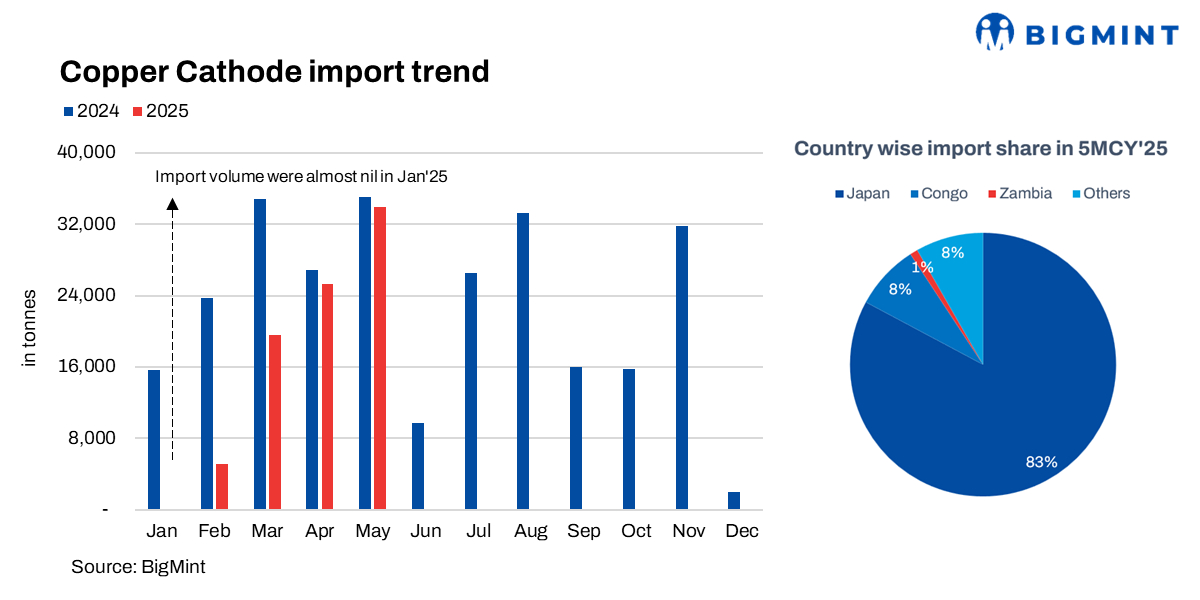
Compliance requirements are regarded as costly and cumbersome by foreign suppliers, particularly Japanese smelters, who historically account for around two-thirds of India’s refined copper imports.
Many domestic BIS licence-holders are using certified copper cathodes mainly for captive consumption, rather than selling in the open market. This has led to restricted material availability.
For foreign suppliers, only a limited number of firms have obtained BIS certification for cathode, with some of the 10 international licencesees focusing instead on supplying copper ingots or semi-finished products rather than cathodes.
Market impact
According to data compiled by BigMint, Imports have sharply declined. In the first five months of 2025, India imported just 84,014 t of copper cathodes, down 38.2% y-o-y compared to the same period in 2024. The most dramatic drop was in January (109 t vs. 15,607 t in January 2024—a 99% fall), demonstrating how the QCO’s introduction created an immediate regulatory bottleneck.
Trade bodies like the Bombay Metal Exchange (BME) have warned of ‘real and immediate shortages’, as both domestic and foreign certified suppliers are either unable or unwilling to address broader market demand.
Japan’s seven QCO applicants represent the backbone of past import flows, but industry sources say some Japanese firms are considering exiting India over “burdensome” certification and high compliance costs
Outlook:
Volumes are recovering but remain below pre-QCO levels, with ongoing “compliance and logistical challenges” continuing to suppress India’s copper imports as of May 2025.
The market outlook will depend on:
- The speed of BIS certification for major Japanese and other foreign suppliers.
- The full ramp-up of major new domestic production facilities
- The government’s willingness to further adapt or relax the QCO to avert prolonged supply disruptions.
Leave a Reply