- Mine disruptions tighten supply, supporting prices
- Falling TC/RCs highlight global concentrate shortage
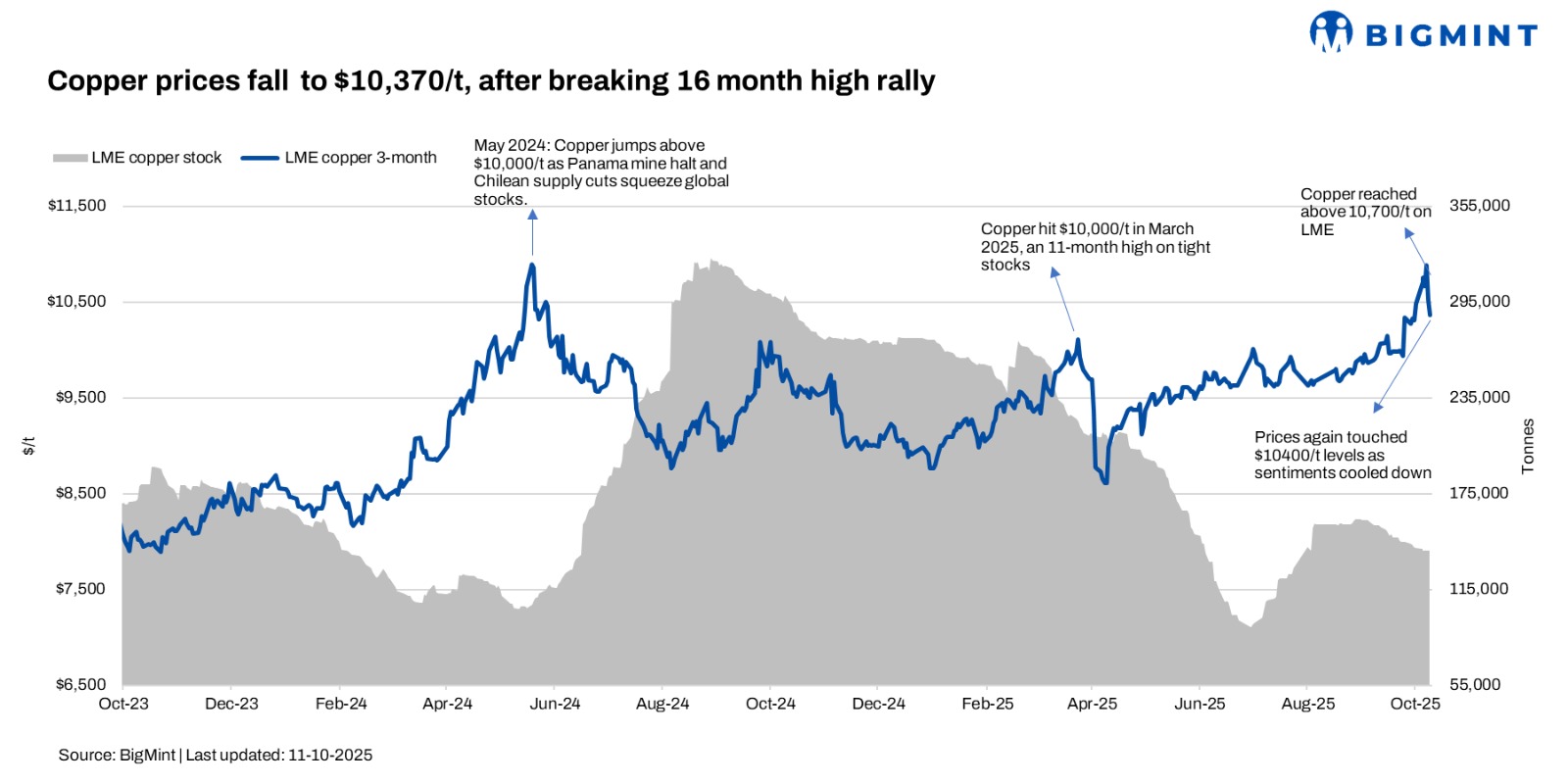
The benchmark three-month copper contract on the London Metal Exchange (LME) closed at $10,370/t on 10 October 2025, registering a sharp 3% decline from 3 October, when the red metal had briefly scaled a 16-month high above $10,700/t. This correction reflects a recalibration in speculative positioning rather than a fundamental shift in the underlying supply-demand balance.
Copper’s early October rally was driven primarily by supply disruptions and tight availability signals. Market sentiment was buoyed by continued output interruptions at Freeport-McMoRan’s Grasberg mine in Indonesia, which faced mudflow and logistics constraints through late September, as well as weather-related issues impacting Chile’s northern mining belt, including Escondida and Collahuasi operations. These developments reinforced expectations of lower refined copper output through Q4-2025 and potential drawdowns in LME inventories, which had already declined below 125,000 tonnes by early October — the lowest since May 2023.
However, the momentum reversed swiftly once speculative long positions began to unwind following a series of macro-economic triggers. The US dollar index strengthened on expectations that the Federal Reserve might delay rate cuts amid still-resilient labour data, making dollar-denominated commodities relatively costlier for non-US buyers.
The International Copper Study Group (ICSG) has revised its global copper balance outlook, projecting the market to swing into a refined copper deficit of around 150,000 tonnes in 2026, compared with a modest surplus anticipated for 2025. This shift is primarily driven by lower-than-expected mine production growth, as several major assets across Latin America and Southeast Asia face ongoing operational and permitting challenges.
On the cost side, treatment and refining charges (TC/RCs) have fallen sharply, highlighting the tightness in copper concentrate supply. As of Q3 2025, spot TC/RCs averaged around –$45/t, slipping into negative territory for the first time in years as smelters competed aggressively for available concentrates. The 2025 annual benchmark, settled between Antofagasta and Jiangxi Copper, was fixed at $21.25/t, marking a steep decline of nearly 73 % from the 2024 benchmark of $80/t. This reflects the widening mismatch between mine supply and smelting demand.
Analysts expect that 2026 benchmark terms could drop even further, potentially testing lows near $10–15/t, unless mine output normalizes in Chile and Indonesia. Such compressed TC/RC levels have already begun squeezing smelter margins globally, particularly in China and India, where many processors depend on imported concentrates. The sustained weakness in TC/RCs underscores the persistent global shortage of copper concentrate, reinforcing the medium-term bullish narrative for refined copper prices.
Outlook
Copper prices are likely to stay rangebound between $10,200–10,600/t in the near term, as supply tightness offsets uneven demand recovery. Ongoing mine disruptions and low LME inventories keep fundamentals firm, while China’s post-holiday restocking and steady demand from India and Southeast Asia lend support. A brief consolidation phase is expected, with prices remaining well above $10,000/t amid tight supply and resilient consumption.
Leave a Reply