- Thermal shipments accelerate; higher freights prompt shift to Atlantic markets
- Russian supply disruption supports Colombia’s growing role in Turkiye
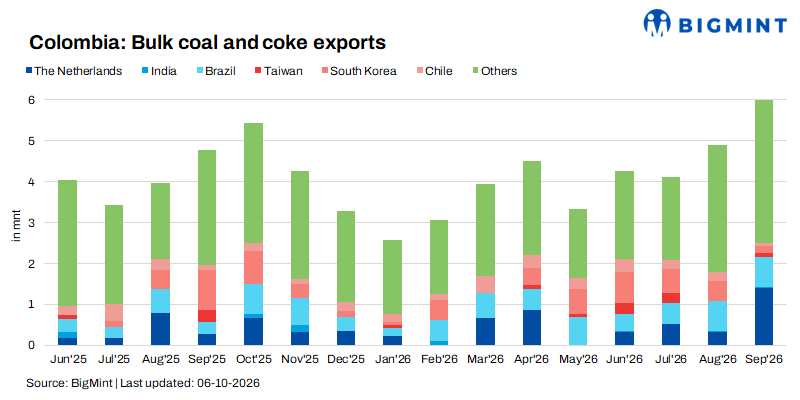
Colombia’s combined coal and met coke exports reached 5.99 million tonnes (mnt) in September 2026, the highest monthly volume of the year, rising 25.8% y-o-y and 22.2% from August. Non-coking coal drove the increase, while stronger met coke shipments added support.
January-September exports totalled 36.63 mnt, up approximately 2.6% from 2025. Behind this modest cumulative growth lies a stronger Q3 recovery and a changing destination mix, with European and American markets absorbing more thermal coal as shipments to India and Taiwan contracted sharply.
Non-coking coal: sustained acceleration reverses first-half weakness
Non-coking exports increased from 3.57 mnt in July to 4.48 mnt in August and 5.43 mnt in September. September was 52.1% above July and exceeded the previous 2026 high of 4.03 mnt in April.
Q3 shipments reached 13.48 mnt, up 23.9% q-o-q and 26.2% y-o-y. This recovery reversed first-half weakness, when exports were approximately 12% below 2025, lifting nine-month volumes into positive territory.
Non-coking coal accounted for approximately 89% of combined exports and supplied the entire cumulative net increase, offsetting weaker metallurgical shipments.
Thermal destinations: Atlantic gains offset Asian declines
The Netherlands became the largest recorded destination. September shipments surged to 1.40 mnt from 0.33 mnt in August, an increase exceeding Colombia’s overall monthly thermal export gain. These cargoes may serve wider European distribution rather than exclusively Dutch consumption.
Brazil and Mexico added 1.42 mnt and 0.79 mnt respectively over nine months. Poland more than doubled its receipts. Conversely, India received only 0.06 mnt, recorded in February, while Taiwan contracted sharply.
South Korea remained broadly stable cumulatively, but September shipments fell to 0.16 mnt from 0.94 mnt a year earlier. Unidentified destinations accounted for 0.81 mnt, or 14.9%, of September exports, limiting precise geographic attribution.
Freight and Black Sea disruption reshape delivered economics
Higher freight costs likely contributed to the shift towards Atlantic markets. Longer voyages to India and East Asia incur greater bunker and vessel costs, weakening Colombia’s competitiveness against nearer suppliers. The destination pattern is consistent with this pressure, although freight cannot be isolated from quality, inventories and procurement timing.
Turkiye presents an additional substitution opportunity. Russian coal exports have faced Black Sea shipping disruption and higher logistics costs, weakening a traditionally competitive supply route. Recent attacks on southern ports have further complicated trade and encouraged longer alternative routes.
Colombia’s thermal shipments to Turkiye increased 26.2% to 2.41 mnt, raising its export share from approximately 6.2% to 7.4%. Supply reliability and higher Russian replacement costs likely supported this growth. However, September shipments were 0.32 mnt against 0.36 mnt a year earlier, indicating cumulative expansion rather than uninterrupted monthly growth.
Met coke: recovery strengthens, but cumulative exports remain lower
Met coke exports rose to 0.50 mnt in September, the second-highest monthly volume of 2026. Q3 shipments reached 1.33 mnt, up 29.1% q-o-q and 3.9% y-o-y. Nine-month volumes nevertheless remained 13.4% lower.
Brazil drove September’s improvement, receiving 0.30 mnt against 0.16 mnt in August and accounting for 60% of monthly exports.

Higher US and Turkish receipts cushioned declines in China, the UK and India. Brazil remained the principal market, absorbing approximately 40% of nine-month shipments.
Coking coal: small volumes and uneven momentum
Coking exports fell 40% y-o-y to 0.06 mnt in September, entirely destined for Japan. Nine-month shipments declined 8.5% to 0.65 mnt, while Q3 fell 22.7% y-o-y.
Japan’s cumulative receipts declined from approximately 0.29 mnt to 0.18 mnt. South Korea received 0.17 mnt, while China and the USA emerged as recorded destinations with 0.11 mnt and 0.06 mnt respectively, partly offsetting reductions elsewhere.
BigMint assessment
Colombia entered Q4 with strong thermal shipment momentum and recovering met coke exports. Atlantic destinations are likely to remain important if elevated freight, competing fuel prices and Black Sea disruption persist.
Higher gas, LNG and alternative solid-fuel costs could support Colombian coal where delivered economics remain attractive, while higher bunker costs penalise distant Asian deliveries. Turkish supply diversification offers additional support.
The recovery’s durability will depend on repeat European purchases beyond September’s Netherlands-led surge, continued American buying and Russian export-route availability. India-bound volumes are likely to remain constrained unless delivered-price competitiveness improves.
Leave a Reply