- Focus shifts to grid flexibility amid rising renewable variability
- Strengthening transmission planning, energy storage remains critical
As India enters the peak summer months of April-June 2026, the government’s approach to power sector management reflects a clear shift. The challenge is no longer about ensuring enough capacity to meet demand. It is about managing a system that is becoming more variable, more market-driven, and increasingly influenced by renewable energy.
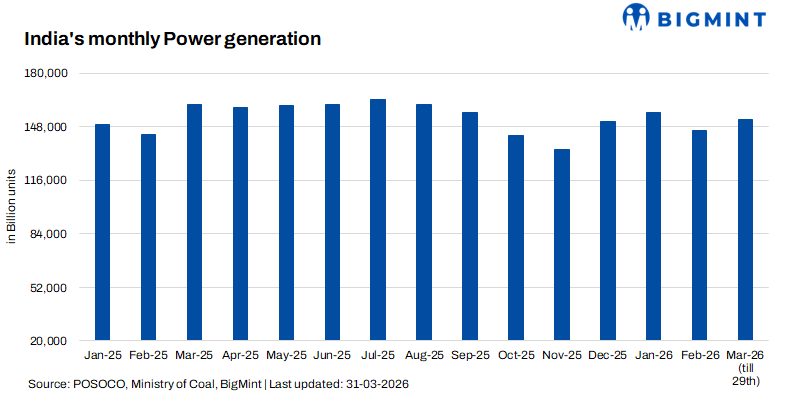
The experience of March 2026 provides the backdrop. Electricity demand remained steady, with peak demand rising marginally to around 238 GW, indicating a resilient but not rapidly expanding economy. At the same time, the power market became more dynamic, with sharp swings in prices and a visible increase in short-term trading volumes. This combination of stable demand and rising variability has shaped the government’s preparedness strategy for the summer.
From adequacy to real-time grid management
India’s power system is now structurally adequate. The country has consistently met peak demand in recent years with minimal shortages, and installed capacity has reached over 520 GW.
However, the nature of the challenge has changed. With renewable energy accounting for a rising share of generation, supply is no longer uniform across the day. Solar output creates periods of surplus during daylight hours, while evening demand continues to rely heavily on dispatchable sources. This mismatch has introduced variability into the system, which is increasingly visible in power market behaviour.
Recognising this, policy is now focused on improving grid responsiveness. The establishment of Regional Energy Management Centres for real-time renewable forecasting, the implementation of automatic generation control, and the expansion of ancillary services are all aimed at enabling the grid to respond dynamically to changing conditions.
At the same time, forecasting capabilities have been strengthened through coordination between meteorological agencies and system operators, allowing better anticipation of both renewable generation and demand patterns.
Coal as the backbone of summer preparedness
Despite the rapid expansion of renewables, coal remains central to India’s summer strategy. The government’s measures clearly indicate that thermal generation continues to be the primary tool for ensuring reliability during peak demand.
Coal stocks at power plants stood at 58.2 million tonnes (mnt) in late March, sufficient for about 19 days of operation at high plant load factors. This provides a comfortable buffer as the system moves into the high-demand season.
Operationally, the emphasis has been on maximising coal-based generation availability. Maintenance schedules for thermal plants have been deferred to ensure that additional capacity — estimated at around 10,000 MW — is available during the summer months. Generators have been advised to maintain full availability, while domestic coal supply has been strengthened through higher rake loading and continued monitoring of logistics.
The decision to direct large imported coal-based plants, such as Tata Power’s Coastal Gujarat Power Ltd., to operate at full capacity from April further underscores the reliance on coal to meet peak demand across key states.
Even as renewables grow, the policy signal remains clear: coal is indispensable for managing peak demand and ensuring grid stability.
Managing renewable variability through system reform
The rapid rise in renewable energy is both an opportunity and a challenge. While it has lowered average power costs and contributed to capacity expansion, it has also introduced intermittency into the system.
The government’s response has been to build institutional and technical mechanisms to manage this variability. Grid codes now require renewable generators to participate in frequency control, while advanced technologies such as STATCOMs and synchronous condensers are being deployed to maintain voltage stability.
At the same time, thermal plants are being required to operate more flexibly, enabling them to ramp up or down in response to fluctuations in renewable output. This marks a significant shift in the operating philosophy of coal-based generation, which was traditionally designed for steady baseload operation.
Transmission and storage: Building the next layer
A key part of the government’s preparedness strategy lies in strengthening the physical infrastructure of the grid. Transmission planning has been aligned with long-term renewable targets, with systems being developed to integrate over 500 GW of non-fossil capacity by 2030 and even higher levels beyond that.
The expansion of Green Energy Corridors and inter-state transmission systems is aimed at ensuring that renewable power can be efficiently evacuated from generation centres to load centres, reducing congestion during peak periods.
In parallel, there is a strong push towards energy storage. Battery storage systems and pumped hydro projects are being actively promoted through policy incentives and funding support. These technologies are critical for smoothing out supply fluctuations and providing dispatchable power when renewable output is low.
Summer 2026: A test of system flexibility
The upcoming summer will test the system’s ability to manage these evolving dynamics. While coal-based generation will continue to anchor supply during peak demand, renewables will dominate daytime generation, requiring careful balancing.
Additional challenges remain, particularly around the availability and pricing of natural gas, which traditionally contributes to peak supply during non-solar hours. With gas markets facing uncertainty, the burden of balancing is likely to fall even more on coal, renewables, and storage.
Bottom line
India’s power sector is entering a new phase where reliability depends not just on capacity, but on flexibility. Demand remains stable, reflecting a resilient economy, but the system is becoming more complex to operate.
The government’s response to summer 2026 reflects this reality. Coal continues to provide the backbone of the system, while renewables drive growth. Between them, a new layer of grid management, transmission, and storage is being built to manage variability.
The transition underway is not just an energy transition. It is a shift towards a more dynamic and responsive power system.

Leave a Reply