- Higher power demand accelerates inventory liquidation
- Leaner inventories improve cash flow, working capital efficiency
Coal India Ltd. (CIL) is quietly executing one of the most significant operational shifts in its recent history.
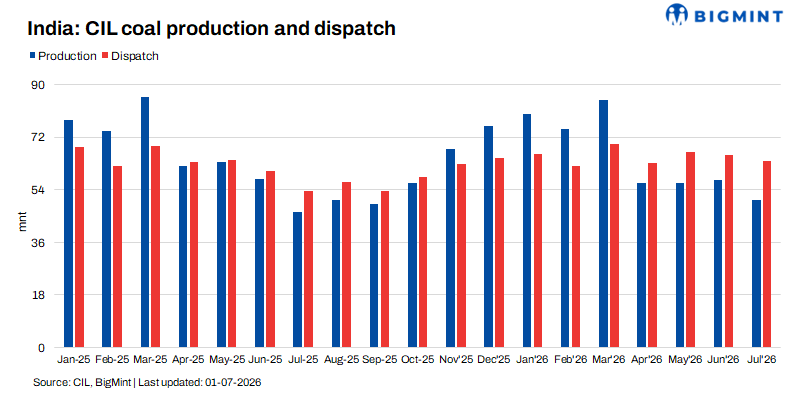
After ending FY’26 with a record 129.96 million tonnes (mnt) of raw coal inventory, the company has deliberately moderated production while prioritising dispatches, reducing pithead stockpiles by an estimated 42.4 mnt in just four months over April-July. The strategy represents a clear shift away from maximising production towards improving inventory efficiency and balance-sheet discipline.
Rather than signalling weaker operational performance, the lower production reflects management’s decision to monetise inventories accumulated during two years of aggressive output growth.
FY26 ended with unprecedented inventories
Coal India’s FY’26 investor presentation reveals the scale of the challenge.
Raw coal inventories increased from 107.16 mnt at the beginning of FY’26 to 129.96 mnt by 31 March 2026, an increase of 22.8 mnt, while inventories stood more than 40 mnt above their December 2025 level.
These stock levels reflected a period when production consistently outpaced demand, domestic coal availability improved, and inventories across the power sector remained comfortable.
While this strengthened India’s energy security, it also tied up substantial working capital and increased inventory carrying costs.
Q1 marks strategic shift
Coal India’s Q1 FY’27 results demonstrate that management responded decisively.
During the April-June quarter,
- Coal production declined 7% y-o-y to 169.63 mnt.
- Offtake increased 4% to 197.86 mnt.
- Raw coal inventories declined from 130.28 mnt at the beginning of April to 101.35 mnt by 30 June, representing a reduction of 28.93 mnt, or 22%, in a single quarter.
The numbers leave little doubt about management’s priorities. Production was deliberately moderated while dispatches were maintained, allowing accumulated inventories to be converted into sales.
July accelerates inventory normalisation
July’s unexpectedly strong electricity demand further accelerated this strategy.
Coal India reported production of 50.36 mnt against dispatches of 64.19 mnt, implying that approximately 13.83 mnt of inventories were released during the month.
Applying these figures to Coal India’s disclosed June-end inventory suggests that raw coal stocks declined further from 101.35 mnt to an estimated 87.5 mnt by 31 July.
If realised, this would represent 42.4 mnt reduction since 31 March 2026 and an approximately 33% decline in just four months.
This estimate is based on Coal India’s reported production and dispatch figures for July combined with the company’s disclosed inventory position as of 30 June.
Power demand provides opportunity
The timing proved favourable. July witnessed one of the strongest months for electricity consumption this year as persistent humidity maintained elevated cooling demand despite the arrival of the monsoon.
Rather than responding by sharply increasing production, Coal India was able to satisfy higher fuel requirements by accelerating dispatches from inventories it had already accumulated.
At the same time, the company’s July SWMA e-auctions recorded only 33% allocation of offered volumes, indicating that industrial consumers continued procuring coal selectively despite healthy auction premiums. This reinforces the view that dispatch growth was driven primarily by the power sector rather than broad-based industrial demand.
A more efficient operating model
Coal India’s evolving strategy reflects the changing dynamics of India’s coal market.
With domestic coal availability significantly improved and thermal coal imports declining, maintaining exceptionally large pithead inventories is no longer necessary from either an operational or financial perspective.
A leaner inventory position reduces working capital requirements, lowers stock carrying costs, and improves cash conversion while preserving adequate buffers to respond to periods of elevated electricity demand.

Leave a Reply