Chinese steel exporters to Europe will have a little more time in which to prepare details that their importing counterparts in the European Union (EU) will need to provide Commission authorities under the EU’s Carbon Border Adjustment Mechanism (CBAM) that formally took effect in October last year, Mysteel Global has learned.
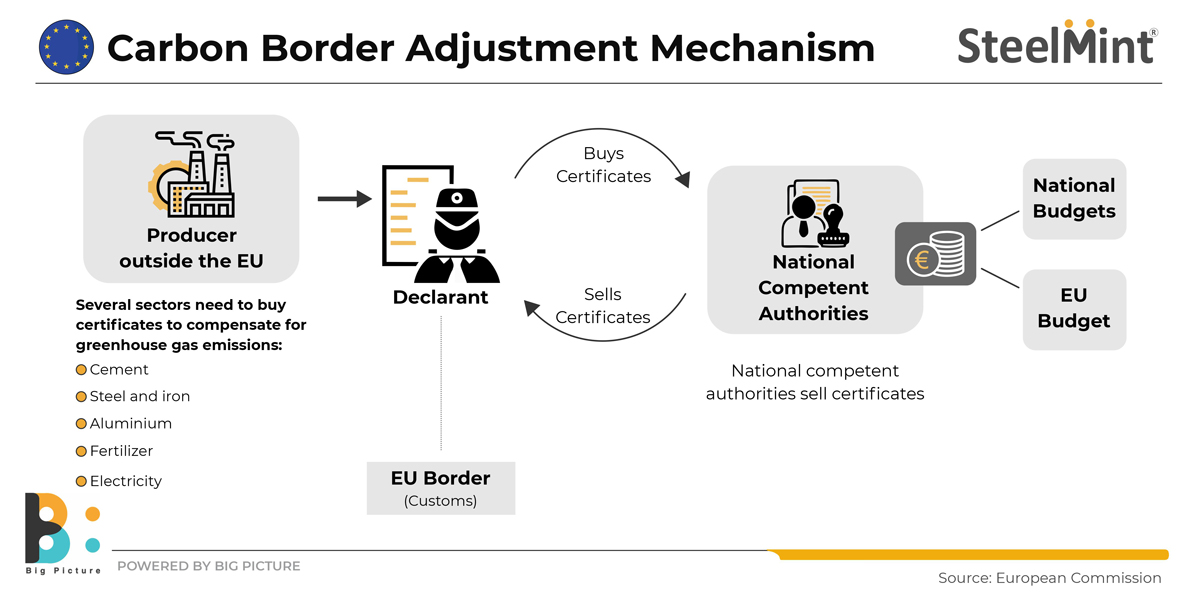
The CBAM is the EU’s climate change response mechanism and is a crucial component in its drive to achieve a 55% reduction in carbon emissions by 2030 compared to 1990 levels, as reported. To prevent what the EU refers to as ‘carbon leakage’-carbon-intensive products being imported into the EU’s 27 countries-the mechanism allows a carbon tax to be imposed on products brought in from non-EU countries, with the initial six products being iron and steel, cement, fertiliser, aluminium and electricity generation.
During the CBAM’s transitional phase (from 1 October last year to 31 December, 2025), 31 January was set as the first deadline by which importers in Europe were required to submit their CBAM report for the fourth quarter of 2023. The reports-which importers of Chinese steel would be required to submit-must include the quantity of goods (steel) imported, the direct and indirect carbon emissions in them, and any carbon price that needs to be paid for those emissions, Mysteel Global notes.
However, in a statement issued by the EC on 29 January local time, it acknowledged that “technical issues” had led to some businesses being unable to submit data and reports related to CBAM.
“To facilitate reporting declarants who may have experienced difficulties in reporting and have not yet submitted their quarterly CBAM report, a new functionality will be made available as of 1 February on the Transitional Registry, allowing them to “request delayed submission”, giving an additional 30 days to submit their CBAM report,” the statement said.
Though the EC’s statement was reported in the Chinese media, for the majority of Chinese steel producers and traders, the “technical problems” that Europe-based importers might have struggled with would be of limited concern because currently, China’s direct steel exports to the EU remain tiny.
For example, during 2023 when China exported 90.26 million tonnes for finished steel, only a tiny 3.67 million tonnes or 4.1% travelled to the EU, according to the General Administration of Customs of China. “Chinese steelmakers are still focusing more on the domestic market and the proportion of exported steel is relatively small,” a market participant noted.
Note: This article has been written in accordance with an article exchange agreement between Mysteel Global and BigMint.