- Seasonal demand weakness keeps mills focused on exports
- China’s pricing advantage continues to boost shipments
- Global manufacturing expansion supports export growth
Morning Brief: China’s finished steel exports increased y-o-y for the third consecutive month in July 2026, rising 2.9% y-o-y to 10.12 million tonnes (mnt), according to General Administration of Customs data. July exports declined 1.9% m-o-m but remained above 10 mnt for the third consecutive month, taking January-July (7MCY’26) exports to around 65 mnt, down by merely 4.4% y-o-y versus a 5.6% decline in H1CY’26 and an 8% drop in January-May.
The resilience is notable given the growing volume of Chinese steel subject to trade measures. Earlier, Dao Fortune had projected that anti-dumping measures alone could reduce China’s exports by nearly 14.7 mnt from 2025 levels, more than twice their estimated impact last year.
The continued rise reflects weak domestic demand during June-July, when China’s steel market typically enters its seasonal off-season as heavy rains in the south and high temperatures in the north disrupt construction activity. At the same time, China’s steel export prices remained below those of key competing origins, allowing mills to retain orders despite tighter trade restrictions, higher freight costs, and tariffs.
July’s y-o-y growth was also partly supported by stronger overseas demand in May and early June, according to Mysteel. However, bookings slowed from late June and remained weak through July amid heavy rains across Asia and competition from Indian and Indonesian suppliers.
Weak domestic demand keeps mills focused on exports
The seasonal demand weakness during June-August prompted mills and traders to look overseas to boost sales, helping keep monthly exports close to the 10-mnt level even as trade barriers increased. This seasonal slowdown added to an already subdued domestic market, with slower manufacturing and infrastructure activity compounding the persistent weakness in property-related steel consumption.
Manufacturing investment fell 1.7% y-o-y during January-July, compared with a 1.2% growth during January-April, while infrastructure investment declined 3.6% during January-July after growing 4.3% in January-April. The deterioration indicates that weakness in steel demand has extended beyond the seasonal construction slowdown.
Competitive pricing, global manufacturing expansion support export growth
Price competitiveness continued to support volumes as trade restrictions reduced access to several markets. In June, China’s FOB hot-rolled coil (HRC) export quotations stood at $516/t, below Japan’s $545/t, Russia’s $543/t, and India’s $550/t to the Middle East and Southeast Asia and $619/t to the EU.
The pricing gap allowed Chinese exporters room to remain competitive in price-sensitive markets despite higher freights and additional trade tariffs.
Meanwhile, global industrial activity also continued to prop up Chinese steel exports. The J.P. Morgan Global Manufacturing PMI stood at 52.1 in July, remaining above the 50-point expansion threshold for the twelfth consecutive month, although it eased from 52.2 in June.
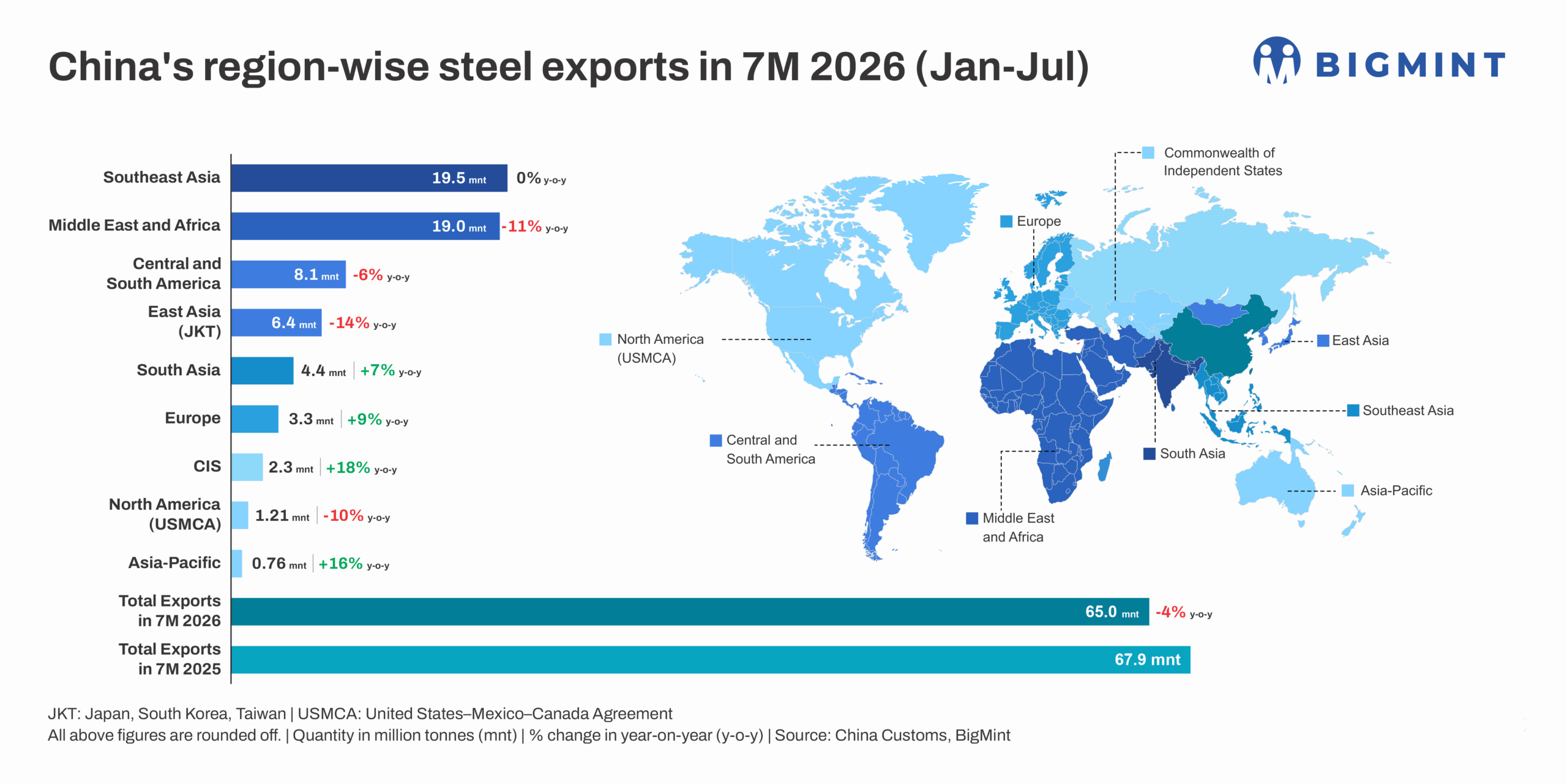
China’s Region-wise Steel Exports in 7M 2026 (Jan-Jul)
Asian demand recovers in 7MCY’26, shipments to West slow
Southeast Asia remained China’s biggest market in January-July 2026, with shipments fully recovering from a 5% drop in January-May (5MCY’26) to y-o-y stability at 19.5 mnt by July.
Meanwhile, South Asia, driven largely by robust infrastructure spending and industrial demand in India, flipped from a 1% dip till May into positive territory, expanding 7% to 4.4 mnt in 7MCY’26.
Other bright spots included the CIS region, which maintained a steady 18% growth clip at 2.3 mnt. Even the Middle East and Africa, despite lagging behind last year’s figures, saw its steep 17% drop in 5MCY’26 narrow to an 11% decline in 7MCY’26 with 19.0 mnt shipped.
However, exports to Central and South America fell by 6% y-o-y to 8.1 mnt in January-July, largely consistent with the 7% drop in 5MCY’26.
Conversely, strict trade barriers and domestic protections continued to squeeze Chinese metal out of advanced economies. Shipments to East Asia continued to fall by a deep 14% to 6.4 mnt, while North American imports contracted by 10% to 1.21 mnt due to heavy local tariffs. Additionally, Europe saw a 9% rise to 3.3 mnt, with growth slowing from the 24% uptick in 5MCY’26.
Overall, while shipments to Western markets slowed, strong appetite across developing Asian, African, and Middle East corridors propped up China’s overall export volumes.
Outlook
BigMint expects China’s steel exports to remain elevated in August, but a modest y-o-y decline is likely rather than further growth. The combination of weak domestic demand, competitive prices, and still-expanding global manufacturing should keep monthly exports around the 10-mnt level, although softer global manufacturing expansion is likely to limit the upside.
For CY’26, the July export run rate remains consistent with BigMint’s earlier projection of 110-115 mnt. With around 65 mnt exported during January-July, the average monthly volume during August-December would come to around 9-10 mnt. With semi-finished steel exports also growing in double digits (up by over 60% in H1CY’26), China’s cumulative steel exports are likely to surpass or remain close to their CY’25 total.
Leave a Reply