- Dragon country eyeing greater exports play
- Domestic surplus fuels price weakness fears
China’s cumin seeds imports from India have been sharply falling over the last couple of years, impacting overall volumes, reveals data maintained with BigMint. Since China, historically, has been one of the largest cumin seeds buyers of India, this shift could spell trouble for the trade. Without China acting as a bulk buyer, the market loses a critical balancing mechanism. This is particularly relevant in a year like 2026, where higher arrivals and sufficient pipeline supply are already exerting downward pressure on prices.
Why is China reducing cumin seeds imports from India?
1) Improved domestic availability in China: In 2024, a 40% drop in China’s own cumin harvest forced it to aggressively import from India, creating a temporary demand surge. The current decline suggests a reversal of that cycle, with improved domestic availability or inventory overhang reducing import dependence.
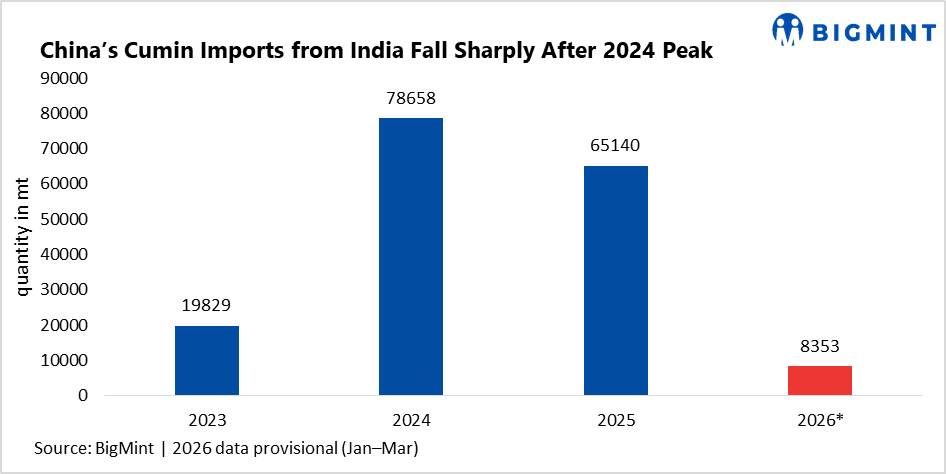
For instance, BigMint data reveals, China’s jeera or cumin seeds imports from India have been steadily reducing from nearly 78,650 tonnes (t) in 2024 to a little over 65,000 t in 2025 while 2026 so far has seen volumes plunging to a mere 8,353 t, drastically reducing the overall export volume from India.
India is possibly staring at a much lower number this year with a mere 1.81 lakh tonnes till date in 2026 while 2025 saw 3.22 lakh tonnes.
This indicates a structural shift in China’s policies rather than a short-term scenario, especially since, in some years, China had accounted for up to 60% of India’s cumin export volumes, acting as a swing buyer that absorbed surplus supply.
2) Diversification strategy: China itself has begun re-entering the export market in spices, including cumin, posing a competitive threat to India in certain destinations. At the same time, other origins such as Turkiye and Syria continue to remain active suppliers in global markets, increasing buyer options. India still dominates the global cumin trade with over 70% share in exports, but this dominance is increasingly being challenged by diversification strategies of importing countries, especially China.
3) Increased focus on production: Keeping the above factors in mind, China has emerged as a significant new player over the last three to four years, with production now reaching nearly 100,000 tonnes annually. This development is gradually altering the global cumin trade dynamics. Chinese suppliers have begun offering cumin to international buyers at competitive prices and are actively pushing their material into markets that India has traditionally supplied to. The increased competition could become particularly relevant if geopolitical tensions disrupt Middle Eastern demand, forcing exporters to compete more aggressively in alternative markets.
Outlook
Going forward, the jeera market may need to adjust to a new demand structure. Unless alternative large-volume buyers emerge, India could face a prolonged phase of weaker exports, higher domestic availability, and capped price recovery.
Leave a Reply