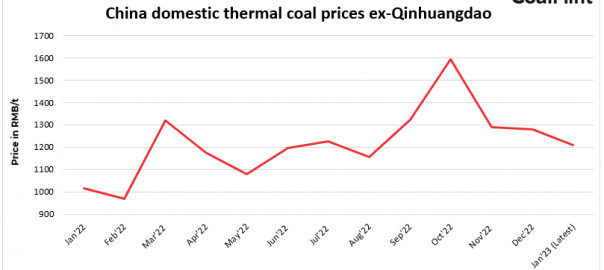
China’s portside thermal coal prices increased slightly this week, marking the first gain of 2023, as traders had less cargoes in hands after previous dumps and bargain hunting ahead of the upcoming Chinese New Year holidays.
In the first few days of this week, traders reported increased purchase demand mainly for consumption before the Chinese New Year holidays, focusing on 5,000 Kcal/kg and 4,500 Kcal/kg NAR grades, prices of which had declined below the government’s price caps.
However, the slight increase, as estimated by most traders, could be less sustainable. Utilities may soon return to silence after the short-lived purchases. Some of them have begun to haggle aggressively, resulting in a big spread between offers and bids.
On January 5, offers for spot cargoes at northern transfer ports showed signs of falling, with the benchmark 5,500 Kcal/kg NAR coal offered at 1,180-1,200 yuan/t FOB with VAT, down from 1,190-1,210 yuan/t a day earlier.
Demand for 5,000 Kcal/kg NAR grade continued, helping maintain offer prices unchanged at 1,050-1,060 yuan/t. Tradable prices were around 1,050 yuan/t. Cargoes of 4,500 Kcal/kg NAR coal were offered at 930-940 yuan/t FOB, almost flat from a day ago.
Traders noted inactive response from downstream buyers. A Fujian-based trader offered 5,500 Kcal/kg NAR at 1,180 yuan/t FOB but received a bid of 1,135 yuan/t. Such a spread would result in a huge loss for the trader, who thereby decided to call off the sale and waited for another chance.
A Guangdong-based trader on January 4 bought a 5,500 Kcal/kg NAR cargo at 1,180 yuan/t FOB, his last purchase before the Lunar New Year holiday. He said some 5,000 Kcal/kg NAR cargoes previously traded at 1,065 yuan/t were only offered around 1,050 yuan/t at present.
Looking ahead, the market is likely to move down, but the decline is less likely to be sharp, according to traders.
On the one hand, traders estimated the demand will be muted until after the Lunar New Year celebrations. A bigger scale of COVID infections before and around the holiday due to intense traveling requirements may delay the rebound in coal demand. That is to say, the market may show no pickups throughout February.
But on the other hand, thermal coal supply would decline as well. A number of coal mines have announced early leaves and production activity is expected to resume about two weeks after the holiday. This is likely to help buffer the price decline caused by poor demand.
Note: This article has been exchanged under the article exchange agreement between CoalMint and Sxcoal.
Leave a Reply