- Coal use to peak by 2030
- Five coal hubs remain strategic
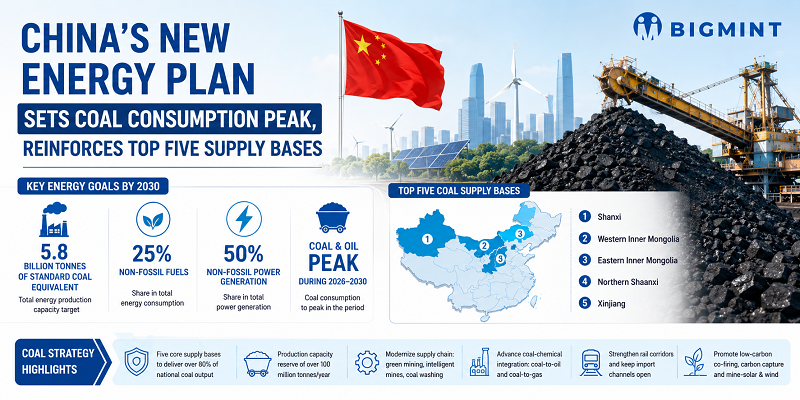
MySteel Global: China’s top economic planner and energy regulator released the 15th Five-Year Plan for Building a New Energy System on June 25, laying out the country’s energy goals through 2030. Coal consumption will peak during this period, but the government is also doubling down on its five major coal supply bases to keep the fuel as a safety reserve.
The plan, jointly published by the National Development and Reform Commission (NDRC) and the National Energy Administration (NEA), targets an initial clean, low-carbon, safe and efficient energy system by 2030.
Overall energy production capacity should reach 5.8 billion tonnes of standard coal equivalent — a standardized unit that converts all fuels (coal, oil, gas, and electricity) into the heat value of standard coal (7,000 kcal/kg NAR) to serve as a common energy yardstick for aggregation. Non-fossil fuels are expected to account for 25% of energy consumed and 50% of total power generation by then.
For coal, the message is mixed.
Coal and oil consumption will both peak during the 2026-2030 period, the document says. It calls for “reasonable control” over coal-fired power capacity and generation, and pushes existing coal plants to shift toward grid-supporting and peaking roles through upgrades in deep cycling and fast ramp-up.
But at the same time, the plan reinforces coal’s role as a fallback supply. It identifies five core supply bases — Shanxi, western Inner Mongolia, eastern Inner Mongolia, northern Shaanxi and Xinjiang — and targets them as accounting for over 80% of national coal output by 2030. The government also wants a production capacity reserve of more than 100 million tonnes per year in place by the end of the decade.
The plan backs modernization of the coal supply chain, from green mining and intelligent mine construction to coal washing and quality standard improvement. It encourages coal-chemical integration, including coal-to-oil and coal-to-gas strategic bases in Ordos (Inner Mongolia), Yulin (Shaanxi), and Zhundong and Hami in Xinjiang.
On transport, the government says it will keep optimizing the nation’s coal logistics network, strengthening key rail corridors — chiefly the Tangshan-Baotou, Wari-Rizhao, Haoji and Shuohuang lines — and expanding Xinjiang coal outbound routes under a “one-axis, two-wings, multi-link” framework. Coal import channels will also stay open, the plan notes.
Thermal power is taking on a supporting role. The plan encourages pilot projects for co-firing low- or zero-carbon fuels and carbon capture at coal plants, and pushes for coal mines to integrate wind and solar projects on subsidence land.
The plan comes as China’s installed power generation capacity hit 40.1 billion kilowatts by end-May, according to NEA data — more than the combined total of the US, EU, India, Japan and Russia.
Note: This article has been written in accordance with a content exchange agreement between Mysteel Global and BigMint.
Leave a Reply