- Inner Mongolia inspections raise supply concerns
- Global coal markets face tightening supplies
Coal markets are increasingly confronting a familiar reality: while demand growth remains uneven across regions, supply-side disruptions continue to emerge faster than new supply can respond.
The latest development comes from China, where authorities in Inner Mongolia have launched a month-long mine safety and compliance campaign following a major coal mine accident in neighbouring Shanxi province. While the inspections themselves are unlikely to trigger a major production collapse, they add another source of uncertainty to a market already grappling with tightening supply conditions across several key exporting regions.
For thermal and metallurgical coal buyers alike, the significance of the campaign lies less in the inspections themselves and more in their timing.
China’s largest coal-producing region under scrutiny
The special rectification campaign, running from 1-30 June, covers all coal mines, non-coal mines, open-pit operations and tailings facilities across Inner Mongolia.
Authorities have ordered mine-by-mine inspections focused on illegal mining activities, hidden working faces, falsified maps, permit violations, subcontracting arrangements and the manipulation of monitoring systems. The campaign also introduces a stricter accountability framework, including potential criminal referrals for serious violations.
Inner Mongolia remains China’s largest coal-producing region, accounting for nearly 30% of national coal output. The province is particularly important for thermal coal supply into northern and eastern China, while also producing significant quantities of metallurgical coal used by the steel sector.
Historically, Chinese safety campaigns have tended to affect smaller underground mines more severely than large state-owned producers. Nevertheless, even modest disruptions can influence market sentiment given the sheer scale of production concentrated within the region.
Chinese coal prices already moving higher
The inspections come as China’s domestic coal market has already shown signs of strengthening.
FOB Qinhuangdao prices for 5,500 kcal/kg NAR thermal coal increased to RMB 868/t ($127.35/t) as of 5 June from RMB 838/t ($122.61/t) two weeks earlier. The 5,000 kcal/kg NAR benchmark rose to RMB 779/t from RMB 751/t over the same period.
Import parity values have also firmed. Recent South China tenders indicated prices around RMB 972/t delivered for 5,500 kcal/kg NAR material, while Russian and other imported 4,500-5,000 kcal/kg NAR cargoes were offered between RMB 759/t and RMB 829/t delivered.
The steady rise in domestic prices suggests that Chinese buyers were already becoming more active before the latest inspections were announced.
Importance of what happens next
The most likely outcome remains a limited impact scenario.
Large state-owned open-pit mines, which account for a substantial portion of Inner Mongolia’s production, are expected to continue operating normally. However, smaller underground mines and operators with compliance issues could face temporary production restrictions.
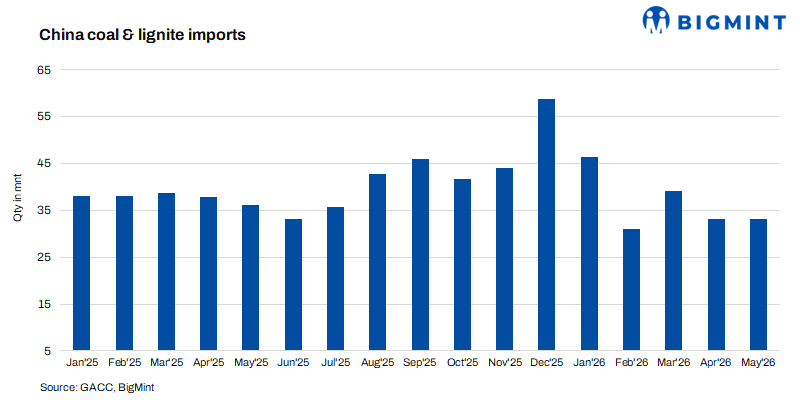
Even if total output losses remain modest, the inspections create uncertainty around future supply availability. Chinese buyers have historically responded to such uncertainty by increasing imports, particularly when domestic prices begin to rise.
For seaborne markets, sentiment often matters as much as actual tonnage losses.
Global supply challenges continue to mount
The Chinese inspections arrive against a backdrop of tightening supply conditions across multiple producing regions.
In Indonesia, the industry’s transition towards the new state-controlled export framework continues to create uncertainty regarding future export flows. While shipments have not collapsed, producers and traders remain cautious as the market awaits the next phase of implementation scheduled for September.
Indonesia remains the world’s largest exporter of thermal coal and any disruption to export availability is closely watched by Asian buyers.
In Australia, market participants continue to report limited spot availability of higher-calorific-value cargoes. Supply of 5,500 NAR and 6,000 NAR thermal coal remains relatively tight compared with earlier in the year, contributing to firmer FOB Newcastle prices.
South Africa has also faced logistical challenges, with periodic disruptions to coal rail movements highlighting the continued vulnerability of export flows from Richards Bay.
Meanwhile, Colombia’s export market has only recently begun stabilising after operational disruptions that supported Atlantic basin prices during May.
Russia, another major supplier into Asia, continues to face mounting cost pressures from rail tariffs, logistics constraints and currency volatility. Industry data indicates that a growing proportion of Russian coal producers are operating at or near loss-making levels, limiting their ability to aggressively increase exports.
Individually, none of these developments are sufficient to trigger a major rally. Collectively, however, they are steadily reducing the market’s supply cushion.
Why coking coal could be more sensitive ?
The implications may be even more significant for metallurgical coal markets.
Unlike thermal coal production, which is dominated by large open-cut mines, coking coal production relies more heavily on underground operations. These are precisely the type of mines most exposed to intensive safety inspections.
Chinese domestic coking coal prices have already strengthened in recent weeks as steel mills gradually replenish inventories and concerns over supply availability persist.
Premium hard coking coal prices have recovered towards $260/t CFR China, supported by tighter availability from Australia and renewed buying interest from Asian steel producers.
Should the Inner Mongolia inspections result in prolonged disruptions at underground operations, Chinese steel mills could increase seaborne purchases of premium hard coking coal from Australia, Canada and the United States.
Market increasingly driven by supply risk
The broader lesson from the Inner Mongolia campaign is that coal markets remain vulnerable to supply-side events.
Over the past several years, coal prices have repeatedly demonstrated that supply disruptions-whether regulatory, logistical, weather-related or geopolitical-often have a greater impact on prices than incremental changes in demand.
The current market is not experiencing a shortage of coal. Global production remains substantial and inventories across many consuming regions remain adequate.
What is changing is the margin of safety.
Indonesia is navigating regulatory change. Australia continues to face periodic availability constraints. South Africa and Russia are grappling with logistics and cost pressures. Colombia remains in recovery mode following disruptions. Now China’s largest coal-producing region is undergoing its most intensive safety review in years.
Taken together, these developments point towards a market where downside price risks are becoming increasingly limited.
Outlook
The Inner Mongolia inspections are unlikely, by themselves, to transform the global coal market.
However, they reinforce a trend that has become increasingly visible across both thermal and metallurgical coal markets: supply-side uncertainty is growing at a time when available exportable surpluses are becoming less comfortable.
As a result, coal prices are likely to remain well supported through June and into the third quarter.
For buyers, the key issue is no longer whether supply disruptions occur, but how many disruptions the market can absorb simultaneously before competition for available cargoes begins to intensify.
That is why developments in Inner Mongolia deserve close attention from coal buyers far beyond China’s borders.

Leave a Reply