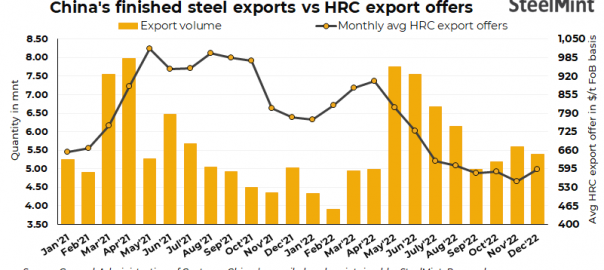
China’s finished steel export volumes rose marginally by 0.9% y-o-y to 67.32 million tonnes (mnt) in calendar year 2022 (CY22) as compared to 66.72 mnt seen in the preceding year, as per data released by the General Administration of Customs of the People’s Republic of China.
In December 2022, finished steel export volumes rose by 7.5% y-o-y to 5.401 mnt as against 5.03 mnt in the same month in the previous year.
What factors kept China’s exports supported in 2022?
1. Weak domestic demand: China’s domestic steel demand remained weak in CY22 due to the recurrence of Covid cases that brought logistical constraints. This prompted steel producers to shift to the export market. In addition, steel prices recorded a continuous decline after the Golden Week holidays (October 1-7, 2022)
2. Lower export allocations from other nations: Japanese exports to the overseas market remained under pressure due to the impact of Typhoon Hinnamnor and the periodic renovation of the hot rolling mills (HRM) in the Oita area of Kyushu Steel Works. Steel production in South Korea was severely affected by the disruptions caused by the typhoon. Meanwhile, Indian steel mills were shackled by the 15% export duty on non-alloy finished steel products since the end of May 2022.
3. Russia-Ukraine war: The Russia-Ukraine War helped China capture the export market for billets. By eliminating players from the CIS, China served a significant portion of the billet export market, especially Thailand. Russia and Ukraine together hold an export share of about 22 mnt of billets.
Outlook
China’s steel exports may decline in 2023, as domestic demand is expected to recover in 2023 due to a series of measures taken by the central government to stabilize the economy and further relaxation of Covid controls by March 2023. This could boost domestic consumption and create a case for lesser exports.

Leave a Reply