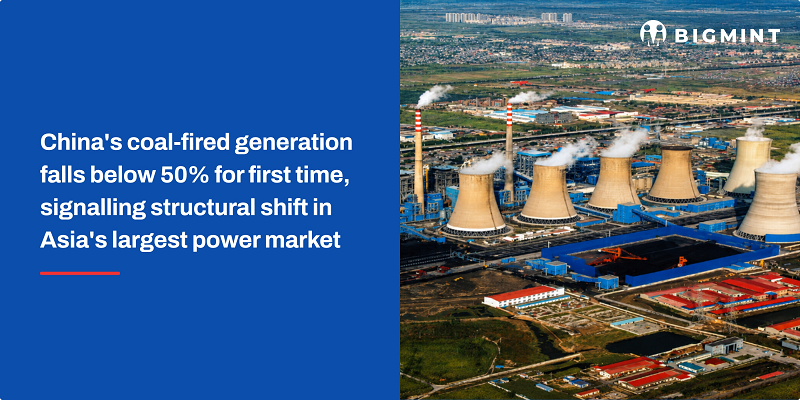
- China’s coal share dropped below 50%, but coal remains critical for grid stability
- India’s rising power demand will sustain coal as Asia’s key demand driver
China’s energy transition reached another milestone in the first half of 2026, with coal-fired electricity accounting for 49.7% of total power generation for the first time in the country’s history, according to data released by China’s National Energy Administration (NEA).
Coal-fired generation totalled 2.5 trillion kWh during January-June 2026, while renewable energy generation approached 2 trillion kWh, representing 41.2% of total electricity generation. According to the NEA, renewable electricity is now capable of meeting nearly 40% of China’s total electricity demand, underscoring the rapid expansion of wind, solar and hydro capacity.
For the first time, China has reached the point where non-coal sources collectively generate more electricity than coal-fired power stations. While coal remains the single largest source of electricity, the country’s power mix has entered a new phase in which renewables, nuclear and other low-carbon technologies together account for the majority of generation. This represents a structural shift in the composition of China’s electricity system rather than a decline in the strategic importance of coal.

Coal remains the backbone despite declining share
The headline number should not be interpreted as signalling a decline in the importance of coal.
China continues to operate the world’s largest coal-fired fleet and remains heavily dependent on thermal power for grid stability, peak demand management and balancing increasingly variable renewable generation. Coal generation in absolute terms remains extraordinarily high, with 2.5 trillion kWh generated in just six months.
Rather than replacing coal, China is progressively changing its role—from the dominant source of electricity to the system’s balancing and reliability backbone.
This evolution has been evident over the past several years as China simultaneously:
• continues approving high-efficiency coal-fired capacity;
• accelerates renewable installations;
• expands ultra-high-voltage transmission;
• develops large-scale battery storage; and
• modernises grid flexibility.
The result is not a “coal exit”, but a transition towards a more diversified electricity mix.
Capacity growth is changing the generation mix
The milestone has been driven primarily by the unprecedented pace of renewable capacity additions.
China has installed record volumes of utility-scale solar, distributed solar and wind power over the past three years. Renewable generation has consequently expanded much faster than electricity demand, reducing coal’s percentage contribution even though coal output remains historically high.
This reinforces a trend that BigMint has highlighted: generation shares are increasingly being determined by capacity additions rather than declines in coal production.
India is moving in same direction, but on a different timeline
China’s experience offers an important reference point for India, which is embarking on a similar, albeit earlier-stage, energy transition.
India has also witnessed rapid renewable expansion, record solar additions and steadily increasing contributions from wind and hydro. Solar generation has been one of the fastest-growing segments of India’s power mix, while renewable capacity additions continue to outpace most conventional technologies.
However, India’s power system remains fundamentally different.
Electricity demand continues to grow at one of the fastest rates globally, driven by industrialisation, urbanisation, air-conditioning demand and rising household consumption. Peak demand has repeatedly reached new records, while coal-fired stations continue to provide the overwhelming share of dispatchable electricity during periods of weak renewable output.
BigMint’s recent analysis of India’s power sector has consistently shown that:
• Coal remains the dominant source of electricity during periods of peak summer demand.
• Weak hydro generation and variable monsoon conditions continue to increase dependence on thermal power.
• Coal inventories at power plants remain a key indicator of system reliability.
• Renewable generation is expanding rapidly, but battery storage and transmission infrastructure must grow in parallel to support higher renewable penetration.
Consequently, India is unlikely to witness coal’s share falling below 50% in the foreseeable future, even as renewable capacity expands rapidly.

Coal’s role is evolving — not disappearing
The experience of both China and India points towards a broader structural trend across Asia. Future electricity systems will increasingly comprise:
• Renewables providing a growing share of annual electricity generation.
• Coal operating at lower average utilisation but remaining indispensable during periods of peak demand and low renewable output.
• Battery storage, pumped hydro and flexible gas generation assuming larger balancing roles.
• Transmission infrastructure becoming as strategically important as generation capacity itself.
For coal producers, utilities and fuel suppliers, this suggests that coal demand will increasingly be determined by system reliability requirements rather than market share alone.
BigMint outlook
China’s sub-50% coal generation milestone is an important indicator of the direction in which Asian power systems are evolving. However, it should not be mistaken for the beginning of a rapid decline in coal consumption.
Both China and India are pursuing what can best be described as an “energy addition” strategy rather than an “energy substitution” strategy. Renewable energy is being added at unprecedented speed, but coal continues to play a critical role in ensuring affordability, reliability and energy security.
For India, the immediate priority remains ensuring adequate dispatchable capacity to support rapidly rising electricity demand while simultaneously accelerating renewable deployment, battery storage and transmission networks. Over time, coal’s percentage share of generation is expected to decline gradually, but its strategic importance in maintaining grid stability is likely to remain central for decades.
For coal markets, the implications are equally significant. As China’s coal generation growth moderates and renewable penetration accelerates, demand growth may become more measured. In contrast, India’s expanding electricity demand and ongoing dependence on thermal generation are expected to make it the principal engine of incremental seaborne thermal coal demand in Asia over the coming decade.
The transition underway across Asia is therefore not a story of coal versus renewables. It is a story of how the two will increasingly coexist, with coal providing reliability and renewables delivering growth, as governments strive to balance decarbonisation, affordability and energy security.

Leave a Reply